

1 or 2 jack post under floor supports?

  • Thread starter Thread starter b4tn
  • Start date Start date
  • Tagged users None

b4tn

Valuable Member
View Badges
Joined
Jun 17, 2015
Messages
1,673
Reaction score
2,244
Location
Columbia MD
Rating - 0%
0   0   0
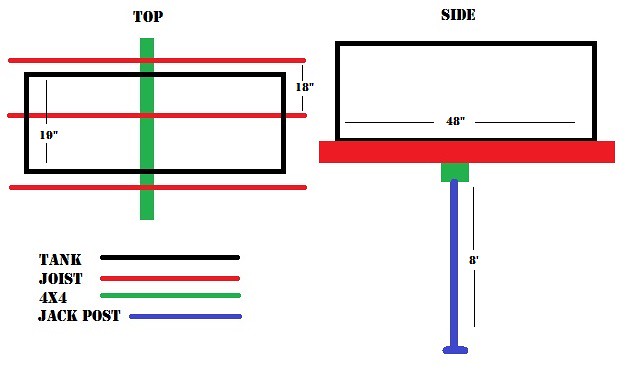
My 75 Gallon w/20 Gallon sump and goodies is going on the first floor of a townhouse. Below is an unfinished basement. The tank is situated on a non load bearing wall. My plan is to put a 4x4 perpendicular to the joists spanning 3 joists with a jack post centered on the middle joist and the 4x4. The jack post supports 9400 lbs at full extension.

I got to thinking and thought maybe I should use 2 jack posts, one on each end vs 1 centered. Would 2 be overkill? One not enough? Any opinions?

Here is a drawing
19733040059_00ea21bbdf_z.jpg
 
What is the floor in your basement? If it's a poured concrete foundation it's not made to support load. If you want to do it right you need to pour proper footings. Another option is to sister the joists or if you can get the tank spanned across 2 joists.
 
A couple points:

First off, I would think modern construction would support a 75 DT with 20 sump.

I also agree with above, if you can sister, might be the way to go.

If you wish to add the support, do not use a 4 x 4....they aren't that strong and warp and twist too easily. It will bend with applied load. You'd be better off nailing three 2x4's or 2x6's together and use that as the "beam"

The issue with a single jack post is that you've now created a fulcrum. I'd be happier with two jack posts.

Now your joists.....what kind of joists do you have.....solid wood or I-joists? If solid wood, no problem putting a support beam directly below. If I-Joists, you need to add squash blocks where the beam contacts the I-Joist. Google search squash blocks and you'll see how you simply add boards to either side of the I-joist where you have the point load.

The second point with joists is the addition of bridging/blocking adding considerable strength to the floor by spreading load. If you don't see bridging or blocking on you joists, add them. Here's a picture to showing bridging/blocking.....either one works, just whatever is easier for you to cut and install. The best installation is all bridging and blocking in a straight line, not staggered. Metal bridging is also available.

extra%20bridging%20blocking.jpg


correct%20and%20incorrect%20placement%20of%20solid%20bridging%20cr.jpg


Hope this helps
 
Last edited:
I t does appear to just be a poured concrete floor but with the majority of the weight already being supported by the floor I'm not sure I would worry too much unless I am wrong. I was going to put the jack post on a 4x4 block as well. I cant get the position across two joists without putting the tank flush against the wall or sitting it 18" out from the wall lol. But by sister the joints do you just mean bolting another section of 2x6 along side the existing joist? If so that seems way to easy I have a couple extra 2x6's and 3 1/2" bolts laying around.
 
A couple points:

First off, I would think modern construction would support a 75 DT with 20 sump.

I also agree with above, if you can sister, might be the way to go.

If you wish to add the support, do not use a 4 x 4....they aren't that strong and warp and twist too easily. It will bend with applied load. You'd be better off nailing three 2x4's or 2x6's together and use that as the "beam"

The issue with a single jack post is that you've now created a fulcrum. I'd be happier with two jack posts.

Now your joists.....what kind of joists do you have.....solid wood or I-joists? If solid wood, no problem putting a support beam directly below. If I-Joists, you need to add squash blocks where the beam contacts the I-Joist. Google search squash blocks and you'll see how you simply add boards to either side of the I-joist where you have the point load.

The second point with joists is the addition of bridging/blocking adding considerable strength to the floor by spreading load. If you don't see bridging or blocking on you joists, add them. Here's a picture to showing bridging/blocking.....either one works, just whatever is easier for you to cut and install. The best installation is all bridging and blocking in a straight line, not staggered. Metal bridging is also available.

extra%20bridging%20blocking.jpg


correct%20and%20incorrect%20placement%20of%20solid%20bridging%20cr.jpg


Hope this helps

Thanks, I also really feel like modern construction should be good. But I read this whole article that has me terrified that my floor is going to buckle under the weight since its not on a load bearing wall! When I went under to look I noticed a few things. First the joists seem to be further apart than what is considered the norm and second the joists runs are very long. In some spots the ends are overlapped about 6 inches and screwed together so they can extend further. It just didnt seem so sturdy to me. I am sure it had to pass some code at some point. Its built in the early 90's and the joists are solid wood.
 
Sistering a joist means putting in a second joist right up against the ones that are there. I'd be surprised if they are 2x6's. You'll want to use the same dimensions of the current joist and run them the full length of current joists....to on top of sill plates, support beams, etc. If need be, pick up double hangers for the sistered joists. Although some code folks call for bolts, three 10P nails ever 3-4 feet would work. Again, I'd also add blocking to the sistered beams. Best of luck.


IF YOU HAD TO TAKE A REEFING EXAM, WOULD YOU PASS?

  • Yes!

    Votes: 32 45.7%
  • Not yet, but I have one that I want to buy in mind!

    Votes: 9 12.9%
  • No.

    Votes: 26 37.1%
  • Other (please explain).

    Votes: 3 4.3%
Back
Top











