


Navigation
Install the app
How to install the app on iOS
Follow along with the video below to see how to install our site as a web app on your home screen.
Note: This feature may not be available in some browsers.
More options
You are using an out of date browser. It may not display this or other websites correctly.
You should upgrade or use an alternative browser.
You should upgrade or use an alternative browser.
3D Printing thread
- Thread starter PurpleMonster
- Start date
- Tagged users None


PLA is non toxic. I have lots of PLA in my fry system. Never an issue all fry have grown out fine. No two headed fish. Look for FDA food contact approved plastics. Most are fine.I considered this but you have no control of how fast or slow it releases carbon, after having a crash due to a carbon source overdose, I'm too nervous to try it. Also, I found some filament pigments are toxic.

Read it again. The pigments are what I have found to be toxic. I test every material I use for toxicity with a snail tank before i let it go into someone's reef tank. I use petg and abs to avoid unwanted carbon sources, not because pla is toxic.PLA is non toxic. I have lots of PLA in my fry system. Never an issue all fry have grown out fine. No two headed fish. Look for FDA food contact approved plastics. Most are fine.

Read it again. The pigments are what I have found to be toxic. I test every material I use for toxicity with a snail tank before i let it go into someone's reef tank. I use petg and abs to avoid unwanted carbon sources, not because pla is toxic.
many people vodka dose add sugar and do other things to get a carbon source. PLA will act as a carbon source just like vodka or sugar or vinegar, but at a VERY slow rate, maybe too slow.
Whites are typically non-toxic as titanium dioxide is the colorant which is food safe.
I have put, yellow, white, black, reds, blues all in a fry system with zero effects. All PLA or PETG. The breakdown of PLA is pretty slow. I am not sure if it is really effective as a carbon source. First thing it does is absorb water, if the parts are thin, this makes the PLA very brittle and it breaks up. If you put a 5 foot spool of PLA in the tank, it will breakup into small pieces with a small amount of pressure after a week. The bio block has been in the water for a while and has shown no signs of biodegrading.
I didn't know own how much pla would act like a carbon source, it's easy enough to just use abs for most things. I have found makerbot yellow abs, colido yellow pla, Hatchbox green pla and Inland black abs were all toxic. I haven't had any problems with white so far.
I assume different pla would break down at different rates based on manufacturing differences.
I assume different pla would break down at different rates based on manufacturing differences.

Which colors / brands / type of plastic have you seen toxic effects. There really should be minimal leeching of the color into the water as the color is locked into the plastic. If it was not, the color would fade.
The main issue I have seen with PLA is the brittleness once water gets into it. I thick chunk is not an issue. I printed a vertical frag rack and the holders are about 4 mm thick and they started falling apart after a month. For me the brittleness increase in water which I assume is swelling due to water uptake is the issue. I thought I could throw a tangled mess of filament into a seahorse fry tank for fry hitch. The PLA broke up into tiny pieces real fast. It was surprising.
For the carbon souce. Vodka is about 40% carbon based (alcohol, not pure carbon). PLA is Poly Lactic Acid and is also cabon based but is almost 100% carbon based (not pure carbon) So a piece that weighs 100g would be equal to maybe a pint of vodka roughly. I am sure someone is going to do the math and come up with the exact number...... So PLA will add carbon, but very slowly over a long period. So, in theory, the PLA adds carbon, but how effective is it. My original thought was it would help support bacterial growth on the biomedia as the water has phosphates and nitrates, and the PLA has carbon. Sounds good, but I would love to prove it.
I assume most of the filament is made in China. Most likely they purchase bulk PLA chips and add color and melt it to make the filament. I doubt many of the filament manufacturers make their own filament. I found a company that sold the filament extruding machine and winder based on melting plastic chips. There may be additives they add to adjust the extrusion and flexability..... Not sure how much modifications are done at the filament level vs the plastic chip level.
I didn't know own how much pla would act like a carbon source, it's easy enough to just use abs for most things. I have found makerbot yellow abs, colido yellow pla, Hatchbox green pla and Inland black abs were all toxic. I haven't had any problems with white so far.
I assume different pla would break down at different rates based on manufacturing differences.
The main issue I have seen with PLA is the brittleness once water gets into it. I thick chunk is not an issue. I printed a vertical frag rack and the holders are about 4 mm thick and they started falling apart after a month. For me the brittleness increase in water which I assume is swelling due to water uptake is the issue. I thought I could throw a tangled mess of filament into a seahorse fry tank for fry hitch. The PLA broke up into tiny pieces real fast. It was surprising.
For the carbon souce. Vodka is about 40% carbon based (alcohol, not pure carbon). PLA is Poly Lactic Acid and is also cabon based but is almost 100% carbon based (not pure carbon) So a piece that weighs 100g would be equal to maybe a pint of vodka roughly. I am sure someone is going to do the math and come up with the exact number...... So PLA will add carbon, but very slowly over a long period. So, in theory, the PLA adds carbon, but how effective is it. My original thought was it would help support bacterial growth on the biomedia as the water has phosphates and nitrates, and the PLA has carbon. Sounds good, but I would love to prove it.
I assume most of the filament is made in China. Most likely they purchase bulk PLA chips and add color and melt it to make the filament. I doubt many of the filament manufacturers make their own filament. I found a company that sold the filament extruding machine and winder based on melting plastic chips. There may be additives they add to adjust the extrusion and flexability..... Not sure how much modifications are done at the filament level vs the plastic chip level.
Any filament I use for commissioned prints is from Atomic Filament. It is a US based company that uses virgin materials to extrude their own filament. Pla and abs are about $30/kg but it is a breeze to use. I have never had a single filament issue from any material from them and I think I've use almost 20 rolls of it this year.

The bio block is a really smart idea.

Have you tried TPU at all in the tanks? I have some ideas where flexible materials would be useful.Which colors / brands / type of plastic have you seen toxic effects. There really should be minimal leeching of the color into the water as the color is locked into the plastic. If it was not, the color would fade.
The main issue I have seen with PLA is the brittleness once water gets into it. I thick chunk is not an issue. I printed a vertical frag rack and the holders are about 4 mm thick and they started falling apart after a month. For me the brittleness increase in water which I assume is swelling due to water uptake is the issue. I thought I could throw a tangled mess of filament into a seahorse fry tank for fry hitch. The PLA broke up into tiny pieces real fast. It was surprising.
For the carbon souce. Vodka is about 40% carbon based (alcohol, not pure carbon). PLA is Poly Lactic Acid and is also cabon based but is almost 100% carbon based (not pure carbon) So a piece that weighs 100g would be equal to maybe a pint of vodka roughly. I am sure someone is going to do the math and come up with the exact number...... So PLA will add carbon, but very slowly over a long period. So, in theory, the PLA adds carbon, but how effective is it. My original thought was it would help support bacterial growth on the biomedia as the water has phosphates and nitrates, and the PLA has carbon. Sounds good, but I would love to prove it.
I assume most of the filament is made in China. Most likely they purchase bulk PLA chips and add color and melt it to make the filament. I doubt many of the filament manufacturers make their own filament. I found a company that sold the filament extruding machine and winder based on melting plastic chips. There may be additives they add to adjust the extrusion and flexability..... Not sure how much modifications are done at the filament level vs the plastic chip level.
*Edit - update. ** Beware using the Hanna version of this, it can possibly scratch your cuvettes. Printer beware **
This came up in a PM suggestion for wider exposure on another forum, and I had forgotten about the post here. Anyone that has done testing with Red Sea or Hanna checkers will know what a pain safely drying out the cuvettes can be. I've almost broke some a few times from knocking them on a shelf.
Last month I got into the world of 3D printing, but couldn't find anything quite like I had wanted. The closest was for hanging single API cuvettes on a tank, so after some SketchUp work and a few sizing tests, the result is these:

cuvette_holder2 by Kyl, on Flickr
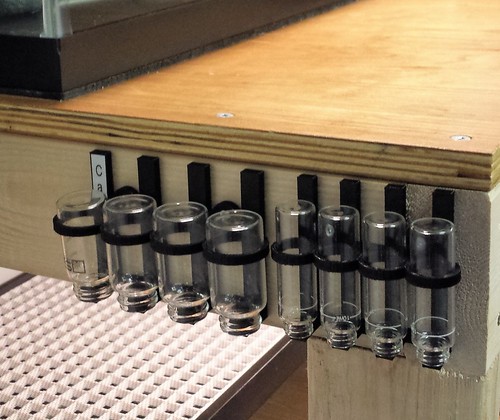
cuvette_holders by Kyl, on Flickr
The STL files for both the Hanna and Red Sea versions (along with sizing test prints) are available to download on Thingiverse. One thing to note is that I'll be revising designs slightly when some more time becomes available. Temporary cap storage while drying will likely be included in a v2, but these currently work quite well for the main goal - securing the cuvettes while they dry out instead of falling and breaking.
Happy printing and reefing!
This came up in a PM suggestion for wider exposure on another forum, and I had forgotten about the post here. Anyone that has done testing with Red Sea or Hanna checkers will know what a pain safely drying out the cuvettes can be. I've almost broke some a few times from knocking them on a shelf.
Last month I got into the world of 3D printing, but couldn't find anything quite like I had wanted. The closest was for hanging single API cuvettes on a tank, so after some SketchUp work and a few sizing tests, the result is these:
cuvette_holder2 by Kyl, on Flickr
cuvette_holders by Kyl, on Flickr
The STL files for both the Hanna and Red Sea versions (along with sizing test prints) are available to download on Thingiverse. One thing to note is that I'll be revising designs slightly when some more time becomes available. Temporary cap storage while drying will likely be included in a v2, but these currently work quite well for the main goal - securing the cuvettes while they dry out instead of falling and breaking.
Happy printing and reefing!
Last edited:

Great design Kyl, I don't use that test kit, but I can see the need and value that design has!

Made a vortech power supply mount



Has anyone tested if PLA can be used as carbon source? There was an article on advance aquarist on negative effect of 3d printed part on marine fish, under captive environment. I was thinking we can only use 3d printed parts for external components, i.e. stuff thats not sub-merged in the saltwater3d printed bioblock. cube, no walls 60-80% fill. Using PLA. PLA should act as a carbon source and slowly degrade over time. I have one block in a sump that is still "whole" after 4 months.

I use unpigmented abs for wet stuff a lot with no affects. I don't use pla for wet stuff just because it will eventually break down.Has anyone tested if PLA can be used as carbon source? There was an article on advance aquarist on negative effect of 3d printed part on marine fish, under captive environment. I was thinking we can only use 3d printed parts for external components, i.e. stuff thats not sub-merged in the saltwater


- Joined
- Feb 14, 2015
- Messages
- 463
- Reaction score
- 404
Made a vortech power supply mount
Nice holder. Do you have the file uploaded anywhere?

I have tons of 3D printed parts in my nano reef and they've been in there for months, some of them almost a year without any noticeable effect on the coral. Currently growing montis, chalice, zoas, and acros. Some of them are growing directly on the 3D printed frag plug. PLA is the main material I use, but also some nylon and polycarbonate parts. Haven't noticed the PLA breaking down either, it looks exactly the same except there's stuff growing on it. For PLA to biodegrade like it's advertised, it needs to be in a heated digester with the correct bacteria, it won't break down on its own.
With that being said, I have noticed the eSun PLA will start to crack as it ages, but only on the spool. None of the parts I've printed with it have aged like that, I'm not sure why, but I suspect it has to do more with how fast it cools prior to being spooled, so there is an inherent stress on it. I even use a eSun PLA printed idler assemply on my printer and it's proven more durable than the original ABS version.
Not saying I'd bet my life on its safety, but with my experience in my little tank stocked heavily with submerged 3D printed parts, my corals seem quite content.
With that being said, I have noticed the eSun PLA will start to crack as it ages, but only on the spool. None of the parts I've printed with it have aged like that, I'm not sure why, but I suspect it has to do more with how fast it cools prior to being spooled, so there is an inherent stress on it. I even use a eSun PLA printed idler assemply on my printer and it's proven more durable than the original ABS version.
Not saying I'd bet my life on its safety, but with my experience in my little tank stocked heavily with submerged 3D printed parts, my corals seem quite content.
I have tons of 3D printed parts in my nano reef and they've been in there for months, some of them almost a year without any noticeable effect on the coral. Currently growing montis, chalice, zoas, and acros. Some of them are growing directly on the 3D printed frag plug. PLA is the main material I use, but also some nylon and polycarbonate parts. Haven't noticed the PLA breaking down either, it looks exactly the same except there's stuff growing on it. For PLA to biodegrade like it's advertised, it needs to be in a heated digester with the correct bacteria, it won't break down on its own.
With that being said, I have noticed the eSun PLA will start to crack as it ages, but only on the spool. None of the parts I've printed with it have aged like that, I'm not sure why, but I suspect it has to do more with how fast it cools prior to being spooled, so there is an inherent stress on it. I even use a eSun PLA printed idler assemply on my printer and it's proven more durable than the original ABS version.
Not saying I'd bet my life on its safety, but with my experience in my little tank stocked heavily with submerged 3D printed parts, my corals seem quite content.
After researching how difficult it is to actually biodegrade PLA, I too am unconcerned with it degrading in tank. Maybe when it's made into a high surface area foamed brick it might work well as a carbon source, but I wouldn't be concerned for normally printed parts to dissolve or anything. It's certainly not the strongest or ideal material for in water but I am no longer concerned undyed PLA in my reef tank.


- Joined
- Apr 3, 2016
- Messages
- 532
- Reaction score
- 451
I have used dyed PLA in my reef for years (3 almost at this point) with no effect what so ever. I think that theoretically it could cause a problem but it's much lower in the scale of things we put in our reef in terms of equipment that could cause harm (namely electrical cables, metal parts, magnets, Mercury thermometers, heaters -some of which leaking toxic goo hint hint- etc). So on my priority list the PLA parts, even dyed ones, are as safe as can be. Just like any other equipment/part i check them periodically thats all. I think, based on my experience, all this hype "they biodegrade" or "the colors are toxic" is just an exaggeration (for the conditions our reefs run at).
It's not a theory. Some pigments used in the materials I've tested are toxic.
How that affects your tank completely depends on saturation and filtration.
The mindset that "it can't be as bad as some of the stuff some people put in their tanks" is stupid.
How that affects your tank completely depends on saturation and filtration.
The mindset that "it can't be as bad as some of the stuff some people put in their tanks" is stupid.












