
Navigation
Install the app
How to install the app on iOS
Follow along with the video below to see how to install our site as a web app on your home screen.
Note: This feature may not be available in some browsers.
More options
You are using an out of date browser. It may not display this or other websites correctly.
You should upgrade or use an alternative browser.
You should upgrade or use an alternative browser.
About refractometers
- Thread starter Timich
- Start date
- Tagged users None



Randy Holmes-Farley
Reef Chemist
View Badges
Staff member
Super Moderator
Excellence Award
Expert Contributor
Article Contributor
R2R Research
My Tank Thread
About refractometers. Ppt or sg? Is one more accurate or better to use? I've been using sg but after research, seems ppt is better?
That makes no difference and cannot impact accuracy, except if it is a brine refractometer (most are if they do not say true seawater refractometer)) and you calibrate with RO/DI, in which case both are inherently inaccurate.
If you calibrate with a 35 ppt/sg = 1.0264 standard, you can use either scale just fine.
OP
OP

Got red sea and vee gee and both per manufacturer instructions say to use distilled or rodi water. I've always been using rodi to calibrate. If that "magic" calibration solution was really necessarily, the manufacturers would use it themselves.That makes no difference and cannot impact accuracy, except if it is a brine refractometer (most are if they do not say true seawater refractometer)) and you calibrate with RO/DI, in which case both are inherently inaccurate.
If you calibrate with a 35 ppt/sg = 1.0264 standard, you can use either scale just fine.


vetteguy53081
Well known Member and monster tank lover
View Badges
Partner Member 2024
Excellence Award
Reef Tank 365
RGB
Article Contributor
Tampa Bay Reef Keepers
West Palm Beach Reefer
Hospitality Award
Ocala Reef Club Member
305 Reef Club
Wisco Reefers
Midwest Reefer
Fish Medic
MAC of SW Florida
Rock Pool Reef Keepers
R2R Secret Santa 2023
My Tank Thread
My Aquarium Showcase
PPT seems to be the industry standard use. I prefer SG but they calculate to same safe rangeAbout refractometers. Ppt or sg? Is one more accurate or better to use? I've been using sg but after research, seems ppt is better?
Randy Holmes-Farley
Reef Chemist
View Badges
Staff member
Super Moderator
Excellence Award
Expert Contributor
Article Contributor
R2R Research
My Tank Thread
Got red sea and vee gee and both per manufacturer instructions say to use distilled or rodi water. I've always been using rodi to calibrate. If that "magic" calibration solution was really necessarily, the manufacturers would use it themselves.
It's not nearly so simple as you assume, and in this case, you assumed wrong. This is the sort of reason why there is a reef chemistry forum rather than a page of links to manufacturer claims, which are frequently misleading or just plain wrong.
Certainly manufacturers recommend pure fresh water for calibration, and that is always correct for the chemicals the refractometer is made for.
Unfortunately, very few refractometers are made for seawater and so that is the wrong advice when using those types for seawater rather than their intended use.
If the Vee Gee you have is the STX3, it is likely not a true seawater refractometer. You can tell that by the vague claim of what it can be used for:

Handheld Salinity Refractometer
Order your Handheld Salinity Refractometer online today with VEE GEE Scientific and receive free shipping and fast delivery.
 www.veegee.com
"Handheld Salinity Refractometers are exceptionally simple to operate and provide quick, accurate measurements for the concentration of nearly any aqueous solution."
The Red Sea is a true seawater refractometer. They specifically note the problem with non seawater refractometers:
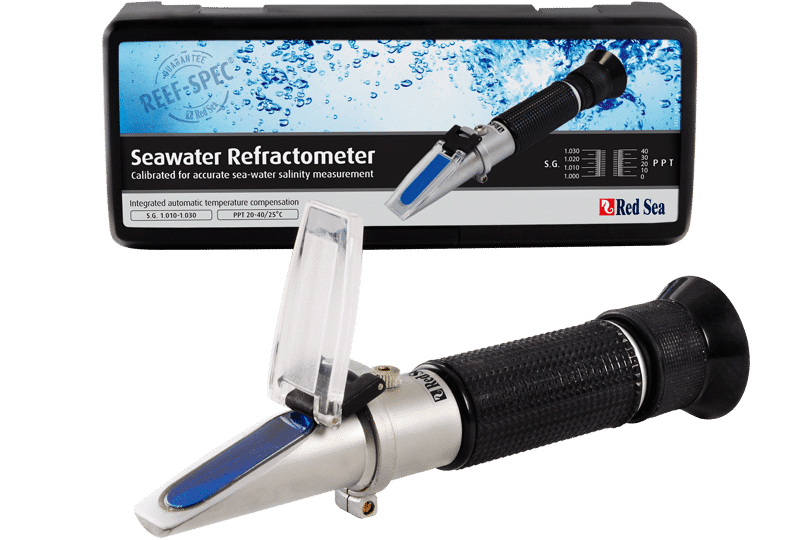
Seawater Refractometer - Red Sea Salinity test for marine aquariums
Red Sea’s Seawater Refractometer offers exceptional accuracy, for measuring the absolute salinity of seawater Specifically designed for saltwater aquariums
"Most refractometers used within the aquarium hobby are not specifically designed for reef aquariums and use an algorithm for the measurement of brine (NaCl – rather than seawater) and at a temperature of 15oC/59 0F rather than 25oC/77 0F. Thus, a measurement deviation of up to 1.5ppt is possible, which can have a significant adverse effect on coral growth and coloration."
Last edited:

I wrote to VeeGee to specifically ask about the STX-3 model. I use one and it always matches my Tropic Marin hydrometer. Here is the page from their catalog. They have other refractometers that measure NaCl so maybe the STX-3 is truly seawater. I will update when/if I get a response.


Randy Holmes-Farley
Reef Chemist
View Badges
Staff member
Super Moderator
Excellence Award
Expert Contributor
Article Contributor
R2R Research
My Tank Thread
OK, let us know what they say. 
OK, let us know what they say.
So here is the response about the STX-3. I asked “is this refractometer a true seawater refractometer or a brine refractometer?”
They said,
“Our refractometer uses the scale for seawater, not just a brine.”
Seems vague to me. If I make your standard using your recipe and use it with the VeeGee after calibrating with distilled and it reads as it should, does that mean it’s seawater?

Jekyl
GSP is the devil and clowns are bad pets
View BadgesHospitality Award
Midwest Reefer
Fish Medic
I've seen lots of posts using that method with bad results. Instantly fixed by calibrating with actual calibration fluid.Got red sea and vee gee and both per manufacturer instructions say to use distilled or rodi water. I've always been using rodi to calibrate. If that "magic" calibration solution was really necessarily, the manufacturers would use it themselves.

Randy Holmes-Farley
Reef Chemist
View Badges
Staff member
Super Moderator
Excellence Award
Expert Contributor
Article Contributor
R2R Research
My Tank Thread
So here is the response about the STX-3. I asked “is this refractometer a true seawater refractometer or a brine refractometer?”
They said,
“Our refractometer uses the scale for seawater, not just a brine.”
Seems vague to me. If I make your standard using your recipe and use it with the VeeGee after calibrating with distilled and it reads as it should, does that mean it’s seawater?
The reason I strongly advise folks to use a 35 ppt standard made for refractometers is as follows:
1. It doesn't matter if it is a brine or true seawater refractometer, it will be correctly calibrated for 35 ppt
2. It doesn't matter if the refractometer was made correctly or not, it will be correctly calibrated for 35 ppt
3. For any device of any purpose, calibration is best done close to the point of measurement, rather than far away.
Last edited:
Randy Holmes-Farley
Reef Chemist
View Badges
Staff member
Super Moderator
Excellence Award
Expert Contributor
Article Contributor
R2R Research
My Tank Thread
I go into much more detail about how refractometers work and are calibrated here:

Refractometers and Salinity Measurement - REEFEDITION
Title photo by R2R member Rskillz By Randy Holmes-Farley Salinity is one of the most important parameters measured in reef aquaria. It controls not only the salt balance between an organism and its surrounding environment, but also the levels of a host of ions Read more here...
www.reefedition.com
OP
OP
Idk, I've heard the same bad claims bout calibration fluid. Same bad reviews on the calibration fluid and how it's not accurate, either due to expiration, brand, temp. I figure I've been using rodi past 6 months no problems, I'll keep it the same.I've seen lots of posts using that method with bad results. Instantly fixed by calibrating with actual calibration fluid.

OP
OP
After calibrating both vee gee and red sea per manufacturer instructions, many times, both refractometers give the same reading. My 3rd ato non brand one gives 2-3 sg .00 points higher reading. I stopped using itIt's not nearly so simple as you assume, and in this case, you assumed wrong. This is the sort of reason why there is a reef chemistry forum rather than a page of links to manufacturer claims, which are frequently misleading or just plain wrong.
Certainly manufacturers recommend pure fresh water for calibration, and that is always correct for the chemicals the refractometer is made for.
Unfortunately, very few refractometers are made for seawater and so that is the wrong advice when using those types for seawater rather than their intended use.
If the Vee Gee you have is the STX3, it is likely not a true seawater refractometer. You can tell that by the vague claim of what it can be used for:
Handheld Salinity Refractometer
Order your Handheld Salinity Refractometer online today with VEE GEE Scientific and receive free shipping and fast delivery.
"Handheld Salinity Refractometers are exceptionally simple to operate and provide quick, accurate measurements for the concentration of nearly any aqueous solution."
The Red Sea is a true seawater refractometer. They specifically note the problem with non seawater refractometers:
Seawater Refractometer - Red Sea Salinity test for marine aquariums
Red Sea’s Seawater Refractometer offers exceptional accuracy, for measuring the absolute salinity of seawater Specifically designed for saltwater aquariumswww.redseafish.com
"Most refractometers used within the aquarium hobby are not specifically designed for reef aquariums and use an algorithm for the measurement of brine (NaCl – rather than seawater) and at a temperature of 15oC/59 0F rather than 25oC/77 0F. Thus, a measurement deviation of up to 1.5ppt is possible, which can have a significant adverse effect on coral growth and coloration."
I don't think they expire if properly sealed against evaporation. I lost confidence in my 20 year old refractometer a few weeks ago, and calibrated against two bottles of Pinpoint fluid I had on hand. They may be twenty years old, so I bought a new bottle, and a new generic refractometer. Once I calibrated, both 'scopes were all measuring consistently across all three fluids and both refractometers - even the elder, which was literally falling apart.
I call them "'scopes" because I assume the neighbors think I am spying on them when I measure through the window.
I call them "'scopes" because I assume the neighbors think I am spying on them when I measure through the window.

Randy Holmes-Farley
Reef Chemist
View Badges
Staff member
Super Moderator
Excellence Award
Expert Contributor
Article Contributor
R2R Research
My Tank Thread
Does calibration fluid go bad? If so, how long does it last?
Thank you
Troy
If it doesn't evaporate or get contaminated with other fluids, it lasts forever.











