Algae Identification

Rusty904

New Member
View Badges
Joined
Jul 21, 2023
Messages
12
Reaction score
12
Location
Surf City
Rating - 0%
0   0   0
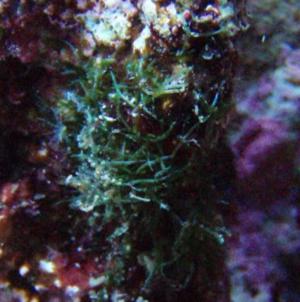
Can anybody positively ID this algae in the attached picture. I’ve done tons of research and am coming up short. Been posted to a few different groups on FB already and not a single person has been able to give me a no crap 100% ID on this stuff. It’s grows really fast and spreads like wild fire.

IMG_4562.png
 

ENTEROMORPHA SP.
greenalgae.png
A distinctive green algae that is in the family Ulvales. It is both a temperate and tropical species, abundant in different forms worldwide. This particular algae features long, slippery tubes or fingers rising from the center of the plant attached by a single holdfast. The Latin term "Enteromorpha" literally means intestine-shaped. It grows in large clumps at the low tide zone on mangrove roots and coarse substrate. Enteromorpha tolerates a wide range of salinities from 17 ppt. to 40 ppt. and is often found at the base of rivers and brackish water estuaries. Like other species of Ulva, it prefers cooler water temperatures in the aquarium and will not do well in temps over 80 degrees. Like other varieties, its very palatable to fish.​
 
cladophoropsis and not cladophora. It's sucks a whole bunch and there isn't a known identifiable solution.

Some people said fluconazone works on some species but may not work on this one.
 
Can anybody positively ID this algae in the attached picture. I’ve done tons of research and am coming up short. Been posted to a few different groups on FB already and not a single person has been able to give me a no crap 100% ID on this stuff. It’s grows really fast and spreads like wild fire.

IMG_4562.png
Did you ask how to kill it or did you first want to identify.

Everything grazes on the Ulva stuff
.
 
cladophoropsis and not cladophora. It's sucks a whole bunch and there isn't a known identifiable solution.

Some people said fluconazone works on some species but may not work on this one.
Someshmuck,
How does this address the original post? And what does it relate to?
 
How does this address the original post? And what does it relate to?
I think he is correct on the diagnosis as cladophoropsis after a google search. Apparently this stuff is the devil. Would love to know how to get rid of it. I’m currently in the middle of trying Fluconazole as we speak. Only 3 days in so far though so not a big noticeable difference.
 
I think he is correct on the diagnosis as cladophoropsis after a google search. Apparently this stuff is the devil. Would love to know how to get rid of it. I’m currently in the middle of trying Fluconazole as we speak. Only 3 days in so far though so not a big noticeable difference.
Press on. its your tank.
 

Cladophoropsis, Green Wiry Algae

Cladophoropsis 300x302


Species in this genus, and related ones, cling to the rock, and spread from a runner. The branches do not get tall, and they are often found with hobbyist frags or on live rock.

Manual Removal: Difficult. Macros that have fragile runners and creep along the rock are the hardest to manually remove. Do the best you can. Get a dental pick and get it all the first time and be done with it.

Clean Up Crew: Rock Boring Urchins, Emerald Crabs, Turbos, and Sea Hares occasionally pick on it, but don't seem particularly interested in it.

Starving it out: It seems to be particularly good at adapting to nutrient lulls, and it is unlikely that a small amount of the algae here and there will be starved out of your tank.

Fortunately these algae species tend to grow slowly, and aren't particularly common.

We distinguish this from Green Turf Algae by keeping this heading limited to green algae that creep along the rockwork, rather than grow up from it.




 

Cladophoropsis, Green Wiry Algae

Cladophoropsis 300x302


Species in this genus, and related ones, cling to the rock, and spread from a runner. The branches do not get tall, and they are often found with hobbyist frags or on live rock.

Manual Removal: Difficult. Macros that have fragile runners and creep along the rock are the hardest to manually remove. Do the best you can. Get a dental pick and get it all the first time and be done with it.

Clean Up Crew: Rock Boring Urchins, Emerald Crabs, Turbos, and Sea Hares occasionally pick on it, but don't seem particularly interested in it.

Starving it out: It seems to be particularly good at adapting to nutrient lulls, and it is unlikely that a small amount of the algae here and there will be starved out of your tank.

Fortunately these algae species tend to grow slowly, and aren't particularly common.

We distinguish this from Green Turf Algae by keeping this heading limited to green algae that creep along the rockwork, rather than grow up from it.


Definitely not this. It’s doesn’t branch.
 
Cladophoropsis is a species name and may look different than the pictures provided.

As far as my research went when i was dealing with my algae, what you got looks like cladophoropsis. In my case, it survived both vibrant (do not recommend, in my case vibrant killed off most of my torches) and fluconazone (so far no problems with anything) treatments so YMMV. It did take it down a notch but so did manual removal of piles of it when i overhauled my tank so I can't tell you if it'll fix your problem.

Fluconazone killed off all other algae variants I had in my tank except for film algae, cyanobacteria, gelidium (wiry red algae), and Cladophoropsis. (No traces of bryopsis or GHA)

One thing I noted was the the cladophoropsis that survived were in low light areas of my tank and IIRC fluconazone does something to an algaes capability to photosynthesize.

 
Another thing to note is that I never saw it in my display tank, only the frag tank connected to it via a shared sump as well as my ATS.

My guess is either my puple and blue tangs took care of all algae growth whereas my scopas and fox face have not. Or it may have to do with lighting. T5s + radion on display, OR3 light bars on frag.
 
Cladophoropsis is a species name and may look different than the pictures provided.

As far as my research went when i was dealing with my algae, what you got looks like cladophoropsis. In my case, it survived both vibrant (do not recommend, in my case vibrant killed off most of my torches) and fluconazone (so far no problems with anything) treatments so YMMV. It did take it down a notch but so did manual removal of piles of it when i overhauled my tank so I can't tell you if it'll fix your problem.

Fluconazone killed off all other algae variants I had in my tank except for film algae, cyanobacteria, gelidium (wiry red algae), and Cladophoropsis. (No traces of bryopsis or GHA)

One thing I noted was the the cladophoropsis that survived were in low light areas of my tank and IIRC fluconazone does something to an algaes capability to photosynthesize.

That’s interesting, this stuff doesn’t seem to like high light intensity at all. It only grows in my tank in low light shaded areas. Areas with direct light it doesn’t grow at all.
 
That’s interesting, this stuff doesn’t seem to like high light intensity at all. It only grows in my tank in low light shaded areas. Areas with direct light it doesn’t grow at all.
I feel that! It might be good to do fluconazone and move your rocks and stuff around and expose all the algae to your light. It might be a good idea to beat it.
 

IF YOU HAD TO TAKE A REEFING EXAM, WOULD YOU PASS?

  • Yes!

    Votes: 32 45.7%
  • Not yet, but I have one that I want to buy in mind!

    Votes: 9 12.9%
  • No.

    Votes: 26 37.1%
  • Other (please explain).

    Votes: 3 4.3%

New Posts

Back
Top