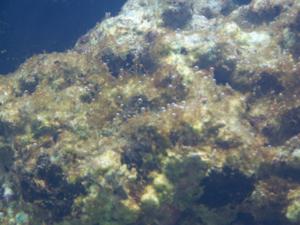
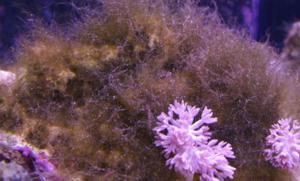
What is this and how do I remove it from my tank ? I tried removing it by hand but it wouldn't budge.
IMO
Calothrix
These species of cyano often appear as a light slimy yet hairy/fuzzy nastiness that loosely attaches to your rock work. Air bubbles are usually trapped while eascaping the "algae", just like in the picture to the left. Calothrix is a type of blue green algae that looks very similar to Dinos. We have them next to each other in the guide to help you distinguish the difference between the two.
Manual Removal: Remove the rock and scrub, and then fine tune with a toothbrush. Let the cleaners get the rest. It helps to use a net to collect the debris that will occur as a result of the toothbrushing.
Starving it out: Use a phosban reactor or a macro like chaeto to take down phosphate. If you have a nitrate problem too, you can add more live rock or rubble to the tank, do some more wcs, add macro, add dsb, etc...
Clean Up Crew: Chitons, Nerites and other cyano cleaners work well.
or
Green Hair Algae
Green Hair Algae or "GHA" is really a broad term that covers hundreds of species of green simple filamentous algae. These species tend to be simple, fine in texture, and have few distinguishable features. True species level identification requires a microscope.
Distinguishing it from look-a-likes: GHA is not coarse or wiry, it should break apart easily when pulled, and should lose form quickly when removed from water. If you can make out a root structure, or a stiff branching structure it is probably not GHA.
Manual Removal: Green hair algae can be pulled out easily, and tooth brushed or scrubbed off the rock work. This is easier to do if the rock is outside of the tank. If it is growing from the sand sift it out with a net.
Clean Up Crew: Assorted Hermits, Blue Legs, Florida Ceriths, Chitons, Turbograzers, Sea Hares, Conchs, Emerald Crabs, Urchins and a few others. It is readily accepted by many herbivores, but because it grows quickly it may persist even in a tank with a fair amount of cleaners.
Why it Happened: An excess of available nutrients, particular the majors like phosphates and nitrates. Keep an eye on possible iron and potassium sources which may also help fuel hair algae. Hair algae spores and fragments are so abundant that keeping it out of the tank via quarantine is unlikely to be successful. Your best bet to preventing this algae from taking hold is to maintain a weekly water change regimen, maintain your filtration and perform manual/natural algae removal as it forms. Proper magnesium and alkalinity levels are thought to discourage the growth of many species of GHA.
Starving it out: Use a phosban reactor or a macroalgae like chaeto to reduce nutrients. Increase the frequency of your water change routine, taking the opportunity to siphon out as much hair algae as you can each time. Older light bulbs tend to drift towards the red spectrum, and fuel the growth of hair algae so considered replacing them if need be.
Hope this helps