Alkalinity too high. Best way to lower??

Rickybobby

Valuable Member
View Badges
Joined
May 30, 2020
Messages
1,173
Reaction score
881
What state or country do you live in
Canada
Rating - 0%
0   0   0
Hey guys. So for almost a year alk was 8dkh. Ph was 7.6-7.8. Started using kalk and went to 8.1 and 10dkh which I was happy with.
however checked alk the other day it was 12 and a couple of my sps have burnt tips. So I stopped putting kalk in the ato for this week. But than I decided to check the alk in my brute can mix and it came up 12! What the heck. Reef crystals salt mixed to 1.026 verified with Hannah

any options on how to bring it down slowly to say 10dkh again??

 
Hey guys. So for almost a year alk was 8dkh. Ph was 7.6-7.8. Started using kalk and went to 8.1 and 10dkh which I was happy with.
however checked alk the other day it was 12 and a couple of my sps have burnt tips. So I stopped putting kalk in the ato for this week. But than I decided to check the alk in my brute can mix and it came up 12! What the heck. Reef crystals salt mixed to 1.026 verified with Hannah

any options on how to bring it down slowly to say 10dkh again??
Just let it drop by normal consumption. This is the safest way to do it. You can use other methods, like water changes with water at less alk, but that requires large qtys. of new SW to lower the alk in it. Especially while using IORC. If you want to continue to use IORC and maintain lower alk, you will need to bring it down via acid or do smaller water changes with it.

Personally, I would just let it drop naturally and use either plain IO with a little acid added if needed to drop the alk.

Besides Kalk, do you dose 2 part or anything else to add alk and cal? If so, you will need to stop the alk and mayneed to reduce the cal. Only testing a few time over the process of letting it drop will let you know if cal needs to be dosed less or not.
 
I do not dose. Water changes and ato and of course aminos her into the Column from selcon in the food and the roe. But I do not dose calcium or magnesium. By the way calcium is 500 and mag is 1500.
 
Just let it drop by normal consumption. This is the safest way to do it. You can use other methods, like water changes with water at less alk, but that requires large qtys. of new SW to lower the alk in it. Especially while using IORC. If you want to continue to use IORC and maintain lower alk, you will need to bring it down via acid or do smaller water changes with it.

Personally, I would just let it drop naturally and use either plain IO with a little acid added if needed to drop the alk.

Besides Kalk, do you dose 2 part or anything else to add alk and cal? If so, you will need to stop the alk and mayneed to reduce the cal. Only testing a few time over the process of letting it drop will let you know if cal needs to be dosed less or not.
By acid what do you mean? Vinegar or something else? Can carbon dosing have the same effect?
 
vinegar, but it can be dangerous b/c you don't know how much added will lower the pH too much.
 
I do not dose. Water changes and ato and of course aminos her into the Column from selcon in the food and the roe. But I do not dose calcium or magnesium. By the way calcium is 500 and mag is 1500.
OK, so it appears you may not need kalk if you do regular water changes. Those numbers are about where most IORC I have used tests at right when mixed. Next is the amount of corals in the tank. If consumption is low., then water changes should replenish most of what is used.

By acid what do you mean? Vinegar or something else? Can carbon dosing have the same effect?
Muratic acid or the like. In the chemistry section, it discusses this in detail. I do not use this method, as I run salt that meets the alk I want to maintain. Vinegar will reduce alk, but it will also fuel bacteria and can cause a bloom. Any acid addition will need to be done out ofd the tank and then the water aerated heavily until the PH stabilizes. PH will drop a good bit when acid is added.
 
Vinegar?
general consensus is to do either large water change or add none and allow to dropon its own which will be gradually and safe
 

Excerpt from: https://reefs.com/magazine/chemistry-and-the-aquarium-solving-calcium-and-alkalinity-problems/

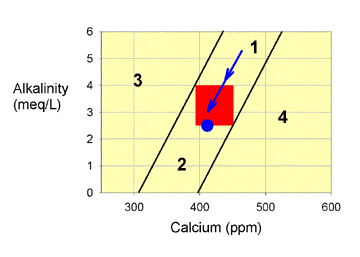
Corrections for Zone 1​


Zone 1 is the easiest problem to correct. Unfortunately, it is also very uncommon. In this case, both calcium and alkalinity are on the high side of normal. Moreover, if you leave the tank alone, the problem will likely correct itself, and you will end up in the red target zone (though you may also pass through it into zone 2 if you wait too long).


figure2.gif
Figure 2. A graph showing how to correct values within zone 1 by allowing calcium carbonate to be deposited in the tank (the blue arrow).

What this zone implies is that both calcium and alkalinity are elevated, and that by removing calcium carbonate from the water, either through biotic deposition into coral skeletons or coralline algae, or through abiotic precipitation, as on heaters, the levels of each will drop in an appropriate ratio. More specifically, the tank parameters will move along a line parallel to the two lines bordering this zone, and directly into the red target zone (the blue arrow in Figure 2). If you are smack in the middle between these two lines, as in Figure 2, then you will continue to move in the middle of these two lines down into the target zone.


This movement can continue right out the bottom end of the target zone (into zone 2), of course, so once you reach the target zone, you’ll have to reinitiate normal calcium and alkalinity additions.
 

IF YOU HAD TO TAKE A REEFING EXAM, WOULD YOU PASS?

  • Yes!

    Votes: 32 45.7%
  • Not yet, but I have one that I want to buy in mind!

    Votes: 9 12.9%
  • No.

    Votes: 26 37.1%
  • Other (please explain).

    Votes: 3 4.3%
Back
Top