Ammonia

  • Thread starter Thread starter kiwis
  • Start date Start date
  • Tagged users None

kiwis

Active Member
View Badges
Joined
Jun 18, 2018
Messages
347
Reaction score
83
Rating - 0%
0   0   0
Hi,
So I've got about 7-8 years freshwater experience under my belt and are about to dive into marine aquariums now.

Just writing a document for my use of the chemistry of marine so I understand it all. Firstly I'm looking at Ammonia, like any tank I understand Ammonia comes from fish waste and uneaten food etc. Does anything else in Marine tank cause Ammonia? (Coral?).

Other than water changes, removing excess for etc how else can you remove Ammonia from your tank and ensure it's converted into Nitrites?
 
Welcome to R2R and to the salty side. Check out the information below related to cycling a tank. With a properly cycled tank, ammonia should not be a concern. Props to my friend @KJ who is the one that typically shares this.


414224


In a freshwater aquarium you can add some flake food, wait a couple weeks, and then you can add fish. In the ocean there is much more involved than mechanical filtration. In fact, 70% of your aquariums filtration relies on the maturity of the live rock. A combination of bacteria, algae, and various invertebrates compose the “live” part of the rock. It takes quite a while to establish an ecosystem, even on a microscopic level. Without a proper understanding of the Marine Cycle, you will be in for a long term battle with parameters and algae. There are six main stages to a properly cycled tank. Follow this guide and you cannot mess up. You will need your basic test kit to test the progress.

Stage 1: Ammonia Cycle

Ammonia is the first thing that forms when something rots. It is a waste product in nearly all creatures as well. Instead of using a fish to start the cycle just use some food. Anything that is all natural and uncooked works just fine. Table shrimp that is uncooked works great. Drop it on the sand so it is in view. The shrimp should begin to rot within a couple hours or more. Let this shrimp rot until it is completely gone. If you are curious what your ammonia levels are, go ahead and take some tests. Keep track of the results as the shrimp rots. The smaller the food gets the more ammonia should be present in your water column and pretty soon should be off the charts. This will stay high for a while, but then start to drop. As soon as the ammonia starts to drop you will see a rise in Nitrite, you are now on the next stage.

Stage 2: Nitrite Cycle

Ammonia when broken down by bacteria becomes Nitrite, which is still a toxin. As your Nitrites rise your Ammonia will drop, drop, and keep dropping as long as you haven’t added any animals. Keep up with testing to observe your progress. Eventually your Ammonia will be very low and your nitrites will peak out until it starts feeding a different type of bacteria that turns it into Nitrates. Once your first signs of Nitrates are seen you are on the next stage.

Stage 3: Nitrate Cycle

Nitrates are removed within the live rock deep inside in all of the deep pours. This hidden bacteria consumes the nitrate and creates nitrogen gas as a byproduct. The nitrogen gas rises in the water column and escapes into the air. When one gas leave, another enters. Oxygen is then infused into the water. After the Nitrates start to dissipate your oxygen will increase and you will be ready for the intermission:
 
Thank you for the comprehensive reply. I'll definitely use this approach when starting my tank.

I guess what I'm trying to make sure I understand is (long term not just cycling the tank).

How do I ensure I have the right and enough bacteria in the tank to convert the ammonia into Nitrite and then into Nitrate?

Is that just about having the right size sump to manage the tank size and number of fish? if I have enough media and a large enough sump the bacteria will just grow to the required size?
 
Once your tank is properly cycled, and you begin to add life to the tank....SLOWLY...your beneficial bacteria will adjust to the bio load of the tank and its inhabitants. That is why I emphasize slowly. If you try to add a bunch of life to a newly cycled tank, your beneficial bacteria will likely not be able to handle it, thus throwing your tank back into what amounts to another cycle.

The point I'm trying to make is if you take your time (a key to success in this madness), properly cycle the tank, and add life slowly, you should never have to worry about ammonia on a regular basis. You will likely get to the point where you don't even test for ammonia believe it or not. The one exception is a catastrophic loss of tank life all at once, but that's a subject for another day that we hopefully never have to have.

Making any sense?
 
Once your tank is properly cycled, and you begin to add life to the tank....SLOWLY...your beneficial bacteria will adjust to the bio load of the tank and its inhabitants. That is why I emphasize slowly. If you try to add a bunch of life to a newly cycled tank, your beneficial bacteria will likely not be able to handle it, thus throwing your tank back into what amounts to another cycle.

The point I'm trying to make is if you take your time (a key to success in this madness), properly cycle the tank, and add life slowly, you should never have to worry about ammonia on a regular basis. You will likely get to the point where you don't even test for ammonia believe it or not. The one exception is a catastrophic loss of tank life all at once, but that's a subject for another day that we hopefully never have to have.

Making any sense?
David,
You nailed it!!

:)
 
Welcome to R2R, @kiwis !

Great advice above. I reiterate, the key is to move slow. The cycle is one thing to establish bacteria. From there, in the marine hobby, we focus on maturing the nitrifiers and denitrifiers to handle an increasing bioload. As you and your tank both mature, you will get a sense of the input and output of nutrients. If you rush it will be easy to get lost and have issues.
 
Hi,
So I've got about 7-8 years freshwater experience under my belt and are about to dive into marine aquariums now.
Welcome What sort of tank are you thinking of doing. Fish, Coral or both ?
 
Welcome What sort of tank are you thinking of doing. Fish, Coral or both ?
At this stage fish but once settled and on top of everything I may look to a few easier corals but I don't want to get ahead of myself and have no time frame on that.
 
Welcome to R2R and to the salty side. Check out the information below related to cycling a tank. With a properly cycled tank, ammonia should not be a concern. Props to my friend @KJ who is the one that typically shares this.

Stage 1: Ammonia Cycle

Ammonia is the first thing that forms when something rots. It is a waste product in nearly all creatures as well. Instead of using a fish to start the cycle just use some food. Anything that is all natural and uncooked works just fine. Table shrimp that is uncooked works great. Drop it on the sand so it is in view. The shrimp should begin to rot within a couple hours or more. Let this shrimp rot until it is completely gone. If you are curious what your ammonia levels are, go ahead and take some tests. Keep track of the results as the shrimp rots. The smaller the food gets the more ammonia should be present in your water column and pretty soon should be off the charts. This will stay high for a while, but then start to drop. As soon as the ammonia starts to drop you will see a rise in Nitrite, you are now on the next stage.

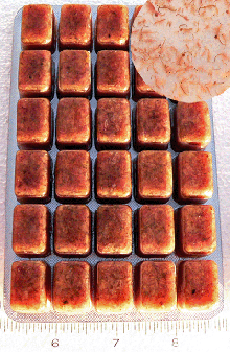
Just thinking about this, most table shrimp is my area are precooked. Can you just use a cube of frozen fish food such as Brine Shrimp? (or half a cube)

Cubetraywithinset02.gif
 
Can you just use a cube of frozen fish food such as Brine Shrimp?
Cube or two its just fine don't worry. Take your time;)
 

IF YOU HAD TO TAKE A REEFING EXAM, WOULD YOU PASS?

  • Yes!

    Votes: 32 45.7%
  • Not yet, but I have one that I want to buy in mind!

    Votes: 9 12.9%
  • No.

    Votes: 26 37.1%
  • Other (please explain).

    Votes: 3 4.3%

New Posts

Back
Top