I am borrowing an apogee 120 from a friend. I'm using it with a multimeter and all I need to do is multiply the number I get by 5? I have the multimeter set at 200m DC.
Quick note , if you are using a LOT of blue violet the par is likely slightly higher as the sensors have been improved in later models. Not enough to really worry about imo.
After you take the measurements times 5, you need to apply a 1.33 correction factor if you are using it underwater. There is also a chart of other correction factors based on a specific light source on page 14 of the manual on the Apogee WebSite.
I think that is pretty good estimate - as good as anything this side of a $1500 LiCor meter. Absolute numbers are really just academic, even thought most people really care too much. Just understanding where you have brighter and dimmer spots in your tank is where the gold is - this will certainly work for that.
I just didn't want to do it wrong and always be second guessing the numbers. I'll just take my time map it out well.
For a $150 I probably should just get one. I'll be setting up frag tank and adding more filler lights soon.
After you take the measurements times 5, you need to apply a 1.33 correction factor if you are using it underwater. There is also a chart of other correction factors based on a specific light source on page 14 of the manual on the Apogee WebSite.
The Apogee Full-Spectrum Quantum Sensor (model SQ-500) is more spectrally accurate than the Original Quantum Sensor (model SQ-120), but the unique optics (mainly the shape) cause the immersion effect to be larger for the new sensor. Underwater PAR measurements collected using a full-spectrum sensor can be corrected by multiplying by 1.32;
measurements collected using an original Apogee sensor should be multiplied by 1.08*.
According to Apogee yes, still need to consider blue content..Red line @ 450 is typical Royal blue
So like 10% of 50% ish of the spectrum if run full 100% channels...(ignoring at my own peril the large amount of royal blue in high K white LED's, 20% error isn't much right..)
W/ the overshoot on other wavelengths it sort of evens out.
Personally , if not a lot of "violet" or UV or 660 or less red a spectrum correction factor is minimal.
One of the reasons 120/Seneyes are a close match "in practice" to 500's or Li-cors
JUST need to remember the limitations..
Still only a educated "guessitmate"..
120 sensor response
my opinion:
44% on an all blue channel is a bit much but possibly right if you throw in a LOT of 420's 410's UV...
Spectral graphs and correction factors for 36 popular light sources and instruction to correct for errors. Apogee quantum sensors help you get the most accurate PAR measurements.
www.apogeeinstruments.com
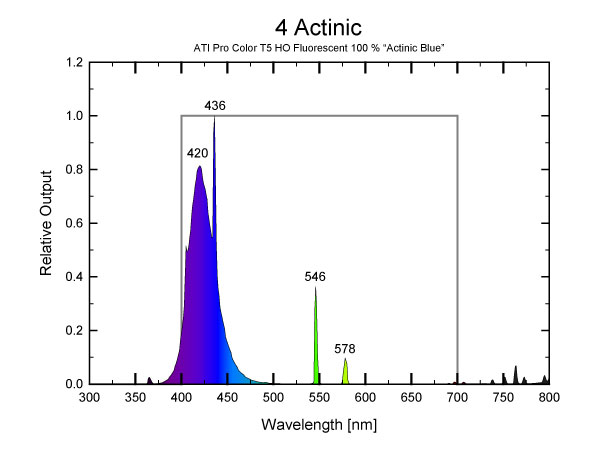
According to the above a "pure actinic" t5 correction would be x 1.4
Peaks at 420, spike at 436, little spikes in the green..















 )
)