Navigation
Install the app
How to install the app on iOS
Follow along with the video below to see how to install our site as a web app on your home screen.
Note: This feature may not be available in some browsers.
More options
You are using an out of date browser. It may not display this or other websites correctly.
You should upgrade or use an alternative browser.
You should upgrade or use an alternative browser.
Best Undergravel Filter
- Thread starter Mei Lin
- Start date
- Tagged users None



nautical_nathaniel
Indecision may or may not be my problem.
View BadgesExcellence Award
Reef Tank 365
Photo of the Month
Article Contributor
West Palm Beach Reefer
Reef Squad Emeritus
- Joined
- Feb 19, 2014
- Messages
- 4,881
- Reaction score
- 12,270
- Location
- West Palm Beach, FL
- What state or country do you live in
- Florida
The hobby has generally gone away from undergravel filters, but maybe someone in the #reefsquad can help.
@Paul B might be your best source of info on UGF's he still uses one in his setup and while yours is freshwater(which arguably has a better use of UG filters) I'm sure his info works in both cases. 


melypr1985
totally addicted
View BadgesExcellence Award
Expert Contributor
Article Contributor
Moderator Emeritus
You'll have to forgive me here since freshwater isn't something I'm overly familiar with, but I'm fairly certain that undergravel filters are all about the same. I do know that UG filters aren't being used all that much even in freshwater. people there are generally going toward canister filters or hang on back.

Crabs McJones
I'm so shi-nay
View Badges
Excellence Award
Reef Tank 365
Article Contributor
Moderator Emeritus
Hospitality Award
Reef Tank 365 Boss
Wisco Reefers
My Tank Thread
Undergravel filters aren't as popular as they used to be. The only one I know of is the kit you can purchase at the big box petstores like Petsmart or Petco where you build your own. HOpe this helps

- Joined
- Jul 22, 2017
- Messages
- 932
- Reaction score
- 2,228
- Location
- HYDERABAD
- What state or country do you live in
- Other International


I haven't used an under gravel filter plate since about 1985. I didn't even know they were still selling them.
The point of an ugf is to draw a slow, constant flow down, through the gravel bed, thus allowing water to pass over bacterial media (the gravel) as it does so. Problem is, the same flow is dragging detritus into that gravel too... no way to prevent it. Eventually, it'll be so clogged with detritus that it no longer functions as a filter. The only way to 'fix' this is to use a gravel vac regularly, a task many of us will try and avoid at all costs.
Reverse flow UGF was popular for a while, pushing water UP through the UGF plate, and passing it through a pre-filter sponge before doing so. Honestly, this wasn't a bad way to go, in a freshwater tank, anyway.
These days, canister or HOB filters seem to be the filters of choice in freshwater setups, with a few hardcore folks opting for wet/dry bio ball sump setups.
The point of an ugf is to draw a slow, constant flow down, through the gravel bed, thus allowing water to pass over bacterial media (the gravel) as it does so. Problem is, the same flow is dragging detritus into that gravel too... no way to prevent it. Eventually, it'll be so clogged with detritus that it no longer functions as a filter. The only way to 'fix' this is to use a gravel vac regularly, a task many of us will try and avoid at all costs.
Reverse flow UGF was popular for a while, pushing water UP through the UGF plate, and passing it through a pre-filter sponge before doing so. Honestly, this wasn't a bad way to go, in a freshwater tank, anyway.
These days, canister or HOB filters seem to be the filters of choice in freshwater setups, with a few hardcore folks opting for wet/dry bio ball sump setups.

- Joined
- Feb 24, 2017
- Messages
- 317
- Reaction score
- 233
When I used to use them, I just made my own. Go buy some light diffuser grid and some fiberglass window screen. Use squares from the grid to hold the main grid off the floor of your tank and cover the grid with the screen.

jsker
Reefing is all about the adventure
View BadgesStaff member
Super Moderator
Partner Member 2024
Excellence Award
Reef Tank 365
Article Contributor
Hospitality Award
Ocala Reef Club Member
R2R Secret Santa 2023
My Tank Thread
- Joined
- Apr 11, 2015
- Messages
- 25,008
- Reaction score
- 80,077
- Location
- Saint Louis
- What state or country do you live in
- Missouri
@Lasse system has an undergrave setup if I recall using pumps.
I would almost go back to an undergravel filter set up with pumps instead of air. That was the be drawback with undergrave, was that one was alway changing the air stones frequently. When the air stones would start to get clogged the filtration would diminish due to the syphing slow down from the lack of air bubbles.
I would almost go back to an undergravel filter set up with pumps instead of air. That was the be drawback with undergrave, was that one was alway changing the air stones frequently. When the air stones would start to get clogged the filtration would diminish due to the syphing slow down from the lack of air bubbles.


- Joined
- Mar 20, 2016
- Messages
- 11,262
- Reaction score
- 30,666
- Location
- Källarliden 14 D Bohus, Sweden
- What state or country do you live in
- Other International
My setup is a reversed undergravel system. I pump water into the bottom of the under undregravel filter and the water will be going from the bottom up to the surface of the filter. The backslash with the undergravel is not (IMO) the upbuilding of detritus – this is instead the holly grail of the system. The detritus will sooner or later form anaerobic environment in the bottom layer of the undergravel filter and when it will do that – the magic will happen.
IMO – the major disadvantage of a undergravel filter – reversed or not – is what can happen if you get a power breakdown. Hydrogen sulphide can be formed in the filter and when the power comes back – the deadly gas will be out in your aquarium water. This will especially happens if your NO3 levels is low (and it will be that way sooner or later if you use a reversed undergravel filter) However oxygen in the water will take care of the hydrogen sulphide but it needs to be enough of oxygen in the water in order to take away all H2S.
Another “disadvantage” of a reversed undergravel filter is that it will probably produce some nutrients (mainly PO4 and NH3/NH4) and a lot of CO2. However – this can be turned to an advantage if you want.
When I planned my new aquarium – I want to test some biological techniques like undergravel filter with reversed flow and a fuge. I chose a system – see figures – there the undergravel filter is placed behind the DT and it works more like a remote DSB. The whole flow (around 2000 l/h) will pass the chamber. On top of the DSB – I have my fuge. After my fuge – the water will pas an overflow chamber and down to the skimmer apartment of my sump. The skimmer takes the same amount of water every hour and has a lot of air going in. The fuge is running at reversed photoperiod.
Original idea
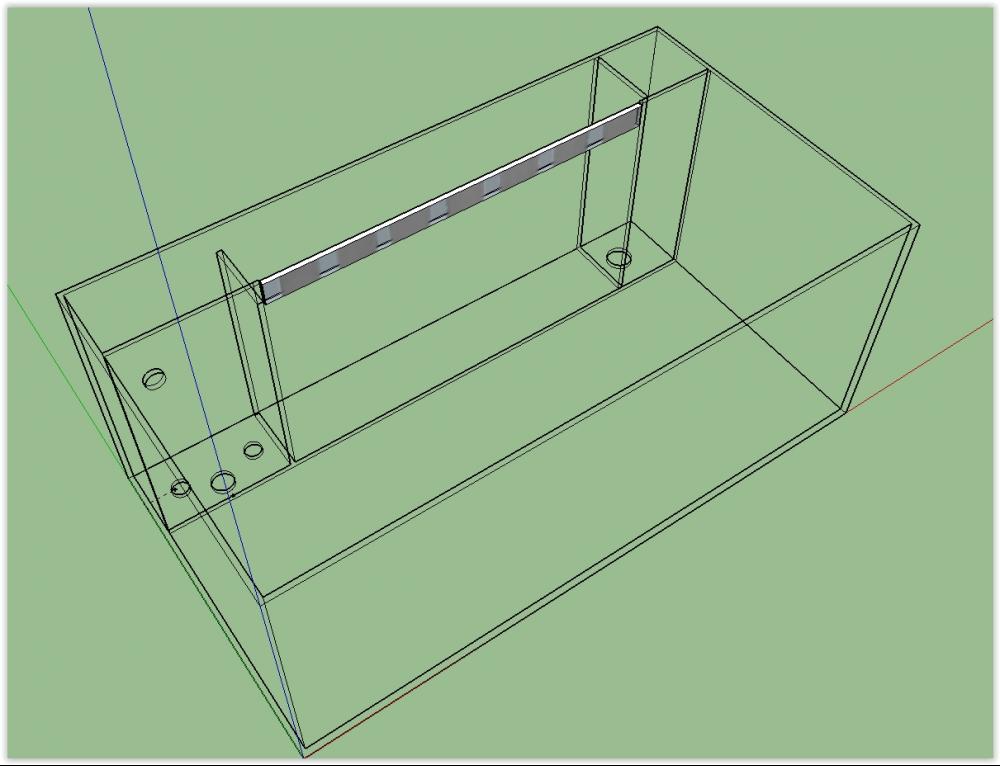 The order

When my system is running in normal mode – some of the water coming from the DT will be pumped down below the undergravel filter (around 150 – 200 l/hour) - released nutrients and CO2 will be used as resources by the corals and microalgae during DT:s photoperiod and as resources for the macroalgae during the Fuges photoperiod. If there is formed any H2S during normal running – the produced oxygen from corals and microalgae or – during night time – the macroalgae will take care of this. The skimmer will also aerate the water before it will be pumped back to the DT. And in order to be more safe – in the return chamber – there is an oxydator.
If I get a power breakdown – H2S will be formed in water inside the DSB. Therefore – the pump down to the bottom of the undergravel has a delay of 30 min before it starts after a power breakdown. But there is a chance that some H2S also will be formed in the water column of the fuge above the DSB. Therefore, the return pump to the DT have a delay of 5 minutes before starting. The skimmer pump and the wavemakers will start directly. This means that – after a power breakdown – the skimmer pump will aerate the skimmer compartment for 5 minutes before the return pump start and water from the fuge (that can contain H2S) will come down. The oxygen in the water (produced of the skimmer) will oxidize the H2S before that the return pumps water will reach the DT. The oxydator will also help in this case.
My experiences say that after half a hour the whole system has an oxygen content high enough to oxidize any H2S from the DSB and the reversed pump will start again.
This system has run for 2 years now and has worked rather good.
What’s my advice with undergravel filter/DSB? The most important is that I will not use them inside the DT because of the risk of forming H2S during power breakdowns. This is valid for freshwater tanks too. If you use it inside the DT – of one or another reason – the use of a Oxydator inside the DT is a good advice.
Sincerely Lasse
IMO – the major disadvantage of a undergravel filter – reversed or not – is what can happen if you get a power breakdown. Hydrogen sulphide can be formed in the filter and when the power comes back – the deadly gas will be out in your aquarium water. This will especially happens if your NO3 levels is low (and it will be that way sooner or later if you use a reversed undergravel filter) However oxygen in the water will take care of the hydrogen sulphide but it needs to be enough of oxygen in the water in order to take away all H2S.
Another “disadvantage” of a reversed undergravel filter is that it will probably produce some nutrients (mainly PO4 and NH3/NH4) and a lot of CO2. However – this can be turned to an advantage if you want.
When I planned my new aquarium – I want to test some biological techniques like undergravel filter with reversed flow and a fuge. I chose a system – see figures – there the undergravel filter is placed behind the DT and it works more like a remote DSB. The whole flow (around 2000 l/h) will pass the chamber. On top of the DSB – I have my fuge. After my fuge – the water will pas an overflow chamber and down to the skimmer apartment of my sump. The skimmer takes the same amount of water every hour and has a lot of air going in. The fuge is running at reversed photoperiod.
Original idea
When my system is running in normal mode – some of the water coming from the DT will be pumped down below the undergravel filter (around 150 – 200 l/hour) - released nutrients and CO2 will be used as resources by the corals and microalgae during DT:s photoperiod and as resources for the macroalgae during the Fuges photoperiod. If there is formed any H2S during normal running – the produced oxygen from corals and microalgae or – during night time – the macroalgae will take care of this. The skimmer will also aerate the water before it will be pumped back to the DT. And in order to be more safe – in the return chamber – there is an oxydator.
If I get a power breakdown – H2S will be formed in water inside the DSB. Therefore – the pump down to the bottom of the undergravel has a delay of 30 min before it starts after a power breakdown. But there is a chance that some H2S also will be formed in the water column of the fuge above the DSB. Therefore, the return pump to the DT have a delay of 5 minutes before starting. The skimmer pump and the wavemakers will start directly. This means that – after a power breakdown – the skimmer pump will aerate the skimmer compartment for 5 minutes before the return pump start and water from the fuge (that can contain H2S) will come down. The oxygen in the water (produced of the skimmer) will oxidize the H2S before that the return pumps water will reach the DT. The oxydator will also help in this case.
My experiences say that after half a hour the whole system has an oxygen content high enough to oxidize any H2S from the DSB and the reversed pump will start again.
This system has run for 2 years now and has worked rather good.
What’s my advice with undergravel filter/DSB? The most important is that I will not use them inside the DT because of the risk of forming H2S during power breakdowns. This is valid for freshwater tanks too. If you use it inside the DT – of one or another reason – the use of a Oxydator inside the DT is a good advice.
Sincerely Lasse

- Joined
- Feb 7, 2014
- Messages
- 1,061
- Reaction score
- 409
- Location
- Metro Detroit
- What state or country do you live in
- Michigan
If you are going to be filtering a freshwater tank, go with a hang on the back like aquaclears. Hands down the best bang for you buck.
If its just a plain tank and you are just growing out fish a sponge filter with a asir pump works awesome.
I used to run over 50 freshwater tanks and have had everything from 450 gallon tank to a 2-1/2 gallon tank. And that's all I used was aquaclears for display tanks and sponge filters. The 450 I used a sump though
If its just a plain tank and you are just growing out fish a sponge filter with a asir pump works awesome.
I used to run over 50 freshwater tanks and have had everything from 450 gallon tank to a 2-1/2 gallon tank. And that's all I used was aquaclears for display tanks and sponge filters. The 450 I used a sump though

- Joined
- Nov 14, 2017
- Messages
- 83
- Reaction score
- 66
- Location
- Lincolnton, NC
- What state or country do you live in
- North Carolina
I have used UG filters as well as HOBs and canisters in my tanks both fresh and salt for over 50 years. I currently also use HOBs and, for my 75 gallon, a canister along with the UGs. I like overkill! Most brands of UG filters work about as well as each other. Penn Plax models are usually the least expensive, but nowadays I’d check Amazon.com or eBay before I bought one. You can also DIY a UG as described in this thread and use PVC pipe to move the water either with an air pump or a powerhead. Penguin powerheads offer a reverse flow kit that uses a sponge prefilter. I use these on three of my FW tanks and I like them very much. My 75 gallon hexagon goldfish tank has a homemade UG filter constructed from the bottom of a 5 gallon bucket. I drilled lots of small holes in the bottom of a bucket and cut off the top of the bucket leaving about two inches at the bottom. I cut holes for two one-inch diameter PVC pipes to move the H2O using reverse flow Penguin Powerhead kits. I turned the bottom of the bucket upside down, inserted the pipes (The bottom ends are cut at an angle to allow for H2O to flow.), and covered the whole gadget with a couple of inches of pea gravel from Lowes (well-washed to remove grit). You do have to use a gravel vacuum from time to time but only clean about half the gravel at a time. I use a Python water changing hose to siphon the crud from the gravel at water changing day and all the detritus and stuff goes right down the drain. My plants grow well even with the UG, because all the wastes that get sucked into the gravel feed them well. UGs are considered old fashioned, but they are good biological and mechanical filters. They worked 50 years ago and still work today. Some of my current UG filters have been in use for 20 years or so! Eventually some plastics will become brittle with age, but it takes a long time before they have to be replaced. Good Luck! Let us know what you decide to do.


For value I don’t think sponge or matten filters can be beat for freshwater .
http://www.swisstropicals.com/filtration-shop/
This place has great filters..
http://www.swisstropicals.com/filtration-shop/
This place has great filters..

Paul B
10K Club member
View Badges
Excellence Award
Reef Tank 365
Reef Of The Month
Article Contributor
Rock Pool Reef Keepers
I got a new UG filter last week from Amazon. It is a "Lees" which I never heard of. They are not easy to find. I am moving my reef to a larger tank in a new house and my old UG filter isn't big enough so I had to get a bigger one. I think it was about $75.00 and is cheaply made but doesn't have to do much except support my rocks.
One tube on my existing Reverse UG filter broke a couple of weeks ago and I never fixed it. That and power outages for a week never bothered anything. I will remove the pump running my UG filter in a couple of days to get ready for the move and it will be wirhout circulation for maybe a week.
One tube on my existing Reverse UG filter broke a couple of weeks ago and I never fixed it. That and power outages for a week never bothered anything. I will remove the pump running my UG filter in a couple of days to get ready for the move and it will be wirhout circulation for maybe a week.
- Joined
- Nov 14, 2017
- Messages
- 83
- Reaction score
- 66
- Location
- Lincolnton, NC
- What state or country do you live in
- North Carolina
Paul B, without knowing how big your tank is, $75 sounds like a lot of money for a UG filter, especially for one that’s cheaply made. I’ve never paid that much for one! Good luck!

Paul B
10K Club member
View Badges
Excellence Award
Reef Tank 365
Reef Of The Month
Article Contributor
Rock Pool Reef Keepers
The tank is 6' long and 18" wide. I only found 2 UG filters and the other one was a few inches smaller than the width of my tank. The tubes are really cheap and I will throw those out. I will use acrylic tubes and PVC elbows.

Are you going planted for the freshwater tank?
A possible disadvantage i see with a planted tank would a limit to substrate choices.
A lot of plants take their nutrients from the their roots only. And i have found a layer of flourite topped with sand easier to manage and cheaper than using root tabs. The constant low flow may cause layered substrates to mix.
A possible disadvantage i see with a planted tank would a limit to substrate choices.
A lot of plants take their nutrients from the their roots only. And i have found a layer of flourite topped with sand easier to manage and cheaper than using root tabs. The constant low flow may cause layered substrates to mix.


- Joined
- Oct 25, 2018
- Messages
- 61
- Reaction score
- 63
- Location
- Decatur, AL
- What state or country do you live in
- Alabama
Paul B, Do you have a dyi thread on how to go about making a reverse ugf? My searching skills must not be too good. I read another thread where someone stated such a topic existed but I can't seem to find it.
Paul B
10K Club member
View Badges
Excellence Award
Reef Tank 365
Reef Of The Month
Article Contributor
Rock Pool Reef Keepers
I actually do not have a thread on that because there are maybe 3 people in the world that use them. They just happen to be the three oldest tanks in the world. 
OK, I am guessing. But you get the filter and throw out the tubes. Then you have to get all three or four tubes to come up in the same place. You can use acrylic, or PVC but you really should have something you can see through. I think I may have used the tubes that came with it and put on PVC elbows.
But however you do it I have all the tubes coming into the bottom of a plastic container just above the water. I have a pump in the tank pumping water into the container but if you have a sump, you can use some of that return water to go in there. But you should run it slow, like 150 GPH down each tube.
This is an old one but you can see 3 tubes coming into the bottom. The other tube comes from a pump behind the rocks.

OK, I am guessing. But you get the filter and throw out the tubes. Then you have to get all three or four tubes to come up in the same place. You can use acrylic, or PVC but you really should have something you can see through. I think I may have used the tubes that came with it and put on PVC elbows.
But however you do it I have all the tubes coming into the bottom of a plastic container just above the water. I have a pump in the tank pumping water into the container but if you have a sump, you can use some of that return water to go in there. But you should run it slow, like 150 GPH down each tube.
This is an old one but you can see 3 tubes coming into the bottom. The other tube comes from a pump behind the rocks.