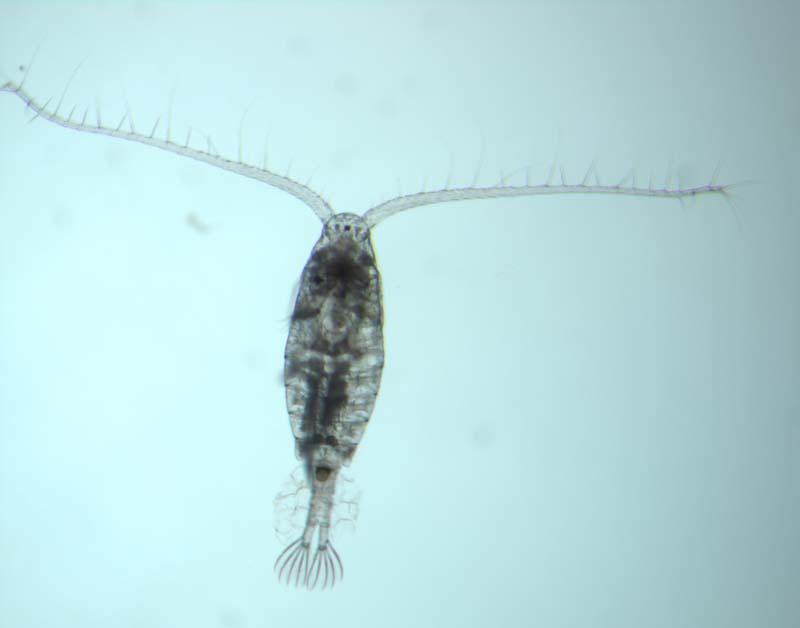
Can anyone ID these pods?

ThRoewer

Valuable Member
View Badges
Joined
Jul 16, 2016
Messages
1,251
Reaction score
1,953
Location
Fremont, CA
Rating - 0%
0   0   0
I found these pods in a fishless tank at a local store and they let my siphon some off. They continued to thrive in my refugium until I had to take it down for a move.
Their swimming pattern is quite distinct and they seem to prefer low flow zones of refugia or bottom corners of fishless tanks:


@Reef Nutrition, Chad, do you have any idea which species this could be and how to culture them in numbers? They are not actually benthic in the sense that the crawl on the substrate but they seem to like being close to a substrate or other structured they can use for shelter.
They seem to be calanoid.

 
That looks like larvae, maybe hermit crab or cleaner shrimp spawned
 
I found these pods in a fishless tank at a local store and they let my siphon some off. They continued to thrive in my refugium until I had to take it down for a move.
Their swimming pattern is quite distinct and they seem to prefer low flow zones of refugia or bottom corners of fishless tanks:


@Reef Nutrition, Chad, do you have any idea which species this could be and how to culture them in numbers? They are not actually benthic in the sense that the crawl on the substrate but they seem to like being close to a substrate or other structured they can use for shelter.
They seem to be calanoid.

Their swimming pattern and size suggests a species of shrimp from the Mysida order (opossum shrimps). They can be difficult to culture as they are highly cannibalistic.
 
Their swimming pattern and size suggests a species of shrimp from the Mysida order (opossum shrimps). They can be difficult to culture as they are highly cannibalistic.
Back then I looked at them under the microscope and they were not Mysids but were most certainly copepods and looked kind of like this:
Diaptomus GLERL 1.jpg


They had large antennae that formed a "T" outline with the body.

Next time I go to the store I need to see if I can collect a few more.
 
Back then I looked at them under the microscope and they were not Mysids but were most certainly copepods and looked kind of like this:
Diaptomus GLERL 1.jpg


They had large antennae that formed a "T" outline with the body.

Next time I go to the store I need to see if I can collect a few more.
Sounds good. A new image would be great.
 
Sounds good. A new image would be great.
What is interesting is that they have a highly geometric swimming pattern: straight lines with sharp directional turns that. In the video, it gets a little lost in the cloud of them but if you try to concentrate on one you can see it.
 
I managed to collect a few more of these at the LFS yesterday. Unfortunately, at this point, I have no way of taking a picture of them. I got to find a good USB microscope. The closest picture I could find so far was this one:

DoubleTisbe_ab38a9ec-b1b8-4cb7-95bc-ea7d4c738b34_1200x1200.jpg


They have two long antennae that somewhat point forward so that they form a "Y" with the body.
Their tail looks bifurcated with two fairly long antennae-like extensions.
They flee from light and are always found in the corner that is farthest from the light source.

@Reef Nutrition Chad, If you are interested I can give you a few to identify them properly and see if there is potential for mass culturing them.
Their size is close to Artemia nauplii which might make them an interesting alternative for raising more tricky larvae.
And since they obviously do well reef tank environment and procreate well in refugia they are an ideal refugia seed organism.
 
I managed to collect a few more of these at the LFS yesterday. Unfortunately, at this point, I have no way of taking a picture of them. I got to find a good USB microscope. The closest picture I could find so far was this one:

DoubleTisbe_ab38a9ec-b1b8-4cb7-95bc-ea7d4c738b34_1200x1200.jpg


They have two long antennae that somewhat point forward so that they form a "Y" with the body.
Their tail looks bifurcated with two fairly long antennae-like extensions.
They flee from light and are always found in the corner that is farthest from the light source.

@Reef Nutrition Chad, If you are interested I can give you a few to identify them properly and see if there is potential for mass culturing them.
Their size is close to Artemia nauplii which might make them an interesting alternative for raising more tricky larvae.
And since they obviously do well reef tank environment and procreate well in refugia they are an ideal refugia seed organism.

I would love to get a sample. Please email me so we can set up a shipment. You can use my FedEx # and ship them FedEx Ground. Cheers!
 
I would love to get a sample. Please email me so we can set up a shipment. You can use my FedEx # and ship them FedEx Ground. Cheers!
Will do as soon as things are slowing down a little on my end - just started a new job and things got a little hectic.
 
Young amphipods
 
Young amphipods
They are most definitely not Amphipod larvae. Those look different:
 
Meant copepod


1592471613380.jpeg
 

IF YOU HAD TO TAKE A REEFING EXAM, WOULD YOU PASS?

  • Yes!

    Votes: 32 45.7%
  • Not yet, but I have one that I want to buy in mind!

    Votes: 9 12.9%
  • No.

    Votes: 26 37.1%
  • Other (please explain).

    Votes: 3 4.3%

New Posts

Back
Top