The Carbon Doser is set at 1 bubble every 5 seconds which should produce 12 bubbles per minute.
Instead the bubble counter produces a little over 18 bubbles per minute as per the stopwatch.
I am following the member @jda CaRx's tuning advice, so I am adjusting the flow rate and bubble count as recommended.
My CO2 tank low pressure gauge is set @ 7.5 1bs feeding a Carbon Doser V1. The CO2 tank is completely full and has no leaks. I have purposely set the CO2 tank's pressure on the lower side in order to avoid really large bubbles. I have also installed the Carbon Doser's included back flow preventer.
Do other users experience the same level of inaccuracy. What causes this device to have such a large discrepancy?
There are a large number of pressure differentials when dealing with not only CO2 tanks but also all of the equipment in between them. Higher quality pressure regulators help but aren't the be all end all. We are asking for very low pressure that is constant against a variable pressure on the other side. Needle valves don't really help because they have no regulation mechanism. The pressure or vacuum created by the wet side also plays in all of this. Also change in tank temp and volume can cause problems too. The bubble count is VERY difficult to get right. Fortunately the CaRx is pretty forgiving, but adjustment is a nightmare.
My demand is pretty low for reef tanks. I have found that a CaRx is the best solution but that doesn't mean that it is the easiest. It has forced me to come up with a way to deal with the low demand and still be able to adjust the effluent.
Here are my understandings in no particular order.
First, using a dosing pump that is NOT connected to a manifold. Pull directly from your sump or your main display. Do not use a continous duty doser. You will not be able to get the fine adjustments that you need.
Second, get a soleniod and hook it up to a controller. Get a decent bubble count. This is tricky because you need adjust as low as you can without having a situation where the bubble count will go to zero. It isn't really important what the bubble count here is just that it is stable long term. For reference mine is about 15 bubbles per second. Then use the soleniod to turn on the soleniod for a very short period of time. The minimum for my controller is 1 second. So I turn the soleniod on for one second and get about 15 bubbles and then I don't turn on the solenoid again for 320 minutes. This allows me to fine tune my bubble count very precisely. It also averages which helps with stability.
Last, get your golden ratio. This is the ratio of bubbles to doser amount that will produce ~25dKh in your effluent without having CO2 accumulate in your CaRx.
Using my tank as an example I found that for a stable ~25dKh I need 320ml/day. I also found that the amount of off time for the bubble count that I have that will give me no CO2 accumulation is 370min. My dKH is 9.9 and I want to slowly bring it down. I decided that I would reduce my effluent by 20ml/day. Now I need to calculate what my new bubble down time will be. I derived this formula for calculating using the numbers that I have:
Base ml/day divided by new ml/day times base buble interval
Specifically for my case:
(320*370) = 118400 / New ml/day
So to go from 320ml/day to 300ml/day, I divide 118400 by 300. I get 394.66 minutes or just 395minutes.
FWIW the 20ml/day drop lowered my in tank dKH to about 9.5.
There are a large number of pressure differentials when dealing with not only CO2 tanks but also all of the equipment in between them. Higher quality pressure regulators help but aren't the be all end all. We are asking for very low pressure that is constant against a variable pressure on the other side. Needle valves don't really help because they have no regulation mechanism. The pressure or vacuum created by the wet side also plays in all of this. Also change in tank temp and volume can cause problems too. The bubble count is VERY difficult to get right. Fortunately the CaRx is pretty forgiving, but adjustment is a nightmare.
My demand is pretty low for reef tanks. I have found that a CaRx is the best solution but that doesn't mean that it is the easiest. It has forced me to come up with a way to deal with the low demand and still be able to adjust the effluent.
Here are my understandings in no particular order.
First, using a dosing pump that is NOT connected to a manifold. Pull directly from your sump or your main display. Do not use a continous duty doser. You will not be able to get the fine adjustments that you need.
Second, get a soleniod and hook it up to a controller. Get a decent bubble count. This is tricky because you need adjust as low as you can without having a situation where the bubble count will go to zero. It isn't really important what the bubble count here is just that it is stable long term. For reference mine is about 15 bubbles per second. Then use the soleniod to turn on the soleniod for a very short period of time. The minimum for my controller is 1 second. So I turn the soleniod on for one second and get about 15 bubbles and then I don't turn on the solenoid again for 320 minutes. This allows me to fine tune my bubble count very precisely. It also averages which helps with stability.
Last, get your golden ratio. This is the ratio of bubbles to doser amount that will produce ~25dKh in your effluent without having CO2 accumulate in your CaRx.
Using my tank as an example I found that for a stable ~25dKh I need 320ml/day. I also found that the amount of off time for the bubble count that I have that will give me no CO2 accumulation is 370min. My dKH is 9.9 and I want to slowly bring it down. I decided that I would reduce my effluent by 20ml/day. Now I need to calculate what my new bubble down time will be. I derived this formula for calculating using the numbers that I have:
Base ml/day divided by new ml/day times base buble interval
Specifically for my case:
(320*370) = 118400 / New ml/day
So to go from 320ml/day to 300ml/day, I divide 118400 by 300. I get 394.66 minutes or just 395minutes.
FWIW the 20ml/day drop lowered my in tank dKH to about 9.5.
You are more than gracious with your time and experience. Extremely useful information. Exactly the kind of info that I was missing. Very appreciated. I too am struggling to get to that golden ratio. The equipment I am using so far is the CarbonDoser and a Kamoer FX-STP2. I also have an Apex but currently not used with the reactor/
Can you help me determine how to achieve what you have pointed out?
Questions I have:
1. I will purchase a good quality solenoid as you suggested. Do you have a recommendation as to orifice size and ac or dc voltage? What solenoid do you use?
2. Currently my Kamoer flow is set @ 20ml/min. and my bpm is approx 15-18. I have a small water pump in my sump to add a little pressure to the water in, but I still also pull the effluent out via the Kamoer back to the sump. You mention to NOT use a continuous duty doser (like the Kamoer). What should I use instead?
3. And most of all, where should I go from here to find the correct flow/day and length of time between turning the CO2 on and how long it stays on?
Hoping I haven't burden you with too many questions,
Gratefully, Ron (Toronto, Ontario CANADA)
I will purchase a good quality solenoid as you suggested. Do you have a recommendation as to orifice size and ac or dc voltage? What solenoid do you use?
I used 1/8" port size and 12VDC for the soleniod. If you are using Apex you need to figure out what voltage(s) are available. If I recall correctly you have a 24VDC line. You can also use 120VAC (line voltage) and plug into a socket. I don't recommend using a soleniod with line voltage because the voltage conversion creates a lot of heat and that usually means a limited life for the soleniod. I could be wrong about this there is a soleniod that people use that build high end regulators. There is a thread here on R2R (you will have to search) the other thread is on Reef Central. For clarification I chose 1/8" so I could get the nice air tube adapters. Here are all of the links:
Valve stays close when the coil is de-energized, and it opens when energized. Armature Tube Material: Stainless Steel. 2PCK Series Fast Acting Plastic Electric Solenoid Valve Specification Operation Model: Direct Acting.
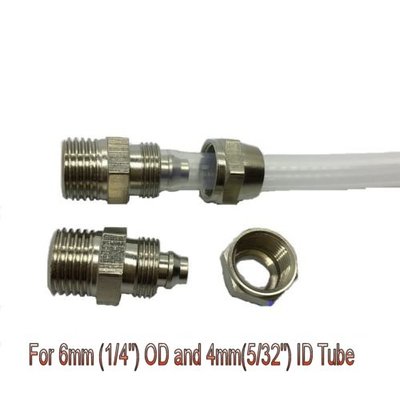
Pneumatic Gas Air Hose Quick Coupler Connector Fittings For 4mm X 6mm Plastic Tube. 1/8" NPT Male. 6 mm OD 4 mm ID Plastic Tube. Quick Tube Connector. Fitting Finish. Fitting Material.
Currently my Kamoer flow is set @ 20ml/min. and my bpm is approx 15-18. I have a small water pump in my sump to add a little pressure to the water in, but I still also pull the effluent out via the Kamoer back to the sump. You mention to NOT use a continuous duty doser (like the Kamoer). What should I use instead?
I would use a doser that doses specific amounts at specfic intervals. I just use the Kamoer cheapy. Also the dosing pump should be plenty strong enough to not have to put pressure behind the doser. Having pressure like this will make the doser inconsistent. You don't want this. My configuration is to pull from the tank and then push through the CaRx. I then calibrate the doser from the line that goes back into the tank (or in your case the sump). That way I can have a reasonable idea of what my flow is. It isn't important that you know the exact amount just that the flow is consistent. This is the doser I use. If you need more horse power the DOS might be a good option for you.
Bluetooth Controllable Dosing | Stand-Alone or With Other Kamoer X1 MicroPumps Kamoer X1 Dosing Pumps are perfect for almost any aquarium that needs liquids dosed up to 12 times per day or all the way down to one time every 30 days. The single channel dosing pump can be controlled on its own, or...
Here is what I would do. Get a glass of water and adjust your CO2 so that you have a consitent bubble rate. Do this without the soleniod on. You just want to get your pressure regulator down low and get your needle valve about half way. It isn't important what the bubble rate is just that it isn't bubbling like mad. Like I said mine is pretty high. The problem that I found is if you try to get a very low bubble count like 4 bubbles per minute then the needle valve will drift down (no clue why) and you will end up with no bubbles. One to five bubbles per second is not unreasonable, but might be a bit low. Once again it isn't important the amount just the consistency. Once you get this in a glass and you know what it is. Then you can get a rough idea of of how many bubbles per second that you get.
Now hook up your soleniod and set it up on the controller. Figure out what your lowest on off time is. My guess is it will be like 1 second maybe even up to five seconds. Once again it doesn't matter. Ok, now that you have everything set up. Set up your off time to something high like 15 minutes, so on for 1 second (or whatever) off for 15 minutes. Now it is time to cycle the soleniod. Have your controller start. Make sure you are watching the bubble count. It will turn on, bubbles will come out, it will turn off. Bubbles will still come out. Count the bubbles until they stop. This will give you a rough idea of how many bubbles per on cycle. Just remember the shorter the on cycle the tail end of the bubbles might get wiped away with the next cycle. This is just a way if you know your bubble count to roughly match it or if you have calculations to match them.
Now that you have the bubbles set up you can switch back to your doser. This is the super easy part. Just set you effluent rate to something. If you have a probe this can help to get these two to line up, but I DO NOT recommend probes for anything other than this. Also you don't need the probe it just brings some of the guess work down. If you don't have a probe just set the effluent pretty high and the bubble count low. Let this run overnight test the effluent. You are looking for ~25dKH. Keep adjusting your effluent slowly down until you get ~25dKH. If your alk starts to climb and you don't want that, then adjust you bubble count down further by adding more off time to the soleniod through the controller. Just a note don't adjust the on time leave it alone. Once you get the bubble count down then continue to bring down the effluent rate. When your alk starts to climbe keep an eye on your chamber to insure that you don't get to much CO2. You will see the bubbles starting to accumulate in the chamber. Most reactors should have a way to outgas excess CO2 if you overshoot and miss. Once you have everything right let the CaRx for a couple days then retest the effluent. Should be stable. Now you can get your golden ratio. Once you have that then you can figure out where you want your tank alk to be and start to adjust up or down depending.
One work of caution. Do NOT move the alk fast coral will die from this (ask me I know). I am currently moving mine about .3dKH per week and even this might be a little too much.
Kind of long winded, but it is really easy once you get the hang of it.
EDIT: I think that I make a video of this ... hmmm ... stay tuned.
As an eBay Associate we earn from qualifying purchases.
So I wanted to start a build thread on how to put together an Alanle style DIY dual stage regulator. Over the last couple of years, after building a couple of my own regulators, I have been helping a bunch of memebers, both here and on RC, with sourcing parts and putting together their...
Hi,
I just finished reading (and re-reading;Shamefullyembarrased) your awesome how to setup CaRx post. It is all making perfect sense now. I imagine that your CaRx setup post will help many other reefers.
I can't thank you enough for your very generous time. I am excited now to get this working!
I have looked thru the Building an Alanle style CO2 Regular link now where they recommend a Burkert 6011a stainless steel solenoid valve. Quite a bit more expensive, so I am wondering if I should spring for it or just use the one your linked to. I know that stainless would be way more inert and I am thinking that buying a premium valve might last a lot longer?
Hi,
I just finished reading (and re-reading;Shamefullyembarrased) your awesome how to setup CaRx post. It is all making perfect sense now. I imagine that your CaRx setup post will help many other reefers.
I can't thank you enough for your very generous time. I am excited now to get this working!
I have looked thru the Building an Alanle style CO2 Regular link now where they recommend a Burkert 6011a stainless steel solenoid valve. Quite a bit more expensive, so I am wondering if I should spring for it or just use the one your linked to. I know that stainless would be way more inert and I am thinking that buying a premium valve might last a lot longer?
I am always of the opinion that it is best to get used to something new on whatever you can cobble together. Spending money up front has proven for me to be wasteful. Better to understand your needs through your own experience than to try to guess what the future might hold.
I would suggest just getting things going as cheaply as possible and after some serious time then you can make better assessments as to what you should be investing in and what can be left alone. I currently have a Tunze regulator. It isn't my favorite but I don't know what I really want in a regulator so it does what I want it to do. I will probably replace it in the future, but I am still trying to get the basics on the reactors down.
There are a large number of pressure differentials when dealing with not only CO2 tanks but also all of the equipment in between them. Higher quality pressure regulators help but aren't the be all end all. We are asking for very low pressure that is constant against a variable pressure on the other side. Needle valves don't really help because they have no regulation mechanism. The pressure or vacuum created by the wet side also plays in all of this. Also change in tank temp and volume can cause problems too. The bubble count is VERY difficult to get right. Fortunately the CaRx is pretty forgiving, but adjustment is a nightmare.
My demand is pretty low for reef tanks. I have found that a CaRx is the best solution but that doesn't mean that it is the easiest. It has forced me to come up with a way to deal with the low demand and still be able to adjust the effluent.
Here are my understandings in no particular order.
First, using a dosing pump that is NOT connected to a manifold. Pull directly from your sump or your main display. Do not use a continous duty doser. You will not be able to get the fine adjustments that you need.
Second, get a soleniod and hook it up to a controller. Get a decent bubble count. This is tricky because you need adjust as low as you can without having a situation where the bubble count will go to zero. It isn't really important what the bubble count here is just that it is stable long term. For reference mine is about 15 bubbles per second. Then use the soleniod to turn on the soleniod for a very short period of time. The minimum for my controller is 1 second. So I turn the soleniod on for one second and get about 15 bubbles and then I don't turn on the solenoid again for 320 minutes. This allows me to fine tune my bubble count very precisely. It also averages which helps with stability.
Last, get your golden ratio. This is the ratio of bubbles to doser amount that will produce ~25dKh in your effluent without having CO2 accumulate in your CaRx.
Using my tank as an example I found that for a stable ~25dKh I need 320ml/day. I also found that the amount of off time for the bubble count that I have that will give me no CO2 accumulation is 370min. My dKH is 9.9 and I want to slowly bring it down. I decided that I would reduce my effluent by 20ml/day. Now I need to calculate what my new bubble down time will be. I derived this formula for calculating using the numbers that I have:
Base ml/day divided by new ml/day times base buble interval
Specifically for my case:
(320*370) = 118400 / New ml/day
So to go from 320ml/day to 300ml/day, I divide 118400 by 300. I get 394.66 minutes or just 395minutes.
FWIW the 20ml/day drop lowered my in tank dKH to about 9.5.
This is far from the typical way that calcium reactors are generally run. Do you have a reason for running yours this way other than low demand? With such low demand why did you choose to run a CaRx to begin with rather than dosing two part or kalk? Why steer someone who is new to this away from the norm?
The continous duty kamoer and the carbon doser that OP already owns are perfect for setting up a calcium reactor the typical way, so why tell them to go buy more equipment?
The Carbon Doser is set at 1 bubble every 5 seconds which should produce 12 bubbles per minute.
Instead the bubble counter produces a little over 18 bubbles per minute as per the stopwatch.
I am following the member @jda CaRx's tuning advice, so I am adjusting the flow rate and bubble count as recommended.
My CO2 tank low pressure gauge is set @ 7.5 1bs feeding a Carbon Doser V1. The CO2 tank is completely full and has no leaks. I have purposely set the CO2 tank's pressure on the lower side in order to avoid really large bubbles. I have also installed the Carbon Doser's included back flow preventer.
Do other users experience the same level of inaccuracy. What causes this device to have such a large discrepancy?
I believe the knob is just a simple potentiometer, some slight variance is to be expected but it should stay consistent over time. If it makes it easier for you, you can just ignore the numbers printed on the carbon doser and use your own manual count. For the record, the way you were initially setting it up is how it is typically done.
There are a large number of pressure differentials when dealing with not only CO2 tanks but also all of the equipment in between them. Higher quality pressure regulators help but aren't the be all end all. We are asking for very low pressure that is constant against a variable pressure on the other side. Needle valves don't really help because they have no regulation mechanism. The pressure or vacuum created by the wet side also plays in all of this. Also change in tank temp and volume can cause problems too. The bubble count is VERY difficult to get right. Fortunately the CaRx is pretty forgiving, but adjustment is a nightmare.
My demand is pretty low for reef tanks. I have found that a CaRx is the best solution but that doesn't mean that it is the easiest. It has forced me to come up with a way to deal with the low demand and still be able to adjust the effluent.
Here are my understandings in no particular order.
First, using a dosing pump that is NOT connected to a manifold. Pull directly from your sump or your main display. Do not use a continous duty doser. You will not be able to get the fine adjustments that you need.
Second, get a soleniod and hook it up to a controller. Get a decent bubble count. This is tricky because you need adjust as low as you can without having a situation where the bubble count will go to zero. It isn't really important what the bubble count here is just that it is stable long term. For reference mine is about 15 bubbles per second. Then use the soleniod to turn on the soleniod for a very short period of time. The minimum for my controller is 1 second. So I turn the soleniod on for one second and get about 15 bubbles and then I don't turn on the solenoid again for 320 minutes. This allows me to fine tune my bubble count very precisely. It also averages which helps with stability.
Last, get your golden ratio. This is the ratio of bubbles to doser amount that will produce ~25dKh in your effluent without having CO2 accumulate in your CaRx.
Using my tank as an example I found that for a stable ~25dKh I need 320ml/day. I also found that the amount of off time for the bubble count that I have that will give me no CO2 accumulation is 370min. My dKH is 9.9 and I want to slowly bring it down. I decided that I would reduce my effluent by 20ml/day. Now I need to calculate what my new bubble down time will be. I derived this formula for calculating using the numbers that I have:
Base ml/day divided by new ml/day times base buble interval
Specifically for my case:
(320*370) = 118400 / New ml/day
So to go from 320ml/day to 300ml/day, I divide 118400 by 300. I get 394.66 minutes or just 395minutes.
FWIW the 20ml/day drop lowered my in tank dKH to about 9.5.
This is far from how calcium reactors are typically run. Do you have a reason for recommending running them this way? If your Kh/Ca demand is so low why do you run a calcium reactor instead of simply dosing two part or kalk? The way OP was initially setting it up falls in line with what is typical, so why recommend they go buy more equipment when they already have all they need? With a continous duty peristaltic as well a Carbon doser, setup should be a breeze but you are making it significantly more complicated.
The Carbon Doser is set at 1 bubble every 5 seconds which should produce 12 bubbles per minute.
Instead the bubble counter produces a little over 18 bubbles per minute as per the stopwatch.
I am following the member @jda CaRx's tuning advice, so I am adjusting the flow rate and bubble count as recommended.
My CO2 tank low pressure gauge is set @ 7.5 1bs feeding a Carbon Doser V1. The CO2 tank is completely full and has no leaks. I have purposely set the CO2 tank's pressure on the lower side in order to avoid really large bubbles. I have also installed the Carbon Doser's included back flow preventer.
Do other users experience the same level of inaccuracy. What causes this device to have such a large discrepancy?
I believe the knob on the carbon doser is a simple potentiometer, and some variance is to be expected, but it should stay consistent over time. You can go by the numbers printed on the carbon doser or your manual count, but it ultimately shouldn't matter.
This is far from the typical way that calcium reactors are generally run. Do you have a reason for running yours this way other than low demand? With such low demand why did you choose to run a CaRx to begin with rather than dosing two part or kalk? Why steer someone who is new to this away from the norm?
I am running my CaRx using the same methods that higher demand reefers run theirs. I am confused as to why you think that I am doing something outside the norm. To your question my demand is enough that kalk won't keep up and two part has a whole set of serious problems as to be worthless to me. I don't know if you have actually used two part but the cost of equipment is not free nor is it cheap. I don't want the pain of the two part nor the other issues associated with it, so I do what many do I use a CaRx.
The continous duty kamoer and the carbon doser that OP already owns are perfect for setting up a calcium reactor the typical way, so why tell them to go buy more equipment?
You never determined the load of the tank of the OP. Neither did I. I simply provided first why CaRx's are hard to tune, and then I provided what I do to tune mine. Continous dosing pumps do not work in every situation and I pointed this out. I related my experience and my solutions. I did not tell the OP to buy new equipment, and where you got this from I don't know. I think the OP is an intelligent human being that can make up his/her own mind about what they should or shouldn't do with their tank.
Why you inserted yourself into this conversation seems off. You have provided no information that might be of help to the OP and have simply scolded me.
I used 1/8" port size and 12VDC for the soleniod. If you are using Apex you need to figure out what voltage(s) are available. If I recall correctly you have a 24VDC line. You can also use 120VAC (line voltage) and plug into a socket. I don't recommend using a soleniod with line voltage because the voltage conversion creates a lot of heat and that usually means a limited life for the soleniod. I could be wrong about this there is a soleniod that people use that build high end regulators. There is a thread here on R2R (you will have to search) the other thread is on Reef Central. For clarification I chose 1/8" so I could get the nice air tube adapters. Here are all of the links:
Valve stays close when the coil is de-energized, and it opens when energized. Armature Tube Material: Stainless Steel. 2PCK Series Fast Acting Plastic Electric Solenoid Valve Specification Operation Model: Direct Acting.
Pneumatic Gas Air Hose Quick Coupler Connector Fittings For 4mm X 6mm Plastic Tube. 1/8" NPT Male. 6 mm OD 4 mm ID Plastic Tube. Quick Tube Connector. Fitting Finish. Fitting Material.
How to build a CO2 regulator for your calcium reactor. Lighting, Filtration & Other Equipment
reefcentral.com
I would use a doser that doses specific amounts at specfic intervals. I just use the Kamoer cheapy. Also the dosing pump should be plenty strong enough to not have to put pressure behind the doser. Having pressure like this will make the doser inconsistent. You don't want this. My configuration is to pull from the tank and then push through the CaRx. I then calibrate the doser from the line that goes back into the tank (or in your case the sump). That way I can have a reasonable idea of what my flow is. It isn't important that you know the exact amount just that the flow is consistent. This is the doser I use. If you need more horse power the DOS might be a good option for you.
Bluetooth Controllable Dosing | Stand-Alone or With Other Kamoer X1 MicroPumps Kamoer X1 Dosing Pumps are perfect for almost any aquarium that needs liquids dosed up to 12 times per day or all the way down to one time every 30 days. The single channel dosing pump can be controlled on its own, or...
www.bulkreefsupply.com
Here is what I would do. Get a glass of water and adjust your CO2 so that you have a consitent bubble rate. Do this without the soleniod on. You just want to get your pressure regulator down low and get your needle valve about half way. It isn't important what the bubble rate is just that it isn't bubbling like mad. Like I said mine is pretty high. The problem that I found is if you try to get a very low bubble count like 4 bubbles per minute then the needle valve will drift down (no clue why) and you will end up with no bubbles. One to five bubbles per second is not unreasonable, but might be a bit low. Once again it isn't important the amount just the consistency. Once you get this in a glass and you know what it is. Then you can get a rough idea of of how many bubbles per second that you get.
Now hook up your soleniod and set it up on the controller. Figure out what your lowest on off time is. My guess is it will be like 1 second maybe even up to five seconds. Once again it doesn't matter. Ok, now that you have everything set up. Set up your off time to something high like 15 minutes, so on for 1 second (or whatever) off for 15 minutes. Now it is time to cycle the soleniod. Have your controller start. Make sure you are watching the bubble count. It will turn on, bubbles will come out, it will turn off. Bubbles will still come out. Count the bubbles until they stop. This will give you a rough idea of how many bubbles per on cycle. Just remember the shorter the on cycle the tail end of the bubbles might get wiped away with the next cycle. This is just a way if you know your bubble count to roughly match it or if you have calculations to match them.
Now that you have the bubbles set up you can switch back to your doser. This is the super easy part. Just set you effluent rate to something. If you have a probe this can help to get these two to line up, but I DO NOT recommend probes for anything other than this. Also you don't need the probe it just brings some of the guess work down. If you don't have a probe just set the effluent pretty high and the bubble count low.
Hi,
It's been a month since we spoke last. I hope you don't mind some further questions. I finally just getting around to try your above method. I am currently not using a pH probe. I have set the bubbles to turn ON for 1 second and then OFF for 15 minutes. This gives me approximately 5 very large bubbles in one second and then shuts off and repeats every 15 minutes. This part works great.
When starting, I do understand that I need to keep testing the effluent until I reach 25 dkh. One point of confusion when I start, concerning the FLOW, you say above that I should "set the effluent pretty high". But you also have advised "not to use a continuous flow pump". Does the effluent flow from the reactor to the sump run continuously (24 hours per day) or just a set ON & OFF times throughout the day?
Let this run overnight test the effluent. You are looking for ~25dKH. Keep adjusting your effluent slowly down until you get ~25dKH. If your alk starts to climb and you don't want that, then adjust you bubble count down further by adding more off time to the soleniod through the controller. Just a note don't adjust the on time leave it alone. Once you get the bubble count down then continue to bring down the effluent rate. When your alk starts to climbe keep an eye on your chamber to insure that you don't get to much CO2. You will see the bubbles starting to accumulate in the chamber. Most reactors should have a way to outgas excess CO2 if you overshoot and miss. Once you have everything right let the CaRx for a couple days then retest the effluent. Should be stable. Now you can get your golden ratio. Once you have that then you can figure out where you want your tank alk to be and start to adjust up or down depending.
One work of caution. Do NOT move the alk fast coral will die from this (ask me I know). I am currently moving mine about .3dKH per week and even this might be a little too much.
Kind of long winded, but it is really easy once you get the hang of it.
EDIT: I think that I make a video of this ... hmmm ... stay tuned.
One point of confusion when I start, concerning the FLOW, you say above that I should "set the effluent pretty high". But you also have advised "not to use a continuous flow pump". Does the effluent flow from the reactor to the sump run continuously (24 hours per day) or just a set ON & OFF times throughout the day?
To clarify. The reason that I suggest not using a continous flow pump is because of the amount of water that it will move throughout the day. The Komaer pump that I was using will do at a minimum 0.1 ml/min. There are 1440 minutes per day. That means that at the very minimum you will be dosing 144 ml/day. This could be good but I fount that at the low flow that this represents, two things happen. First you get clogging and second the pump drifts pretty badly because of this clogging. I had my Komoer set at .3ml/min and I was experiencing this pretty badly. I was constantly flushing the input line to clear it. The CaRx is pretty forgiving, but the swings seemed pretty excessive. If you can solve those issues or don't have those issues then by all means use a continous duty pump.
A continous duty pump like the Kamoer FX-STP, or Versa will run constantly. This is very desirable for stablity, but it does come with downsides. If find that the on off cycles of a non-continous duty pump to be better in this situation because the faster flow is more likely to keep the lines clear and is more like to hold a stable flow over time. The dosing pump that I am using currently only allows 12 settings per day, so I use all of the settings trying to best spread out the dosing. I would prefer 24 settings but the pump is cheap and I am not really interested in buying a new one.
Hope this will help you more.
EDIT: I forgot about this thing also. A change on my Kamoer from .1 ml/min to .2 ml/min raises my effluent rate from 144 ml/day to 288 ml/day. This lack of granularity was an issue when I was trying to dial in the golden ratio.
Im not sure why so many people make running a carx seem difficult.
I run no ph probe or controller.
I set my bubble count, which never varies unless I adjust it.
I set my effluent in ml per minute by drip rate, no pump.
I have a solenoid valve but its always open. I only turn it off when filling the reactor or changing co2 bottles.
I run my regulator at 20psi to achieve a steady bubble count. Lower psi and the bubble count varies on my system.
Its just so simple doing it this way.
To clarify. The reason that I suggest not using a continous flow pump is because of the amount of water that it will move throughout the day. The Komaer pump that I was using will do at a minimum 0.1 ml/min. There are 1440 minutes per day. That means that at the very minimum you will be dosing 144 ml/day. This could be good but I fount that at the low flow that this represents, two things happen. First you get clogging and second the pump drifts pretty badly because of this clogging. I had my Komoer set at .3ml/min and I was experiencing this pretty badly. I was constantly flushing the input line to clear it. The CaRx is pretty forgiving, but the swings seemed pretty excessive. If you can solve those issues or don't have those issues then by all means use a continous duty pump.
A continous duty pump like the Kamoer FX-STP, or Versa will run constantly. This is very desirable for stablity, but it does come with downsides. If find that the on off cycles of a non-continous duty pump to be better in this situation because the faster flow is more likely to keep the lines clear and is more like to hold a stable flow over time. The dosing pump that I am using currently only allows 12 settings per day, so I use all of the settings trying to best spread out the dosing. I would prefer 24 settings but the pump is cheap and I am not really interested in buying a new one.
Hope this will help you more.
EDIT: I forgot about this thing also. A change on my Kamoer from .1 ml/min to .2 ml/min raises my effluent rate from 144 ml/day to 288 ml/day. This lack of granularity was an issue when I was trying to dial in the golden ratio.
Thanks, this clarification. This makes understanding your method clearer now. So to summarize, it's fine to run your pump continuously as long as your effluent flow stays reasonably constant over time. In my case, I believe that my needed flow will be much higher, more in the range of 10-30ml/min so I would likely have daily flows remaining constant over time. In the event that you need to run very low daily flows, like you do, then constant flow stability becomes an issue. Hence you split up the usual continuous 24 hour flow into say 12 ON/OFF periods but with each ON period, running through the line a lot faster but still equaling the same flow as when you were to run the flow continuously 24hrs per day. Hope I have stated this correctly.
Im not sure why so many people make running a carx seem difficult.
I run no ph probe or controller.
I set my bubble count, which never varies unless I adjust it.
I set my effluent in ml per minute by drip rate, no pump.
I have a solenoid valve but its always open. I only turn it off when filling the reactor or changing co2 bottles.
I run my regulator at 20psi to achieve a steady bubble count. Lower psi and the bubble count varies on my system.
Its just so simple doing it this way.
It's true - nothing is difficult once you have the benefit of experience. But gaining this experience still takes time.
Btw, what CO2 equipment allows your bubble count to never vary? In my case, my bubbles per minutes hold for no more than 2 days before it unexpectedly rises or falls. One day it holds at 17 bpm and then the next day if falls to 14 bpm or another day it rises to 22 bpm. Hence constant adjusting
It's true - nothing is difficult once you have the benefit of experience. But gaining this experience still takes time.
Btw, what CO2 equipment allows your bubble count to never vary? In my case, my bubbles per minutes hold for no more than 2 days before it unexpectedly rises or falls. One day it holds at 17 bpm and then the next day if falls to 14 bpm or another day it rises to 22 bpm. Hence constant adjusting
Also remember that if you are averaging over 15 minutes then the variations become much smaller.
@90's reefer reefer makes a good point about using a two stage regulator. This IMO is the way to go. For me I haven't gone that way because I am not ready to do the research and pony up the money.
I was looking for a second stage regulator to replace the needle valve, because needle valves suck. I just didn't know that you could get a regulator for the low pressure because I wasn't seeing it in my research.
Im not sure why so many people make running a carx seem difficult.
I run no ph probe or controller.
I set my bubble count, which never varies unless I adjust it.
I set my effluent in ml per minute by drip rate, no pump.
I have a solenoid valve but its always open. I only turn it off when filling the reactor or changing co2 bottles.
I run my regulator at 20psi to achieve a steady bubble count. Lower psi and the bubble count varies on my system.
Its just so simple doing it this way.
Well thats pretty simple. With a quality 2 stage regulator you can adjust bubble count to whatever you want.
You could use a peristaltic pump for effluent, I have a masterflex, but dont use it. I still use a screw type, Tunze model, to control effluent. My system also does not use a feed pump. The intake to my recirc pump is adjusted with the screw valve. This is what Tunze reactors do, I started with one, and it works well although a peristaltic pump would give consistant values over this method. I just have not needed it yet.