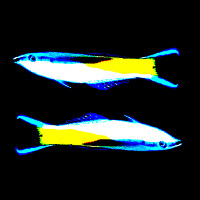
Cleaner Wrasse Colour Variation

Paddy CP

New Member
View Badges
Joined
Jun 20, 2023
Messages
2
Reaction score
0
Location
Bristol, UK
Rating - 0%
0   0   0
I'm wondering if anyone knows if it is possible to get hold of bluestreak cleaner wrasse in the UK that have a yellow top to their head, like many do in Indonesia (see images)

I've only ever seen plain blue/black/white ones here in the UK, but would love to get my hands on some with a yellow cap if possible!
Any ideas of suppliers/individuals with them would be super appreciated :)

Yellow heads:
yellow cleaner 2.png

yellow cleaner.png


Plain:
plain cleaner.jpg
 
Labroides phthirophagus is a species found only in Hawaii, and as such, is still under collection ban. I wouldn't expect to see a golden cleaner wrasse any time soon.
 
I'm wondering if anyone knows if it is possible to get hold of bluestreak cleaner wrasse in the UK that have a yellow top to their head, like many do in Indonesia (see images)

I've only ever seen plain blue/black/white ones here in the UK, but would love to get my hands on some with a yellow cap if possible!
Any ideas of suppliers/individuals with them would be super appreciated :)

Yellow heads:
yellow cleaner 2.png

yellow cleaner.png


Plain:
plain cleaner.jpg

I had always assumed that the color variation on these was size related. This species is not dimorphic, so it isn't male/female related. I checked though, and Joe Rowlett wrote an article a few years ago that discusses some differences in coloration in this widespread species:


From a husbandry standpoint, I always acquire cleaner wrasse coming from the West Pacific (Kenya for example) or Australia. These are MUCH hardier than ones from Indonesia or the Philippines. This is probably due to better handling/collection techniques there, but it is so well known that some importers have begun calling all cleaner wrasse "African" in order to have better sales.


Jay
 
I had always assumed that the color variation on these was size related. This species is not dimorphic, so it isn't male/female related. I checked though, and Joe Rowlett wrote an article a few years ago that discusses some differences in coloration in this widespread species:


From a husbandry standpoint, I always acquire cleaner wrasse coming from the West Pacific (Kenya for example) or Australia. These are MUCH hardier than ones from Indonesia or the Philippines. This is probably due to better handling/collection techniques there, but it is so well known that some importers have begun calling all cleaner wrasse "African" in order to have better sales.


Jay
Thanks Jay, that's super interesting - and great article!

Do you have any recommendations of suppliers who might be able to source some of these more diverse individuals by any chance? It'd be great to know what might be possible.

Thanks :)
 
Thanks Jay, that's super interesting - and great article!

Do you have any recommendations of suppliers who might be able to source some of these more diverse individuals by any chance? It'd be great to know what might be possible.

Thanks :)
Biota has tanked raised some at times, but I don’t know if the supply to the UK. Kenya Tropicals sells a lot of fish to Europe and the UK, but I don’t know who might distribute for them - Amblard Trading perhaps.
Jay
 

IF YOU HAD TO TAKE A REEFING EXAM, WOULD YOU PASS?

  • Yes!

    Votes: 32 45.7%
  • Not yet, but I have one that I want to buy in mind!

    Votes: 9 12.9%
  • No.

    Votes: 26 37.1%
  • Other (please explain).

    Votes: 3 4.3%
Back
Top