Is ok to pull your live rock everynow and then and clean it in a bucket of tank water? Ive got some hair algae id like to scrub off. Will have any negative effects on anything?
You’ll want to leave all your rock in your tank.
Constantly taking it out and cleaning them will throw off your tank. I would find the source of the algae and then handle it from there

You’ll want to leave all your rock in your tank.
Constantly taking it out and cleaning them will throw off your tank. I would find the source of the algae and then handle it from there
You’ll want to leave all your rock in your tank.
Constantly taking it out and cleaning them will throw off your tank. I would find the source of the algae and then handle it from there
would also like to hear what damage this would do. Taking you live rock out of the display and scrubbing it in tank water is a great way to get your pest algae problem under control.
Is ok to pull your live rock everynow and then and clean it in a bucket of tank water? Ive got some hair algae id like to scrub off. Will have any negative effects on anything?

Probably depends on how much old crap your gonna disturb from your sand bed. I notice you’ve got a few large softies also, they may be damaged if you’re a bit clumsy. The flow and light on the rocks will change on the rocks, but that effect will be minimal, unless you locate them back in the tank in totally different locations, orientation. Are you talking taking everything out, or just a few hairy rocks? Are your urchins being lazy, and do you have any snails? Happy new year.
do a search of member @brandon429 sand washing and rock scrubbing thread. He's documented actual tanks where the sand has been rinsed and rocks pulled scrubbed and rinsed in fresh rodi water. even surgically scraping rocks and using H2O2 on most difficult algae. Sufficient beneficial bacteria will survive and repopulate to balance very quickly.
after my first 5 years of struggling with algae, cyano and dinos, my rockscape is now set up so I can pull any rock to scrub it as needed and it looks and coral and fish are doing better than any time in my experience. A lot of happiness due to stumbling on Brandon (and others) sharing their first hand experience with sand washing and rock scrubbing.
Tank filled and was almost cloudless :D Turned on the klir roller and added a filter sock and it was clear in 2 hours. Made a makeshift frag rack as I cannot bring all rock back. Scrubbed each frag plug with a stainless steel brush or remounted depending how bad the plug was. Grabbed a couple...
www.reef2reef.com
that thread itself is roughly forty pages or so I didn’t count, purely a rock removal and cleaning thread for the unlucky who required that to be algae controlled myself included. My old pico reef years ago was getting perfect input water had perfect params and still needed guiding to become solid coralline, now it needs zero guiding and is on cruise control until it dies from external factors like power outage etc, or an errant nerf ball. Manual control fixed it since I couldn’t stumble upon the lucky balance to cure it. Had tried all manner of clean up crew, perfect ro di make water, your standard efforts didn’t work but hand guiding sure did.
from those pages we can see if guiding is harmful or not, people will post angry updates if that action harmed their reef.
and on page one of that forty pager is sub linked five other threads ranging sixty pages on average, we have two hundred or so readable pages for hand guiding.
don’t permit a tank takeover, period. Don’t let an investment falter just because the lucky arrangement on white rocks couldn’t be found in the first year. If your lawn is prone to weeds and dandelions don’t be the neighbor that sits back and lets it fill up to become the eyesore of the hood, get out there with a butter knife and force compliance until that fescue fills in so thick you don’t have to.
if there was a fix to algae that didn’t require hand guidance three things would happen:
1. Everyone would be using that method and algae challenges would stop permanently.
2. that method would have a readable link we could see
3. and of methods that for sure beat algae and do have links, such as vibrant or fluconazole or grazer threads it’d be working for every single entrant, they don’t. click one, or post it here. They’re full of trade off invasions: I killed my gha but why do I have dinos now or complete cyano takeover?
when perusing algae control posts watch for the pattern: a focus on someone’s tank who won, who found the hands off way and the proof ends there. Any viable method should be featured oppositely: doesn’t focus on the authors tank but instead is made up of solely other people’s fixes, that’s how you know if you’re onto something.
in our hand work study thread above, anyone got a tradeoff invasion or do they post clean hard work tanks
Is ok to pull your live rock everynow and then and clean it in a bucket of tank water? Ive got some hair algae id like to scrub off. Will have any negative effects on anything?
In my experince this is a very useful technique helping reduce algae during the maturing process that usually takes months as the various microbiomes beneficial for corals grow and establish dominace over microbiomes beneficial for algae. As microbiomes fluctuate over months, years and decades it is also a technique I'll periodicly use to some extent on some systems as equilibriums shift. If you aren't aware of ROhwer's book and video you may find them helpful to understand how microbial processes may favor corals or favor algae. Here's links to both and to some other research you may find helpful:
"Coral Reefs in the Microbial Seas" This video compliments Rohwer's book of the same title (Paper back is ~$20, Kindle is ~$10), both deal with the conflicting roles of the different types of DOC in reef ecosystems. While there is overlap bewteen his book and the video both have information not covered by the other and together give a broader view of the complex relationships found in reef ecosystems
Changing Seas - Mysterious Microbes
Nitrogen cycling in hte coral holobiont
BActeria and Sponges
Maintenance of Coral Reef Health (refferences at the end)
I pull out the rocks one or two at a time at least once per year and scrub them down (fowlrs) but did the same with reefs.. I don't even use tank water to be honest. I do also scrub them as necessary in the tank for minor algae cleanup but I avoid allowing it to get out of hand. I agree controlling the source of algae is key. I feed big ol puffers and other meat eaters well. Big and often water changes, vacuuming substrate and keeping filter socks clean makes a huge difference.
So did I understand this correctly in the first video "Coral Reefs in the Microbial” at about 28 minutes the study concluded if we add filter feeders and clams to our reef tanks they will remove pathogens?
I take my rocks in my 40g and 20g out all the time to scrub. When I get overrun with algae or am trying to get under control, it can be necessary. I take it out, pull algae, scrub with toothbrush or metal brush, rinse and put back. I usually do a huge water change too. Sometimes almost 100%. Never had issues except corals open and are much happier withing hours.
Part of our problem at home aquaria is not having the natural predators of algae in our tanks. We cannot as some are just too big. So, we have to balance this another way. We can manually handle it with scrubs, we can use chemicals, we can use scrubbers, etc. It takes time to balance.
Keep an eye on feeding, water source, filtration methods.
Ok thanks for the replies guys! Seems most are in agreement that its ok to pull and scrub rock. I didnt pull every rock when I did it, just like 3 on top that had hair algae on them. I didnt wanna risk pulling it off in the tank, and have it spread around. So I used a little h202 and a toothbrush and bucket of tank water. Just to keep things under control. I dont want the algae to get an upper hand. Alot of my cleanup crew seems a bit lazy, so I wanted to help out.
Probably depends on how much old crap your gonna disturb from your sand bed. I notice you’ve got a few large softies also, they may be damaged if you’re a bit clumsy. The flow and light on the rocks will change on the rocks, but that effect will be minimal, unless you locate them back in the tank in totally different locations, orientation. Are you talking taking everything out, or just a few hairy rocks? Are your urchins being lazy, and do you have any snails? Happy new year.

Short term solution maybe but will it work forever? I guess that depends on you. The solutions to pest algae are herbivores and time... Coral cover is the greatest barrier and so long as there are herbivores and no corallivores it's a matter of entropy. Will you still be pulling rocks out to scrub them frequently in a year? 5? more? I don't think I have the dedication to white rocks that it would take to do that consistently forever. By scrubbing or bathing your rocks in chemicals to kill everything you are just resetting the maturing process. It's a tradeoff I guess.
So did I understand this correctly in the first video "Coral Reefs in the Microbial” at about 28 minutes the study concluded if we add filter feeders and clams to our reef tanks they will remove pathogens?
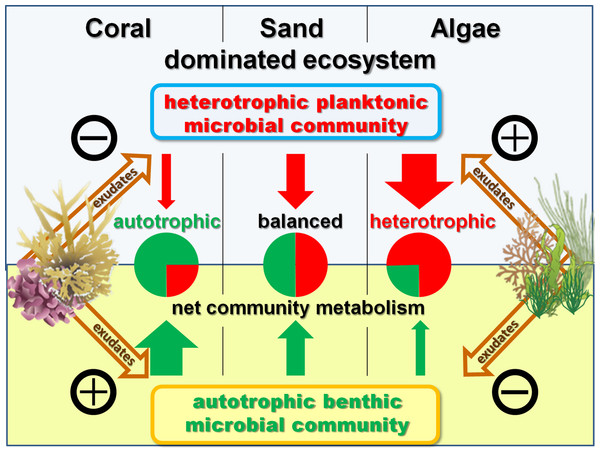
Yup. You can use Scholar.google to tack down the study. What's can only be inderectly inferred by the stuff presented by Rohwer (his book has almost 100 refferences) is the role of sponges. Here's some more links on DOC and sponges if you're interested into digging into the subjects more.
Indirect effects of algae on coral: algae‐mediated, microbe‐induced coral mortality
Benthic primary producers in tropical reef ecosystems can alter biogeochemical cycling and microbial processes in the surrounding seawater. In order to quantify these influences, we measured rates of photosynthesis, respiration, and dissolved organic carbon (DOC) exudate release by the dominant...
peerj.com
Role of elevated organic carbon levels and microbial activity in coral mortality
Effects of Coral Reef Benthic Primary Producers on Dissolved Organic Carbon and Microbial Activity
Algae releases significantly more DOC into the water than coral.
Benthic primary producers in marine ecosystems may significantly alter biogeochemical cycling and microbial processes in their surrounding environment. To examine these interactions, we studied dissolved organic matter release by dominant benthic taxa and subsequent microbial remineralization in...
journals.plos.org
Pathologies and mortality rates caused by organic carbon and nutrient stressors in three Caribbean coral species.
Starch and sugars (doc) caused coral death but not high nitrates, phosphates or ammonium.
Planar optodes were used to visualize oxygen distribution patterns associated with a coral reef associated green algae (Chaetomorpha sp.) and a hermatypic coral (Favia sp.) separately, as standalone organisms, and placed in close proximity mimicking coral-algal interactions. Oxygen patterns were...
peerj.com
Biological oxygen demand optode analysis of coral reef-associated microbial communities exposed to algal exudates
Exposure to exudates derived from turf algae stimulated higher oxygen drawdown by the coral-associated bacteria.
Algae-derived dissolved organic matter has been hypothesized to induce mortality of reef building corals. One proposed killing mechanism is a zone of hypoxia created by rapidly growing microbes. To investigate this hypothesis, biological oxygen ...
www.ncbi.nlm.nih.gov
Microbial ecology: Algae feed a shift on coral reefs
Human pressures on coral reefs are giving macroalgae a competitive advantage over reef-building corals. These algae support larger, and potentially pathogenic, microbial populations that are metabolically primed for less-efficient, yet faster, carbohydrate remineralization, perpetuating a...
www.nature.com
Coral and macroalgal exudates vary in neutral sugar composition and differentially enrich reef bacterioplankton lineages.
Increasing algal cover on tropical reefs worldwide may be maintained through feedbacks whereby algae outcompete coral by altering microbial activity. We hypothesized that algae and coral release compositionally distinct exudates that differentially alter bacterioplankton growth and community...
www.ncbi.nlm.nih.gov
Sugar enrichment provides evidence for a role of nitrogen fixation in coral bleaching
Elevated ammonium delays the impairment of the coral-dinoflagellate symbiosis during labile carbon pollution
(here's an argument for maintaining heavy fish loads if you're carbon dosing)
Labile dissolved organic carbon (DOC) is a major pollutant in coastal marine environments affected by anthropogenic impacts, and may significantly con…
www.sciencedirect.com
Excess labile carbon promotes the expression of virulence factors in coral reef bacterioplankton
Coastal pollution and algal cover are increasing on many coral reefs, resulting in higher dissolved organic carbon (DOC) concentrations. High DOC concentrations strongly affect microbial activity in reef waters and select for copiotrophic, often potentially virulent microbial populations. High...
www.nature.com
Unseen players shape benthic competition on coral reefs.
Recent work has shown that hydrophilic and hydrophobic organic matter (OM) from algae disrupts the function of the coral holobiont and promotes the invasion of opportunistic pathogens, leading to coral morbidity and mortality. Here we refer to these dynamics as the (3)DAM [dissolved organic...
www.ncbi.nlm.nih.gov
Macroalgae decrease growth and alter microbial community structure of the reef-building coral, Porites astreoides.
With the continued and unprecedented decline of coral reefs worldwide, evaluating the factors that contribute to coral demise is of critical importance. As coral cover declines, macroalgae are becoming more common on tropical reefs. Interactions between these macroalgae and corals may alter the...
www.ncbi.nlm.nih.gov
Macroalgal extracts induce bacterial assemblage shifts and sublethal tissue stress in Caribbean corals.
Benthic macroalgae can be abundant on present-day coral reefs, especially where rates of herbivory are low and/or dissolved nutrients are high. This study investigated the impact of macroalgal extracts on both coral-associated bacterial assemblages and sublethal stress response of corals. Crude...
www.ncbi.nlm.nih.gov
Biophysical and physiological processes causing oxygen loss from coral reefs.
Analysis of 60 sites in three ocean basins suggests that overgrowth of fleshy algae on coral reefs supports higher microbial abundances dominated by copiotrophic, potentially pathogenic bacteria via the provision of dissolved inorganic carbon.
www.nature.com
Coral Reef Microorganisms in a Changing Climate, Fig 3
Because sponges are essential players in the carbon, nitrogen and phosphorus cycle(s) on reefs here's some links to research done with them.
Element cycling on tropical coral reefs.
This is Jasper de Geoij's ground breaking research on reef sponges. (The introduction is in Dutch but the content is in English.)
Marine sponges are ubiquitous colonizers of shallow, clear-water environments in the oceans (1, 2). Sponges have emerged as significant mediators of biogeochemical fluxes in coastal zones by virtue of respiring organic matter and facilitating both the consumption and release of nutrients (3, 4)...
www.pnas.org
Phosphorus sequestration in the form of polyphosphate by microbial symbionts in marine sponges
Coral reefs are highly productive ecosystems that raise a conundrum called “Darwin’s paradox”: How can high production flourish in low-nutrient conditions? We show here that in three abundant Caribbean sponges, the granules that have been commonly observed in sponge tissue for decades are...
www.pnas.org
Differential recycling of coral and algal dissolved organic matter via the sponge loop.
Sponges treat DOC from algae differently than DOC from corals
Surviving in a Marine Desert The Sponge Loop Retains Resources Within Coral Reefs
Dissolved organic carbon and nitrogen are quickly processed by sponges and released back into the reef food web in hours as carbon and nitrogen rich detritus.
PDF | On Jun 23, 2015, Jasper M de Goeij and others published 2013 deGoeij Science Sponge loop | Find, read and cite all the research you need on ResearchGate
www.researchgate.net
Natural Diet of Coral-Excavating Sponges Consists Mainly of Dissolved Organic Carbon (DOC)