I agree with above. First, better PE probably for increased gas exchange from the higher initial photosynthesis levels. Then, depending on the light and amout, they corals could start to thrive under the higher light (polyps go back to normal) or if they are suffering bleach with retraction.
With acros, you can see burnt tips and burnt corallites. Unfortunately, damage is done when this happens.
I see corals brown in conjunction with high light and also high building blocks (N & P). High light with low N and P can produce very bright and vivid colors with lots of contrast in stonies.
For long term high light keys, you should see more growth and more skyward growth if the coral is happier with the increased light - your typical patterns that you see in the ocean or in large colonies. Some acros can grow downward to avoid bad light - this is not a good sign. Some people say that more encrustation and less branches is a sign of not enough light, but I have not experienced this (some corals just encrust a lot).
The rest of my opinions depend on light source. It seems like high spikes of blue at, or below 450 are not all that dangerous and you can have nearly as much as you want. If you want higher light above 450nm, then you need a proportional amount of waves coming from 450 to 850 to help with the Emerson Effect. In most MH or T5, this is done automatically and you can just add more light slowly without any real concerns. For LED, unless you built your own unit, this is not possible, so you have to really keep these peaks down since there is not the red and far-red to balance them and not much chance at Emmerson Effect. The Iwasaki 6500k is one of the highest growth, color and output sources around and it has massive amounts of all of the spectrum (chart below), only without a blue peak... so the blue peak is not as necessary for growth as the rest of the spectrum... but is sure makes stuff look nicer to most eyes.
You can look at the chart of your light source and see what to expect. Look to the right of 450. It seems that you need to have a slow downward curve towards 800-850nm (yes, IR matters) if you want high light. These are two totally different lights that can both blast coral with more than 1000 PAR and the coral will thrive once acclimated. See how both have a good downward amount of waves above 450 and even have a good amount of IR. These lights will allow coral to thrive with massive amounts of light where that same quantity will kill coral from other sources.
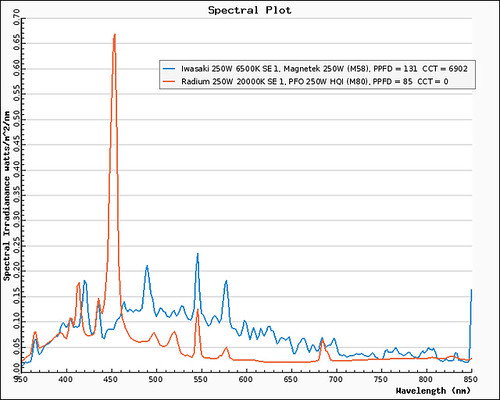
The bottom line is that without red and IR, I would keep the light down or go really slowly. If you have a true chart of your lights (not from a manufacturer), then you can probably tell if you can really crank them, or not.
























