Coral response to high lighting

  • Thread starter Thread starter Brew12
  • Start date Start date
  • Tagged users None
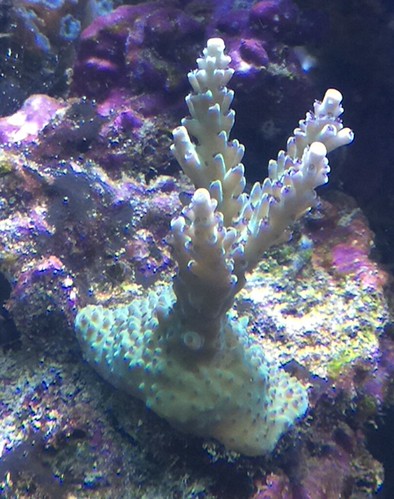
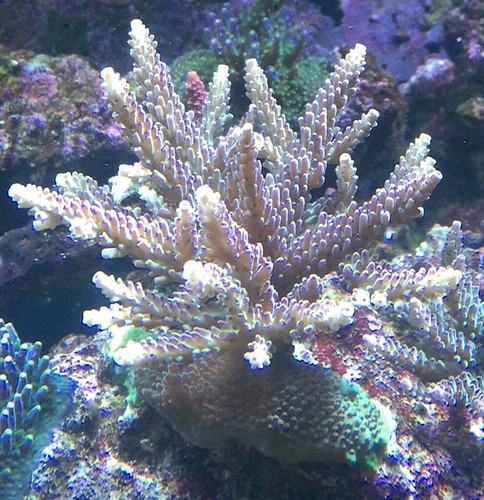
Here's two frags from the same mother colony. The first one has been in PAR 165 and the other one in 550. They live in the same water system. Fun to see how much different light conditions can do :)
No big difference in grown I think(haven't measured).
Snapseed.jpeg
Snapseed.jpeg
Fascinating!

Do you think the polyp extension is related to PAR or are they in substantially different flow, also?
 
I ramp up my reef breeders at 100% output for several hours a day which are literally like 2 inches off the water and have never acclimated my acros to my light. I put them where I want them and they've never shown negative signs of too much light so it probably all depends on the system. I have high nutrients so I would bet that's a big contributing factor
 
Just so you know Red and greens do have a impact on par.
Maybe Dana can talk more about spectrum.
chloro.png
 
This is one of the things behind my question. I run my lighting very "white" and it seems like all my non-red acro's tend to green on the sides that get the most light. Was wondering if there was a correlation.


I was not asking about PAR since, as you point out, that is spectrum related. Since I do run my reds and greens very high, which has little impact on PAR, I was wondering if there are visual cues to look for.
Interestingly , I first noticed it with blue led that was supplementing my metal halides at the time.
It was always on the side closest to the led.

I have two acros that green in a heart beat , and yes, I fragged em into pieces all over my tank lol.

The ones on the sand are yellow with pinks , on the rocks green as a frog skin.
 
Fascinating!

Do you think the polyp extension is related to PAR or are they in substantially different flow, also?

We have two orange spotted Filefish(eat Acropora polyps) in the tank where the bright frags is. And I found AEFW(flatworms) on the frag next to it. So in this case I don't think it's possible to compare the polyp extension :)
 
My only caution is that we probably don't know what colors and waves that corals actually use. Just a few short years ago, UV, IR, red and green were all not needed by coral, and now all are back in fashion. I am not saying that any of this is right, or wrong, and I do not want to start a debate where people post links to studies... I only wanted to mention that nobody probably really knows for 100%.

Here are two frags of RR The Vinh. They were both about 3/4 inch in June or July mounted at the same time, as frags from the same colony in my other tank. One is at 350 PAR and one is at 550 PAR. The smaller one under 350 PAR is what most people expect for growth about a 2.25 inch "mini-colony" with three sizable branches that could all be fragged and sold...not bad for 9 months and most people would be happy with this. The one under 550 PAR is about 4x5" and actual mini colony - this is the kind of growth that the old-school guys with high intensity, high quality lighting expect in nine months. These are in the same tank with good flow, NSW water parameters and otherwise the same conditions... one is under a light near the top and the other is about 18 inches deep. In another nine months, the 350 PAR will probably be the size of the other one and the 500 PAR colony will be 8x10 inches, or so... the continue to grow exponentially larger with more energy, not linear. As always, my apologies for iPhone photos...the colors are horrible, so just focus on the size.

I have some Garf Bonsai like this too... one at 500 PAR and one at about 375 and the 500 is double the size.
 
My only caution is that we probably don't know what colors and waves that corals actually use. Just a few short years ago, UV, IR, red and green were all not needed by coral, and now all are back in fashion. I am not saying that any of this is right, or wrong, and I do not want to start a debate where people post links to studies... I only wanted to mention that nobody probably really knows for 100%.

Here are two frags of RR The Vinh. They were both about 3/4 inch in June or July mounted at the same time, as frags from the same colony in my other tank. One is at 350 PAR and one is at 550 PAR. The smaller one under 350 PAR is what most people expect for growth about a 2.25 inch "mini-colony" with three sizable branches that could all be fragged and sold...not bad for 9 months and most people would be happy with this. The one under 550 PAR is about 4x5" and actual mini colony - this is the kind of growth that the old-school guys with high intensity, high quality lighting expect in nine months. These are in the same tank with good flow, NSW water parameters and otherwise the same conditions... one is under a light near the top and the other is about 18 inches deep. In another nine months, the 350 PAR will probably be the size of the other one and the 500 PAR colony will be 8x10 inches, or so... the continue to grow exponentially larger with more energy, not linear. As always, my apologies for iPhone photos...the colors are horrible, so just focus on the size.


I have some Garf Bonsai like this too... one at 500 PAR and one at about 375 and the 500 is double the size.

Same light?
 
I short , if your at an lfs drooling on a coral, no. IMO

Color temp, kinda, 20k (and all others) can be mixed a number of ways.

I’m my Ricordia observation , I kinda think there was either a spike in a specific band , or not enough of another , IMO, most likely red. As that was in fashion when those lights were made.
I had two, one directly on the sand , so par overdose IMO , but the shaded one also greened but much less.
Many others in the tank were completely unaffected.


Fwiw, par is higher relative to intensity on a 56k bulb vs a 20k in general as the 56 has a higher amount of other colors corals don’t use , but plants do. Y&O.
Because Par meters aren’t just for coral.

Yes, don’t they rank farm land by par. So my understanding is there are different specs of zooxanthellae that prefer certain wave lengths or light, and the color we see is them blocking other waves? Going to have to think on your post, thanks!
 
Here's two frags from the same mother colony. The first one has been in PAR 165 and the other one in 550. They live in the same water system. Fun to see how much different light conditions can do :)
No big difference in grown I think(haven't measured).

NICE!!! Which one do you prefer?
 
Yes, don’t they rank farm land by par. So my understanding is there are different specs of zooxanthellae that prefer certain wave lengths or light, and the color we see is them blocking other waves? Going to have to think on your post, thanks!
They rank agricultural crops by temperature and light and put them IMO zones, sprung also suggested this for coral btw , particularly in indoor farming and greenhouses for ornamental plants. Most greenhouses I’ve been to use a lux or footcandle meter at the lux par is set and not too variable.

And yes your correct. Slightly different spectrums are being sorted. But mostly it’s in intensity.
It’s counter to most thought that acros need high light , the coral I mentioned and the red dragon are deeper water , so need less par. Similar to many other coral species.

With the caveat, it’s par needs is more likely in the blues (pur what the coral finds useful), as there is little to no red at depth.
It becomes speculative at best for us hobbiests to figure this pur out as few of us own a Pam fluorometer.

Not perfect , but it’s why I have on my phone.
9F32E7C0-7398-4C66-9DE1-3C05126FBEF4.jpeg


And Jedi Master Ben.
https://www.reef2reef.com/threads/lighting-spectra-photosynthesis-and-you.100170/#post-1108955
 
I ran my radions Gen4 on 100% for a few weeks and was disappointed, I blame sanjay for false advertisment;Facepalm
How long was your ramp/acclimation.
What was the result , burn it green it or just horror ?
 
How long was your ramp/acclimation.
What was the result , burn it green it or just horror ?

I starved out most of my monti, stylos, porciliporas until they bleached out. Alot of corals on the sand and bottom did ok. Im sure other frags died from nutrient and lack of bio diversity issues but having high bio load and dosing aminos probably helped me out. I did not really acclimate but had the lights ramp up to 100% and drop down to 50% 6 times throughout the day.
 
Just my recent experience , I had a 90 gallon that I ran 4 Bulb 54 watt T5 fixture and a supplemental LED , I upgraded to a 200 gallon and an ATI 8 bulb 80 watt fixture running double the same bulbs on my 90 because I like a little more white in my tank also, my 90 had 1 blue plus , 1 Coral plus , 1 Agua blue special , and 1 purple plus, loved the color in my 90. So I just doubled those bulbs on my 200 , now I also run very low nutrients close too 0. Within the first week all of my SPS except my Green Slimmer and my Rainbow Milli where completely white and bleached. I removed 4 of the bulbs and running 2 blue plus , purple plus , and 1 coral plus , and three weeks later all color is back in all corals , I will be adding two more bulbs back too the fixture in another couple FO weeks. It is a slow acclimation for some corals some love it. But remember most color spectrum in the ocean other than Blue disappears at around 15 feet , more blue and I really like more white but it can be balanced, it just takes moving bulbs around and finding what you like and what the corals like. Sorry for the long winded post but I just went thru this.
 
Yes, don’t they rank farm land by par. So my understanding is there are different specs of zooxanthellae that prefer certain wave lengths or light, and the color we see is them blocking other waves? Going to have to think on your post, thanks!

This is true some of the pigments/proteins are to block certain wave lengths or change them to usable spectrum..

Red has been tested to inhibit growth in corals so a coral may use pigments to block them just like UV.
 
This is true some of the pigments/proteins are to block certain wave lengths or change them to usable spectrum..

Red has been tested to inhibit growth in corals so a coral may use pigments to block them just like UV.
Red in high doses was the experiment.
But yep.
 
I have not seen a LED yet that can put out as much PAR as the sunlight, even in the USA - the amount of sunlight at the equator is much greater.

Just an FYI.. 15.4 degrees North of the equator.. Surface "PAR"... Not 3,6,20ft under water..

6a00e553d5d110883301b8d23c5513970c-pi


Lets take this light.. 1500 PAR at the surface..If one takes in to account DLI (daily light integral) you might see that yes, LED and any light can exceed sunlight..
PAR only exceeds 1500 for say 5 hours....
711OWkmAOYL._SL500_.jpg

Just something to think about..

Oh Hawaii.. 2" below the water..
image_full

https://www.advancedaquarist.com/2013/9/aafeature
 
Last edited:
I assume —par per Foot depth?

So are we trying for wavelengths the coral does not use to induce color? Is it possible to grow under a full spectrum bulb for fastest growth, and then color up with specific wavelength before sale?
 

IF YOU HAD TO TAKE A REEFING EXAM, WOULD YOU PASS?

  • Yes!

    Votes: 32 45.7%
  • Not yet, but I have one that I want to buy in mind!

    Votes: 9 12.9%
  • No.

    Votes: 26 37.1%
  • Other (please explain).

    Votes: 3 4.3%

New Posts

Back
Top














