

Cycling a tank with (not for) SPS corals?

pseudorand

Well-Known Member
View Badges
Joined
Oct 29, 2019
Messages
641
Reaction score
439
What state or country do you live in
Colorado
Rating - 0%
0   0   0
First, let me say that I did not intend to cycle a tank with SPS corals in it. I set up my QT tank, added a few media bags that have been in the sump of my DT to the QT HOB filter and bought my frags, assuming the media bags would sufficiently cycle the QT tank.

A bit less than a week in I did my first water test on the QT tank: 0.25 Ammonia, 0.25 Nitrite, 0 Nitrate. dang. :(

I added another media bag from my DT sump and I've been doing 40% water changes every other day to keep it under control. This morning, about 36 hours since my last water change, ammonia is not exactly zero but not at 0.25 (the first notch on my API test kit). Same for nitrites. Nitrates are still 0 (though I may test with my Nyos kit too, just to be sure).

All the corals are generally looking good, except for this Bird's Nest:
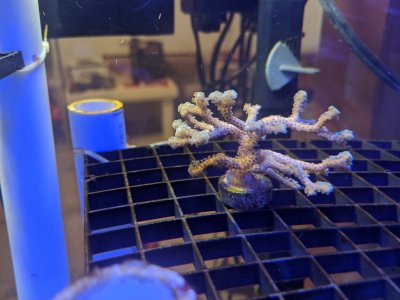
Bird's Nest Sick.jpg
The first week, all the polyps were coming out every day. Now only the ones at the tip are coming out.

Additionally, I got 10 hermits, 6 astrea snails and an emerald crab to QT at the same time because I'm trying to stock my DT without having something in QT for a year. I've had 5 of the 6 astrea snails die, but I suspect they may have starved, as I didn't think astreas were that sensitive to water quality. They did seem to ignore the algae discs I tried to feed them, and there's no other algae in the tank yet. I also had to turn them right-side-up constantly, and I don't think I kept up with it enough.

As for the water quality, the tank was up with the media bags for about 24 hours before I added all the livestock. I fed algae disks and crab pellets the second day and spot fed some of the corals brine shrimp. That, and/or the dead astreas are the likely source of the ammonia/nitrites.

Now to my questions:
  • Is there anything else I can do to try to save the bird's nest?
  • Is there any way to distinguish between non-zero ammonia/nitrite vs. other potential issues (light, flow, feeding, etc.) in terms of what's ailing the bird's nest?
  • My guess is that most of the bacteria in the media bags died before I got the livestock/food in the tank and then I over-fed (at least w.r.t. what the remaining bacteria could handle). Any other thoughts in what I did wrong?
  • How the heck do you QT astrea snails? Do you have to have a tank with substrate and rocks so they don't end up on their backs all the time?

Here's the rest of the tank:
Frag QT setup.jpg
  • 1 bird's nest
  • 1 montipora
  • 1 duncan
  • 1 candy cane
  • 1 kenya tree leather
  • 2 favias
  • 2 zoas
  • 1 emerald crab
  • 5-9 very small red/blue leg hermits
  • 1 astrea snail
  • Some cheato and pom pom from my DT fuge.

Bird's Nest Sick.jpg Frag QT setup.jpg
 
If I understand correctly what you were doing...attempting to cycle a coral QT with media bags from your DT?

If so, maybe some observations:

1. API test kits almost always show 0.25 ammonia even when cycled.
2. The media bags should have helped a lot with the cycling...but you can always add some BioSpira to help colonize the nitrifying bacteria. The bacteria need somewhere to attach and colonize. You might do better adding a few pieces of small live rock into the tank since you are also running bare-bottom.
3. If you weren't "feeding" the tank, there wasn't anything for the bacteria to break down into ammonia-->nitrite-->nitrates. This is probably the reason for no nitrates showing up in the system now. Feed the tank some more and you should see a nitrate spike occuring.
4. If you are always flipping over the astraea snails, then they were sick and dying. They can't flip themselves over, but they are pretty darn good and not getting themselves flipped over in the first place...unless sick. I have quite a few astraea snails and they are great...I quarantine them for around 30 days feeding them sheets of seaweed attached to a small piece of liverock.
5. The bacteria in the media bags won't die out and go away. They might reduce in amount, or even hibernate, possibly. But they won't go away. Add some food to the system and they will begin to multiply greatly...just give them a good place to live (ie: piece of live rock, sand, etc...).
 
1. API test kits almost always show 0.25 ammonia even when cycled.
API has its problems, but I've never found falsely registering ammonia as one of them. I was going to post QT vs DT water tests to demonstrate, but it looks like (thankfully) the "cycle" in my QT has run its course. In the picture below, DT is on the left and QT is on the right. Both seem to clearly match 0 ppm to my eye.

QT vs DT ammonia.jpg


As of this evening, nitrites also read 0 and nitrates look like they're between 0 and 5 ppm in the QT. (DT is slightly darker at ~5 ppm, as expected and desired).

2. The media bags should have helped a lot with the cycling...but you can always add some BioSpira to help colonize the nitrifying bacteria. The bacteria need somewhere to attach and colonize. You might do better adding a few pieces of small live rock into the tank since you are also running bare-bottom.

The media bags in the HOB are full of carbon and ceramic, both new before I dumped them in my DT sump 1.5 months ago. The HOB also has one of those wheel thingies. I have a hard time believing LR would get more flow * surface area than that.

I still think I had ammonia and nitrite for a bit while the bacteria and bioload matched up. If so, is there anything I should do for my bird's nest other than wait and see?

Assuming I just read my tests wrong and there was no NH4/NO2 problems, what's with my bird's nest? Or more specifically, is there a way to distinguish between light, flow, feeding or other problems so I know what to change to try to save it?
 
API has its problems, but I've never found falsely registering ammonia as one of them. I was going to post QT vs DT water tests to demonstrate, but it looks like (thankfully) the "cycle" in my QT has run its course. In the picture below, DT is on the left and QT is on the right. Both seem to clearly match 0 ppm to my eye.

QT vs DT ammonia.jpg


As of this evening, nitrites also read 0 and nitrates look like they're between 0 and 5 ppm in the QT. (DT is slightly darker at ~5 ppm, as expected and desired).


The media bags in the HOB are full of carbon and ceramic, both new before I dumped them in my DT sump 1.5 months ago. The HOB also has one of those wheel thingies. I have a hard time believing LR would get more flow * surface area than that.

I still think I had ammonia and nitrite for a bit while the bacteria and bioload matched up. If so, is there anything I should do for my bird's nest other than wait and see?

Assuming I just read my tests wrong and there was no NH4/NO2 problems, what's with my bird's nest? Or more specifically, is there a way to distinguish between light, flow, feeding or other problems so I know what to change to try to save it?

There are so many factors that can be effecting the Bird's nest coral. The best thing probably is to change one at a time and see if you can see a change in the coral's reaction. Light and flow are usually pretty big factors...but so can the amount of NO3/PH4 in the system as well.
 
There are so many factors that can be effecting the Bird's nest coral. The best thing probably is to change one at a time and see if you can see a change in the coral's reaction. Light and flow are usually pretty big factors...but so can the amount of NO3/PH4 in the system as well.
Anyone with experience have a plan for that?

For example:
- now that I think I've dealt with the cycling issue, how long do I wait to see if it recovers before changing something else?
- If I change light or flow, how long do I leave those changes in place?
- If the polyps near the center that aren't coming out did die, will new ever grow back?
- How much more sensitive are bird's nest than my montipora, Duncan and zoa's? Since those look healthy, should I assume the birds nest has light/flow issues, or would the bird's nest be affected by water quality when the other frags are not?
 
Anyone with experience have a plan for that?

For example:
- now that I think I've dealt with the cycling issue, how long do I wait to see if it recovers before changing something else?
- If I change light or flow, how long do I leave those changes in place?
- If the polyps near the center that aren't coming out did die, will new ever grow back?
- How much more sensitive are bird's nest than my montipora, Duncan and zoa's? Since those look healthy, should I assume the birds nest has light/flow issues, or would the bird's nest be affected by water quality when the other frags are not?

I don't have a birds nest coral, so I'm not a good one to give specific parameters for this coral. But if you find online that they like medium par and high flow, then maybe put in a place like this in the tank for a week or two and see how it reacts.

But what i recall of these corals is that they like high flow but some like intense lighting and others more subdued lighting. So maybe try high flow, medium par... then, attempt to keep the high flow and move up the lighting if it doesn't like the first trial run of lights.

You might find that the corals adapt easily to different par levels and flow, but it's the nutrient levels that make them unhappy.

Maybe some Birds nest people will chime in and give you a little more advice on placement!
 
Good news! The polyps on my bird's nest are showing their faces... tentacles again.

MVIMG_20200823_092217.jpg


After my last post, only a few of the green polyps at the tips were coming out. I moved it to a lower shelf based on a BRS sick corals video that said too much light kills quickly while not enough takes weeks. But the next day not a single polyp came out and I thought I'd lost it. So I moved it back to the top shelf and now, a few days later, most of the polyps are coming out, including the ones in the center that I haven't seen for over a week.

I guess patience is the key in this hobby ("Duh!", say all the experienced reefers in unison).
 

IF YOU HAD TO TAKE A REEFING EXAM, WOULD YOU PASS?

  • Yes!

    Votes: 32 45.7%
  • Not yet, but I have one that I want to buy in mind!

    Votes: 9 12.9%
  • No.

    Votes: 26 37.1%
  • Other (please explain).

    Votes: 3 4.3%
Back
Top









