DIY Alkalinity Monitor

Yes I believe this is exactly how it operates. However in my scenario the faulty reading would result in the 0.2 dKH being added and then 0.2 dKH 2 hours later, and another 0.2 dKH 2 hours after that, etc. Until the tank was either way out of my chosen band, or the blockage had cleared and the true reading could be ascertained and the socket disabled. In my case the blockage cleared after 2 or 3 re-tests, but if it had not, and I was far far away on vacation, then the outcome would have been different. The alkatronic relies only on the dosing pump's accuracy for the sample volume. Another means of cross checking the sample volume would help to avoid a similar occurrence in any proposed version we come up with.

Dennis

I wonder what the odds are of having 5 or 10 inaccurate tests - but I see the desire to have a cross check. It will be interesting how it's decided to rectify if the two systems (cross checking) have discrepancies and how to deal with any potential differences in accuracy and precision inherent in the 2 methodologies.

 
I wonder what the odds are of having 5 or 10 inaccurate tests - but I see the desire to have a cross check. It will be interesting how it's decided to rectify if the two systems (cross checking) have discrepancies and how to deal with any potential differences in accuracy and precision inherent in the 2 methodologies.

For the most part, the inaccurate readings where an automatic re-test is performed are not that common. When I had my big drop, there where a few black dots on my graph indicating that a re-test had been performed. This probably indicates that the issue was potentially happening intermittently in a partial fashion before it became severe and repeatable enough for the alkatronic to believe it was a legit reading and dose against it. For the most part, the re-tests are very rare, though coincidentally I got one last night at my 9 PM test. The test completed at 21:39 which tells me it did 3 tests (each test takes about 15 minutes). The test result that (eventually) appeared in the graph was 0.03 lower than the test from 6 hours before and right where I expected it to be.

When looking to see what could be interfering with the sample size, I noticed that the clear silicon tube appears to have some green algae growing on the inside surface. I think I will replace that tube with an opaque one to prevent algae growing and possible affecting the flow rate. I am not sure if this could be the cause, but its presence is not desirable in any case.

My vision of the cross check was to use a level sensor that worked more like a float switch (but not be an actual float switch). Perhaps a set of titanium probes that can sense continuity.

Dennis
 
Lol. I noticed today that there was a mysterious Raspberry Pi that was logged on to one of my access points. At first I figured it was one of my own RPI boards that I had left plugged in somewhere and forgot about. I saw that SSH was open so I tried to log into the board to help figure out where this device was. None of the default passwords, or any of my common ones, worked. I started wondering of this mysterious device might not be located at a neighbour's house?! I went back and looked at my dashboard and noticed it had been connected for 45 days and had sent more data than it had received (45MB/648MB). Then it dawned on me what it was. It's the RPI located in the Alkatronic. Crisis averted.

Dennis
 
Any updates here?

This has been on my mind again recently, and I'm digging through my design files and other ideas I had in this space. The principle is all the same really, just needs some implementation :)

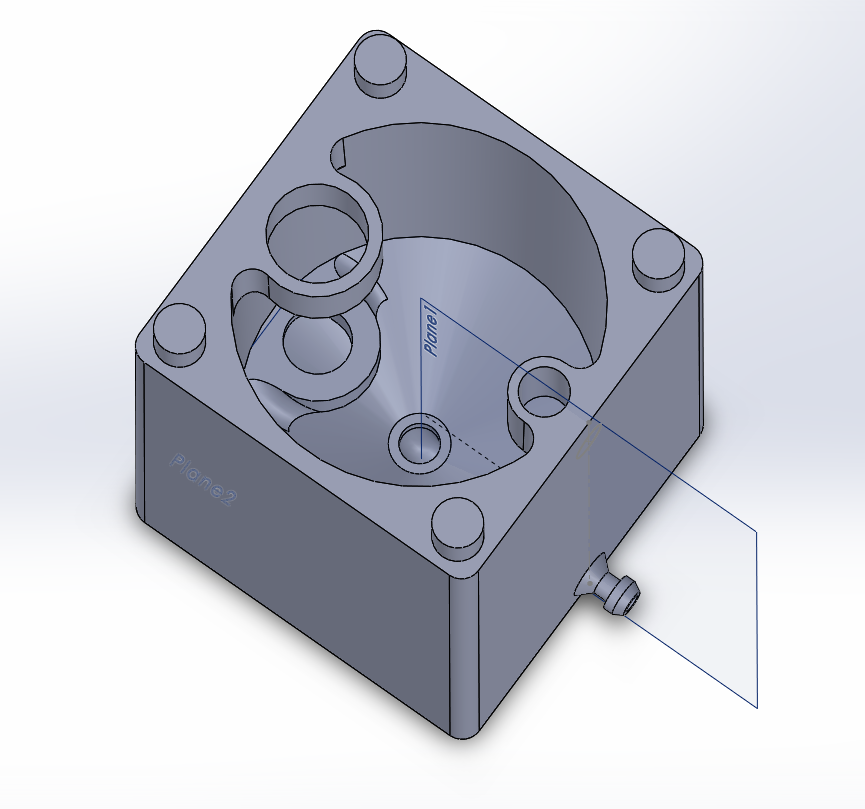
Here is the titration chamber I knocked up a long while ago to be 3d-pinted. It has a spot to hold a pH probe, and an integrated drain. I never solved the agitation problem (maybe we just shake the whole assembly?).

chamber_1.png


I was planning on using a 1.0 or 0.1N standard HCl acid solution as the titration medium (removes a number of unknowns to use an off the shelf acid, plus you can buy it in gallons).

In retrospect, the titration chamber is likely far bigger than it needs to be, but having more liquid allows us to overcome errors in dispensing, cleaning, and other concerns. I also had no housing in mind when I made that chamber, but will look for something suitable.

Maybe shake the whole assembly with something like a cell phone ringer?
 
Interesting project!

When using a pH probe keep in mind you only need the reversal point around ph ~4.5 as your endpoint, so no real calibration necessary. Also the "waste" is only sodium chloride in slightly acidified seawater, if you dont do many tests a day Uor have a super-nano tank) it should be absolutely safe to pump back the sample from the titration chamber into the sump. - so no "waste" generated.

Best,
Christoph
Thats a very useful information, thank you for sharing
 
Lol. I noticed today that there was a mysterious Raspberry Pi that was logged on to one of my access points. At first I figured it was one of my own RPI boards that I had left plugged in somewhere and forgot about. I saw that SSH was open so I tried to log into the board to help figure out where this device was. None of the default passwords, or any of my common ones, worked. I started wondering of this mysterious device might not be located at a neighbour's house?! I went back and looked at my dashboard and noticed it had been connected for 45 days and had sent more data than it had received (45MB/648MB). Then it dawned on me what it was. It's the RPI located in the Alkatronic. Crisis averted.

Dennis
I didnt know alkatronic uses rpi. Impressive.
 
I didnt know alkatronic uses rpi. Impressive.

I am pretty sure the alkatronic uses a bunch of Atlas Scientific gear. I expect they use a Tentacle T3 and the drain pump and alk dosing pump are off the shelf Atlas Scientific pumps.

Dennis
 
I've been thinkering about this one myself.

I like the reefbot tester unit, and have looked into making one myself.

It actually uses electric sliders with step motors (even more precise than peristaltic pump) to suck up and deliver reagents in a siringe with fine needle, kinda like a diy 3d printer. You can have multiple tests in 1 bot.
A fixed cup is rinsed with rodi and filled with tankwater, not sure if counting drops is needed as the fine needle output provides a precise scale already. an electric stirrer (ez diy) is in the cup to help rinse and mix reagents.
A colorimeter (lots of diy stuff out there for grabbing) is then used to define when the needed color is reached and calculations are made on position of electric slider/siringe value.

only specific tests can be used in the bot to do the tritations, as some of them need some powder to be added instead of fluids.

following :)
 
Thank you to @cgaubuchon for making this thread. I've doing a similar matter after considering Apex, GHL and Reefbot with something like Reef Pi. I really liked the Apex solution and I felt they have the clear business strategy required to make both a successful product and ecosystem. I didn't like their term of "IoTa" as I found it distasteful. Vendor specific API is never a good thing and with the focus on everyone having something smart, the need for anyone to have proper integrations and automations is the future. Anyone should be able to leverage those, not just Neptune Systems. There is also the case of Mindstream and the ends of such. Too many of these have the risk for getting locked into a SaaS model, even if it doesn't exist today.

With Reef Pi and perhaps with the Reefbot, it's solid offering. @Ranjib did everyone solid with Golang and ReactJS. There's certainly a following here on that topic so I needn't say more. Reefbot was cool and I have found a means to replicate that, the unfortunate part is the commercial reagents required are a challenge for COTS procurement and the Reefbot can't leverage any of those. The more accurate solutions require reagents, typically powder - which it's outside the business and technical requirements of the project. I also have reservations on the viability of that business entity. Instead, unless some library or unplanned event occur - I'm considering Azure for development. I want it to be as plug and play to the smaller nano community whom has already had digital transformation.

All I can say to everyone whom contributed here, thank you!!!
 
Any updates here?

This has been on my mind again recently, and I'm digging through my design files and other ideas I had in this space. The principle is all the same really, just needs some implementation :)

Here is the titration chamber I knocked up a long while ago to be 3d-pinted. It has a spot to hold a pH probe, and an integrated drain. I never solved the agitation problem (maybe we just shake the whole assembly?).

chamber_1.png


I was planning on using a 1.0 or 0.1N standard HCl acid solution as the titration medium (removes a number of unknowns to use an off the shelf acid, plus you can buy it in gallons).

In retrospect, the titration chamber is likely far bigger than it needs to be, but having more liquid allows us to overcome errors in dispensing, cleaning, and other concerns. I also had no housing in mind when I made that chamber, but will look for something suitable.

I too am doing CAD design on similar. Please feel free to reach out if interested.
 

IF YOU HAD TO TAKE A REEFING EXAM, WOULD YOU PASS?

  • Yes!

    Votes: 32 45.7%
  • Not yet, but I have one that I want to buy in mind!

    Votes: 9 12.9%
  • No.

    Votes: 26 37.1%
  • Other (please explain).

    Votes: 3 4.3%
Back
Top