


More information as promised
I started out with an available 18x12x12 acrylic tank. (made from ¼ inch acrylic)
I then drilled the drain holes in an 18x12 acrylic plate (filter plate), the holes were drilled over an area that left a clearance of about 1.5 inches from the long sides. I also ground a little from the long sides to allow placement in the tank.
Two holes drilled in the tank, one intake (1 inch) and one outflow (1 1/2 inch). I did not drill an overflow, but the design is such that if the filter paper is fully clogged, the water will rise and flow over the filter plate into the return section.
I installed three 1/2 inch PVC pipes as guides. at the locations marked on the tank over rounded 1/2 inch acrylic rods. (I used a square rod with edges ground. A round acrylic rod is better). This is to allow the filter paper to more easily roll around the guides.
I glued two 1/2 inch square rods on the inside long sides of the tank, on this was placed the drilled acrylic plate (I wanted it to be removable to clean the bottom of the tank). The drilled plate was angled in a way that it can slide out completely, and when installed rests on the rods and makes a tight fit at the bottom below one of the guides.


It allows easy placement and removal of the plate that makes installing the filter paper easy and allows cleaning of the tank.


I fashioned the top as a rectangular box, 6x12x18, this holds the filter paper both fresh and dirty, removable to allow the filter plate to be removed/installed (The paper will need to be cut for this). The cover will be any flat material (plastic/acrylic).

To allow easy placement of the filter paper, I cut a half inch piece from a 2 inch acrylic cylinder, then made 2 halves, each half was glued to hold the 1 1/4 inch PVC pipe that has the clean filter paper.

The powered end that holds the dirty paper was done differently. I wanted to be able to load and unload easily, one end was done similar to the clean filter side, but the power end has a hole (1 1/4 inch) through which the motor shaft passes, to allow unloading without unscrewing, I fashioned an aluminum adapter with one end 1 1/4 inch wide and the other ground down to fit into a coupler. The coupler then joins this to the shaft of the motor ( a 5 rpm 12v DC gearmotor). I glued a 1 inch piece of PVC inside the PVC that holds the filter paper to provide better surface for the aluminum adapter to rotate the pipe, this was cut to fit the adapter.
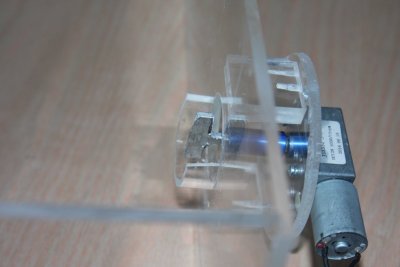
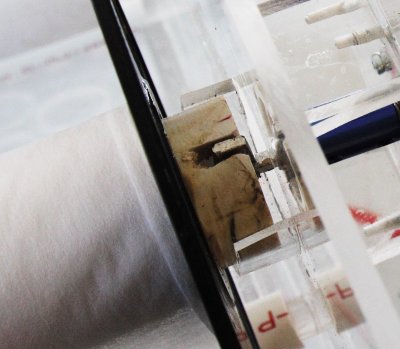
To load/unload, the motor will be rotated so that the adapter is vertical, you simply lift up the spool. I obtained some 6 inch diameter plastic spools from ebay, and mounted them on the prepared dirty filter PVC pipe.
For the operation, a float switch was placed on the inside.
If you have a controller such as Apex simply wire the float switch to your controller and you can program one outlet to turn on when the switch closes, the gear motor is then plugged to this outlet.
A second option that I have also tested (preferred) is to get a relay (I tested the Functional Devices RIBL1CDC) and simply connect both the float switch to the input and the gear motor to the output of the relay. You can power both circuits with one 12v DC power source.
Option 3 is either manually advancing the paper as needed or using a timer. The overflow design makes this safe but the affordable cost of the relay and float switch suggests that there is no reason not to automate it
This was designed to be served by a pump, with placement anywhere. I found out that the intake requires a valve to adjust the flow, a bigger outflow will allow more flow through the filter.
































