DIY led light for school project

NewbieReefer11

Active Member
View Badges
Joined
Feb 22, 2018
Messages
200
Reaction score
146
Rating - 0%
0   0   0
Hi everyone.
I am planning a diy light for my school project this term it will be mounted on my my new tank and am not sure what design would be best (clusters, spread out, ECT).
I would love to here your opinion and advice.

I live in Australia so if anyone knows the best place to purchase the components that would be great.

So far I plan on the light being adjustable and relatively cheap.

Thanks in advance.
20181218_161041.jpeg
 
IMHO single leds spread out in as big an array as you can make works better than pucks or tight clusters. The array will help reduce shadows which are a much bigger problem with leds that are in tight groups like a puck. And I'd only do a variety of blues, maybe a few violet, possibly a few UV and a variety of whites. I wouldn't waste my time with red or greens, you'll get enough of that from the whites. I'd also do twice as many blues as white. Everybody with leds seems to run their 50/50 blue /white fixtures at 2 or 3 time the intensity on the blue as the white. Personally, I run mine at 90% blue and 40% white and then added a second all blue fixture that I run at 100%. Dimming is absolutely required these days. Sunrise & sunset are strictly for your own personal enjoyment, the tank inhabitants couldn't care less! That said, I love having sunrise and sunset ability with my fixture.

Good luck and keep us in the loop.
 
Hi everyone.
I am planning a diy light for my school project this term it will be mounted on my my new tank and am not sure what design would be best (clusters, spread out, ECT).
I would love to here your opinion and advice.

I live in Australia so if anyone knows the best place to purchase the components that would be great.

So far I plan on the light being adjustable and relatively cheap.

Thanks in advance.

20181218_161041.jpeg

Counter point to @Ron Reefman - tight clusters remove (or at least minimize) color banding and shadowing. Yes, a flat diffuse emitter (e.g., a T5) is best for consistency, but with LEDs I'd recommend some level of mixing if you're going to run a widely spread array of LEDs. I used to run a spread single LED setup, before moving to tightly packed LEDs, and much prefer the latter. The rest of the industry has moved to point emitters like this, or if they're using larger panels use diffusers (Philips).
 
+1 to @theatrus as I feel the same way after building a whole pile of fixtures over the years. I find clusters will have sufficient spread and offer much better color mixing than spread out emitters. It also lets you use some of the higher output LEDs that are available more easily without "throttling down" so hard. Use a diffuser if you need, and this can be as simple as plexiglas/acrylic that has been sanded with fine sandpaper if you are unable to source the stuff made specifically for the purpose. My solution would be several clusters of tightly packed LEDs and a simple diffuser about 3~5" from the LEDs.

Some of the Cree-based Radion puck clones that you see from Alixpress, eBay, etc might be a good option for you here too. Price is right, and lets you focus on the build with less to worry about.

I'm not sure how availability is on things in Australia otherwise, but most of the usual US based suppliers will ship to you if you can handle the increased shipping cost.


Do you have a controller in mind, or are you building your own? An affordable and rather versatile one is this one-
https://www.ultimatereef.net/threads/simple-multichannel-up-to-16-led-controller.784531/

I run four tanks off of mine :)
 
My LEDs are semi-DIY, as they are modified black box lights. My LEDs are spread apart, and I have a diffuser hanging below the LEDs about 4". This both blends the color spectrum, and prevents shadowing. I think pucks, or spread out LEDs can work great if they are properly diffused.

I run my tank very blue right now, 100% blue power, and only 3% whites. I find it helps with undesirable algae growth, and also makes the coral pop. I used to run more whites, which gives a more natural look, but decided to switch to almost all blue after much research. I personally am liking the very blue look.
 
Not sure on your "diode availability" but as for cheap control-ability..
Modified tc-420 and Meanwell LDD drivers are bout as cheap as you can get..barring building your own drivers..
https://www.tc420.net/connecting-high-power-LEDs-to-the-TC420.php

Tc420's should be fairly easily found down under..
tc-421's are wireless (android app)..
https://www.amazon.com/BSOD-Controller-Wireless-Programmable-Multi-functions/dp/B07F3WBMLB

Out of the box they are for constant voltage arrays (i.e strip lights) but easily converted to do 5V PWM dimming..

OK just checked evil bay AU..
https://www.ebay.com.au/itm/45W-450...711831?hash=item41d386f6d7:g:r30AAOSwEEBZ~vGS

many like these,and about the only "big" rb quality chip though there probably are plenty of cheap ones available..


https://www.ebay.com.au/itm/30W-Cre...614770?hash=item2599a67c32:g:xnQAAOSwU9xURiCF

depends on your "direction" or how DIY you want to go..
 
As an Amazon Associate we earn from qualifying purchases.
Not sure on your "diode availability" but as for cheap control-ability..
Modified tc-420 and Meanwell LDD drivers are bout as cheap as you can get..barring building your own drivers..
https://www.tc420.net/connecting-high-power-LEDs-to-the-TC420.php

Tc420's should be fairly easily found down under..
tc-421's are wireless (android app)..
https://www.amazon.com/BSOD-Controller-Wireless-Programmable-Multi-functions/dp/B07F3WBMLB

Out of the box they are for constant voltage arrays (i.e strip lights) but easily converted to do 5V PWM dimming..

OK just checked evil bay AU..
https://www.ebay.com.au/itm/45W-450...711831?hash=item41d386f6d7:g:r30AAOSwEEBZ~vGS

many like these,and about the only "big" rb quality chip though there probably are plenty of cheap ones available..


https://www.ebay.com.au/itm/30W-Cre...614770?hash=item2599a67c32:g:xnQAAOSwU9xURiCF

depends on your "direction" or how DIY you want to go..
After seeing those radion clone pucks I am thinking 4 ish could the TC 421 run them?
 
As an Amazon Associate we earn from qualifying purchases.
sure.. w/ the 5v tap off..
https://www.reef2reef.com/threads/diy-radeon-clone.409451/
Chip Quantity: 21pcs
LED PCB Diameter: 122mm
Channel 1: Epileds UV 395nm x4pcs
Forward Voltage & Current: DC 14-15V 350-600mA
Channel 2: XTE royal blue x4pcs
Forward Voltage & Current: DC 12V 350-1500mA
Channel 3: XPE blue x4pcs
Forward Voltage & Current: DC 12V 350-1000mA
Channel 4: Epileds UV 420nm x4pcs
Forward Voltage & Current: DC 12V 350-1500mA
Channel 5: XPG2 8000K x2pcs + Epileds 660nm x1pcs+ Epileds 495nm x1pcs+XTE royal blue x1pcs
Forward Voltage & Current: DC 14V 350-600mA

you could "technically" run one chip, 5 channels, non -modified TC-420 at constant voltage and terminating resistors w/ a 15V power supply but that is usually NOT done..
some of the resistors will need to be larger than "usual" like 5W

and another chip in parallel... Only need a big enough power supply an not exceed 4A per channel.. about 4 chip/channels ..
https://www.power-supplies-australia.com.au/blog/constant-voltage-or-constant-current-led-driver
 
+1 to @theatrus as I feel the same way after building a whole pile of fixtures over the years. I find clusters will have sufficient spread and offer much better color mixing than spread out emitters. It also lets you use some of the higher output LEDs that are available more easily without "throttling down" so hard. Use a diffuser if you need, and this can be as simple as plexiglas/acrylic that has been sanded with fine sandpaper if you are unable to source the stuff made specifically for the purpose. My solution would be several clusters of tightly packed LEDs and a simple diffuser about 3~5" from the LEDs.

Some of the Cree-based Radion puck clones that you see from Alixpress, eBay, etc might be a good option for you here too. Price is right, and lets you focus on the build with less to worry about.

I'm not sure how availability is on things in Australia otherwise, but most of the usual US based suppliers will ship to you if you can handle the increased shipping cost.


Do you have a controller in mind, or are you building your own? An affordable and rather versatile one is this one-
https://www.ultimatereef.net/threads/simple-multichannel-up-to-16-led-controller.784531/

I run four tanks off of mine :)
I have no idea what controller I want to use however one that i can plug-in and have working almost straight away would be great. Would this one work? https://www.amazon.com/gp/product/B...6221S&linkId=f76b2d9f92700481717adc1ed0c0412f
 
As an Amazon Associate we earn from qualifying purchases.
I have no idea what controller I want to use however one that i can plug-in and have working almost straight away would be great. Would this one work? https://www.amazon.com/gp/product/B...6221S&linkId=f76b2d9f92700481717adc1ed0c0412f
OMG I only just realised that was a dimmer not power supply.

I have no idea what I'm doing really. So far im thinking 4 of these pucks https://www.ebay.com.au/itm/5-Chann...m56afb6ed80:g:V1MAAOSwenlbB9FZ&frcectupt=true. I have no idea where to start looking for a power supply any idea? I would like something that I can control like real Ecotech radions. Am I forgetting anything else? Thanks
 
As an Amazon Associate we earn from qualifying purchases.
Do you want it done the "right" way or alternate semi-right way?
Right way would use constant current drivers..
You will need one for every channel/2 puck in series if you want to use normal power supplies..
There are only a few "rules".. 1)voltage adds in series
2) W= V X A 3) Amps add in parallel.
Sort of how to do it w/ a 24V power supply..

You can save drivers by putting 2 in series and using a 36V power supply.
Need to calculate Amps or simply add up LDD's and add 10% (crude estimate)
Example:
Channel 1: Epileds UV 395nm x4pcs Forward Voltage & Current: DC 14-15V 350-600mA
Running Driver (suggest no more than 500mA)----------1 row(15V)-------------2nd row(15V)-------
Need 30V. Since Meanwells require a differential of 3Vor so.. 33V minimum
33V @ 550mA output for that one channel..
Need to add channel mA's
3 in series and a 48V ps is maximum for normal parts. Leaves you an odd man out.
suggest 2 in series x 2 for symmetry..For those pucks..
Key is adding "running" voltages (V(f) @ chosen mA) of each series diode
All this is easier than it sounds..:)
Below would require 5X 1000mA + 10% capable power supply though it's NOT really accurate..
https://www.nano-reef.com/forums/topic/389072-leds-for-standard-20g-long-reef/
https://ledgroupbuy.zendesk.com/hc/en-us/articles/215186423
5a7863bf7fe99_LEDFixtureSingle_Lines_Series.thumb.png.f887b6fe2f610e63902298222ef6bd9b.png


HTB1Tq0xRVXXXXXjXVXXq6xXFXXXt.jpg
 
Last edited:
Do you want it done the "right" way or alternate semi-right way?
Right way would use constant current drivers..
You will need one for every channel/2 puck in series if you want to use normal power supplies..
There are only a few "rules".. 1)voltage adds in series
2) W= V X A 3) Amps add in parallel.
Sort of how to do it w/ a 24V power supply..

You can save drivers by putting 2 in series and using a 36V power supply.
Need to calculate Amps or simply add up LDD's and add 10% (crude estimate)
Example:

Running Driver (suggest no more than 500mA)----------1 row(15V)-------------2nd row(15V)-------
Need 30V. Since Meanwells require a differential of 3Vor so.. 33V minimum
33V @ 550mA output for that one channel..
Need to add channel mA's
3 in series and a 48V ps is maximum for normal parts. Leaves you an odd man out.
suggest 2 in series x 2 for symmetry..For those pucks..
Key is adding "running" voltages (V(f) @ chosen mA) of each series diode
All this is easier than it sounds..:)
Below would require 5X 1000mA + 10% capable power supply though it's NOT really accurate..
https://www.nano-reef.com/forums/topic/389072-leds-for-standard-20g-long-reef/
https://ledgroupbuy.zendesk.com/hc/en-us/articles/215186423
5a7863bf7fe99_LEDFixtureSingle_Lines_Series.thumb.png.f887b6fe2f610e63902298222ef6bd9b.png


HTB1Tq0xRVXXXXXjXVXXq6xXFXXXt.jpg
Would 2 of these work one for each two pucks?
Screenshot_20190515-112152_eBay.jpeg
Screenshot_20190515-112205_eBay.jpeg
Screenshot_20190515-112210_eBay.jpeg
 
Channel 1: Epileds UV 395nm x4pcs
Forward Voltage & Current: DC 14-15V 350-600mA
Channel 2: XTE royal blue x4pcs
Forward Voltage & Current: DC 12V 350-1500mA
Channel 3: XPE blue x4pcs
Forward Voltage & Current: DC 12V 350-1000mA
Channel 4: Epileds UV 420nm x4pcs
Forward Voltage & Current: DC 12V 350-1500mA
Channel 5: XPG2 8000K x2pcs + Epileds 660nm x1pcs+ Epileds 495nm x1pcs+XTE royal blue x1pcs
Forward Voltage & Current: DC 14V 350-600mA

You only need one but you will need to get 20 drivers..
4 pucks in parallel.
Max voltage (if specs are correct) is 15V + 3V for LDD..18V so 24V ps is just fine.
Using "best guess" as to best current to drive each channel at
.350A (violets will last a LOT longer)
1.00A
.750A
1.00A
.500A
=3.6A

x 4 =14.4A

You'd use the same driver amp rating but only 10 drivers for 2 pucks in series/ 2 series sets in parallel..
But voltage needs to be 15x 2 = 30 + 3V = 33
So 36V power supply.
Current capability only needs to be 1/2 that.. so 7.2A

two best choices..
you can do multiple power supplies but it is "clunky"..

Keep in mind this is just estimates..
Doing "exact" would require measuring the ACTUAL voltage draw at driver current.
2nd method is calc all channels individually based on driver choice and guessing voltage.

.35x 14= 4.9W
1.0 x12 = 12W
.75 x 12 = 9w
1.0 x 12 = 12W
.5 x 14.5V = 7.25W

45.5W per puck x 4 =182W + 10% overhead = 200w

so really about 24V 200W ps (8.3A as opposed to rough estimate of 14.4A)

As you can see using just the driver current is misleading to a degree.
All this of course is based on my understanding of this ..;)

There are variations on these pucks so adjust accordingly.. but don't see too much in the way of varying enough to cause any issues..YMMV.
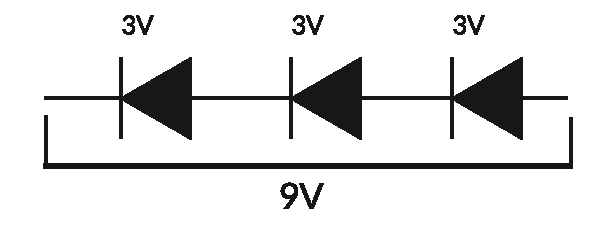
EACH channel is like this.
https://www.waveformlighting.com/pcb-designs/led-strip-light-schematic-and-voltage-information

9v-led.png
 
Last edited:
You only need one but you will need to get 20 drivers..
4 pucks in parallel.
Max voltage (if specs are correct) is 15V + 3V for LDD..18V so 24V ps is just fine.
Using "best guess" as to best current to drive each channel at
.350A (violets will last a LOT longer)
1.00A
.750A
1.00A
.500A
=3.6A

x 4 =14.4A

You'd use the same driver amp rating but only 10 drivers for 2 pucks in series/ 2 series sets in parallel..
But voltage needs to be 15x 2 = 30 + 3V = 33
So 36V power supply.
Current capability only needs to be 1/2 that.. so 7.2A

two best choices..
you can do multiple power supplies but it is "clunky"..

Keep in mind this is just estimates..
Doing "exact" would require measuring the ACTUAL voltage draw at driver current.
2nd method is calc all channels individually based on driver choice and guessing voltage.

.35x 14= 4.9W
1.0 x12 = 12W
.75 x 12 = 9w
1.0 x 12 = 12W
.5 x 14.5V = 7.25W

45.5W per puck x 4 =182W + 10% overhead = 200w

so really about 24V 200W ps (8.3A as opposed to rough estimate of 14.4A)

As you can see using just the driver current is misleading to a degree.
All this of course is based on my understanding of this ..;)

There are variations on these pucks so adjust accordingly.. but don't see too much in the way of varying enough to cause any issues..YMMV.
EACH channel is like this.
https://www.waveformlighting.com/pcb-designs/led-strip-light-schematic-and-voltage-information

9v-led.png
I think this has just made me move confused so I has no idea I needed drivers after the powersupply. (I have also been watching some YouTube videos and there were so many different methods)
Could you please right a list of the parts I need. (If it's not too difficult. you have helped a heap already)

Thank you
 
I'll need what pucks you are going to use to recommend drivers.
One suggestion is to use LDD-HW drivers (just have bare wires and no circuit board needed.
also don't need to worry about a pull down resistor which will just complicate a "first build"..
Long story but it's a resistor to shut off the lights in the event of a
controller failure.
PROBLEM is you need a controller right away and need to remeber to "common" the negatives..
I know sounds confusing but using the HW's eliminates the issue
substitute a channel for a LED star in the below..
connection_diagram_01.png


school.jpg


Opp's just noticed I recommended the 8.5A ps..SIZE is also determined by pucks/drivers.
Bigger than needed isn't a problem... Smaller sort of is. Your LED's won't get to full power.

Just remeber a single 3W LED has a part. voltage it needs and a voltage it draws at a certain amperage.
When you string them in series this NEED adds up

Say 1,2,3,4, diodes in + -+ -+-+-and each needs 3V = 12V..
 
Last edited:
I'll need what pucks you are going to use to recommend drivers.
One suggestion is to use LDD-HW drivers (just have bare wires and no circuit board needed.
also don't need to worry about a pull down resistor which will just complicate a "first build"..
Long story but it's a resistor to shut off the lights in the event of a
controller failure.
PROBLEM is you need a controller right away and need to remeber to "common" the negatives..
I know sounds confusing but using the HW's eliminates the issue
substitute a channel for a LED star in the below..
connection_diagram_01.png


school.jpg


Opp's just noticed I recommended the 8.5A ps..SIZE is also determined by pucks/drivers.
Bigger than needed isn't a problem... Smaller sort of is. Your LED's won't get to full power.

Just remeber a single 3W LED has a part. voltage it needs and a voltage it draws at a certain amperage.
When you string them in series this NEED adds up

Say 1,2,3,4, diodes in + -+ -+-+-and each needs 3V = 12V..
Would one of these work for a controller?
Screenshot_20190516-075149_Chrome.jpeg
Screenshot_20190516-075159_Chrome.jpeg
 
I'll need what pucks you are going to use to recommend drivers.
One suggestion is to use LDD-HW drivers (just have bare wires and no circuit board needed.
also don't need to worry about a pull down resistor which will just complicate a "first build"..
Long story but it's a resistor to shut off the lights in the event of a
controller failure.
PROBLEM is you need a controller right away and need to remeber to "common" the negatives..
I know sounds confusing but using the HW's eliminates the issue
substitute a channel for a LED star in the below..
connection_diagram_01.png


school.jpg


Opp's just noticed I recommended the 8.5A ps..SIZE is also determined by pucks/drivers.
Bigger than needed isn't a problem... Smaller sort of is. Your LED's won't get to full power.

Just remeber a single 3W LED has a part. voltage it needs and a voltage it draws at a certain amperage.
When you string them in series this NEED adds up

Say 1,2,3,4, diodes in + -+ -+-+-and each needs 3V = 12V..
Would one of these work for a controller?
Screenshot_20190516-075149_Chrome.jpeg
Screenshot_20190516-075159_Chrome.jpeg
 
Would one of these work for a controller?
not without modifications. Those are built for constant voltage arrays..
2 MAIN ways of driving LED's
1)Constant voltage (ok for low wattage diodes (sub. 1A)
2)constant current (preferred)

already listed the power supplies depending on IF you run each puck alone or 2 in series..

Assuming each puck is 50W
24V 200W switching power supply..
If you want to be safe or think you might add a puck in the future go w/ 24V 300+W
Meanwell LRS-350-24
https://www.alliedelec.com/product/...VjJyzCh2qgAA3EAkYASABEgIY0_D_BwE&gclsrc=aw.ds

just standard 3w LEDs there are 21 LEDs
Guesstimating one will never drive the total puck at more than 67W..or shouldn't.. :)

Again.. the difference between needing the 200W and 350W is based on things you control not what "is"...
 
Last edited:

IF YOU HAD TO TAKE A REEFING EXAM, WOULD YOU PASS?

  • Yes!

    Votes: 32 45.7%
  • Not yet, but I have one that I want to buy in mind!

    Votes: 9 12.9%
  • No.

    Votes: 26 37.1%
  • Other (please explain).

    Votes: 3 4.3%
Back
Top