Do acros start growing fast once they are a colony?

  • Thread starter Thread starter zachtyd
  • Start date Start date
  • Tagged users None

zachtyd

Well-Known Member
View Badges
Joined
Oct 21, 2019
Messages
685
Reaction score
686
What state or country do you live in
California
Rating - 0%
0   0   0
So I was curious just by the shear speed some small Acro colonies I got are growing, do acros get more growth as a colony or do frags grow faster than colonies? In your personal experiences
 
I don't think corals growth rates change due to age or size (well, kind of). It's more due to water parameters and light.

Big corals do 'grow' faster than small corals. But it isn't so much that the overall rate of growth is faster, but because there is more growing area, the amount of new growth is more.

Take for example: A monti that grows by adding new material along the outer edge. A frag with a 2" circumference adds 1/4" of new coral all around that edge. So 2"x 1/4" = 1/2 square inch of new coral. But a small colony with a 4" circumference grows the same 1/4" over the same time frame. That's 4" x 1/4" = 1 square inch of new coral. And a big colony at 20" circumference grows the same 1/4" over the same time and it adds 20" x 1/4" = 5 square inches of new coral.

So the rate of growth is the same for all 3 corals but the bigger the coral the more new material it makes, so it is faster growing, but the rate of growth is all the same. Does that make sense?
 
I don't think corals growth rates change due to age or size (well, kind of). It's more due to water parameters and light.

Big corals do 'grow' faster than small corals. But it isn't so much that the overall rate of growth is faster, but because there is more growing area, the amount of new growth is more.

Take for example: A monti that grows by adding new material along the outer edge. A frag with a 2" circumference adds 1/4" of new coral all around that edge. So 2"x 1/4" = 1/2 square inch of new coral. But a small colony with a 4" circumference grows the same 1/4" over the same time frame. That's 4" x 1/4" = 1 square inch of new coral. And a big colony at 20" circumference grows the same 1/4" over the same time and it adds 20" x 1/4" = 5 square inches of new coral.

So the rate of growth is the same for all 3 corals but the bigger the coral the more new material it makes, so it is faster growing, but the rate of growth is all the same. Does that make sense?
Yes that’s exactly what I was thinking but couldn’t word it right thank you very much that was an awesome answer!
 
My opinion is they dont necessarily grow faster but by having more appendages to grow it makes it look like they are growing faster because there are more pieces of it growing. But it's possible for some reason that they do indeed grow faster.
 
My opinion is they dont necessarily grow faster but by having more appendages to grow it makes it look like they are growing faster because there are more pieces of it growing. But it's possible for some reason that they do indeed grow faster.
Yeah I think the more branches probably grow the same speed, but since there’s so many vs 1 on a frag it’s like growing 10 frags on a disc
 
I don't think corals growth rates change due to age or size (well, kind of). It's more due to water parameters and light.

Big corals do 'grow' faster than small corals. But it isn't so much that the overall rate of growth is faster, but because there is more growing area, the amount of new growth is more.

Take for example: A monti that grows by adding new material along the outer edge. A frag with a 2" circumference adds 1/4" of new coral all around that edge. So 2"x 1/4" = 1/2 square inch of new coral. But a small colony with a 4" circumference grows the same 1/4" over the same time frame. That's 4" x 1/4" = 1 square inch of new coral. And a big colony at 20" circumference grows the same 1/4" over the same time and it adds 20" x 1/4" = 5 square inches of new coral.

So the rate of growth is the same for all 3 corals but the bigger the coral the more new material it makes, so it is faster growing, but the rate of growth is all the same. Does that make sense?
This is a good answer. Mine would be a 1" frag doubles in six months so now it's 2" inches, six months later that doubles to 4" then to 8" to 16" and so on.
 
For a typical acropora, the time that it takes a 1" frag to reach golf ball size, it can reach softball size in the same amount of time, then more than cantaloup. The size is exponential if you can keep from killing it, dying back from shadows or shading and don't frag it a bunch. The growth can be exponential, but so is the care.
 
For a typical acropora, the time that it takes a 1" frag to reach golf ball size, it can reach softball size in the same amount of time, then more than cantaloup. The size is exponential if you can keep from killing it, dying back from shadows or shading and don't frag it a bunch. The growth can be exponential, but so is the care.

Just to be clear, what you are saying is the amount of growth (the amount of new coral) can be exponential. But the actual 'rate' of growth stays roughly the same. Right?

In other words, a small stick grows at a rate of 'X' from one tip. That same coral branches out to have 5 tips and each tip still grows at a rate of 'X' but because there are 5 tips, there is now 5 times as much new coral. An when it has 100 tips, it still grows at roughly the same rate 'X', but now it makes 100 times as much new coral. The 'rate' of growth stays fairly constant, but the 'amount' of growth (new coral) increases as the coral gets bigger.
 
Just to be clear, what you are saying is the amount of growth (the amount of new coral) can be exponential. But the actual 'rate' of growth stays roughly the same. Right?

In other words, a small stick grows at a rate of 'X' from one tip. That same coral branches out to have 5 tips and each tip still grows at a rate of 'X' but because there are 5 tips, there is now 5 times as much new coral. An when it has 100 tips, it still grows at roughly the same rate 'X', but now it makes 100 times as much new coral. The 'rate' of growth stays fairly constant, but the 'amount' of growth (new coral) increases as the coral gets bigger.

I believe this is generally correct but also a bit to simple. At a certain size some of those 100 tips will grow less than X (and no growth is a possibility) due to constraints just on those tips. At that point the coral will shift energy and resources to the tips without these constraints and those can than grow more than X. The average growth over all the 100 tips remains X though.
 
I do think that it speeds up. Let's take a table, for instance... one encrusted and with a nice base, which may take a year, the top will expand more in year 3 than it did in year 2. If you get into year 4 without needing to significantly frag it back, then it would be even faster. The trouble with year 4 is that nearly nobody gets here without a massively large tank since you can grow wall-to-wall acropora (we are in the SPS forum) from 1" frag in three years if you are doing stuff right.

From year two to three, you can see/notice growth with the bare eye every day or two.

This can get really hard too since a lot of corals are shipped any more and it can take some of that first year to get over shipping and start to take off - so some of that first year does not really count. Point source lights can cause issues with actual colonies. Lots of people frag and frag which also sets corals back. Chemicals and other treatments can set corals back sometimes, along with bouncing parameters.

Steve Weast's Tank at Oregon Reefs or Copp's can show what can happen to colonies in short order with great lighting, lots of room and good husbandry. They have/had some colonies that in two or three years would barely fit into most tanks on this board.

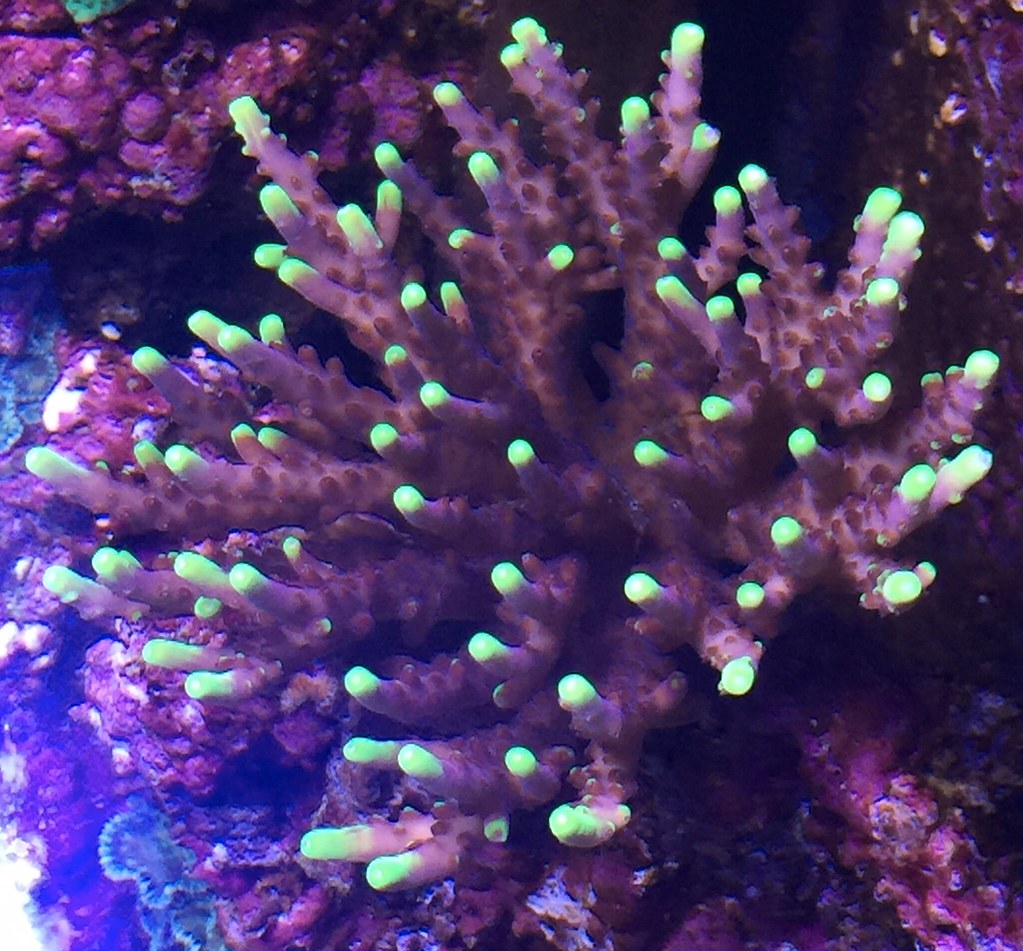
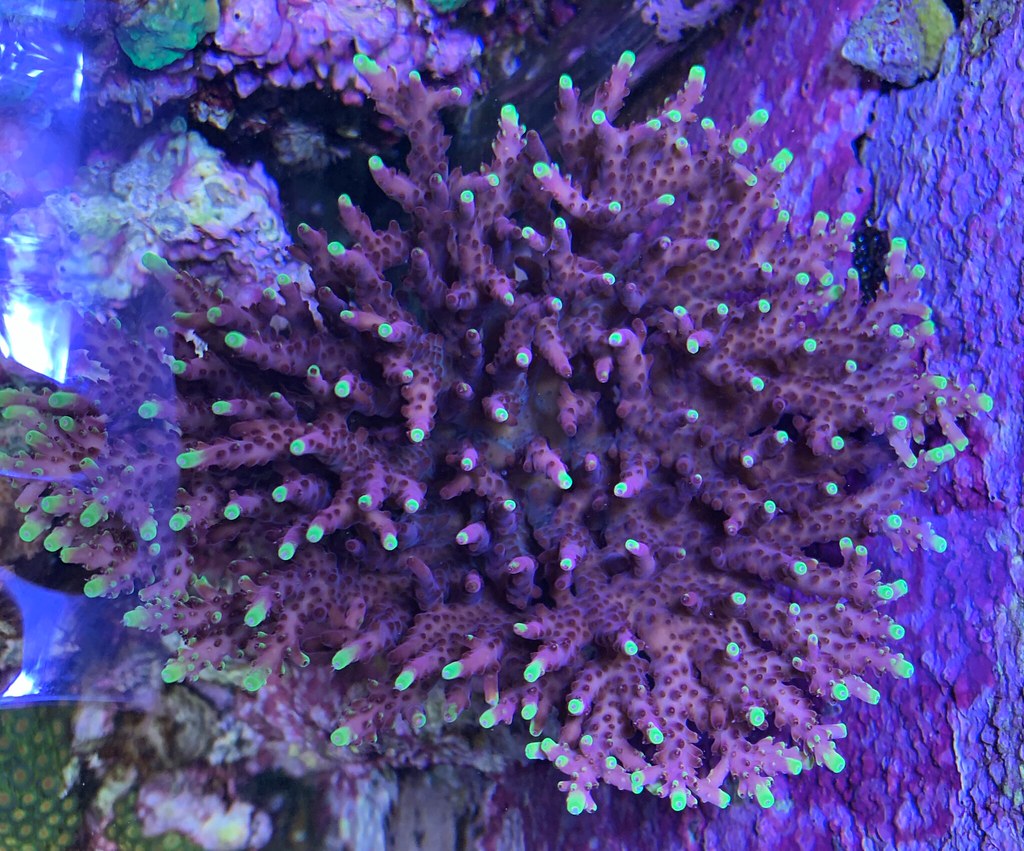
Here is about 16-18 months worth of growth on a Fox Flame... there was about a 4 month period where my tank did nothing because I treated my Fuge for Red Planaria and treated too much and it browned out my corals and they stopped growing for a while. The first photo was after about three months worth of growth, second one about six months later, then the stagnant period, then about three months after that. The larger photo is about 10" across and 8" tall. It is hard to get consistent growth without spurts when you do something dumb like I did. All in all, 1" to 8x10 frag is not bad for 16-18 months for this coral, which is not a slow grower, but not super fast either. I have about another year for growth and when it hits 15-18 inches, it will need to get fragged up because my tank is not that big:


 
So I was curious just by the shear speed some small Acro colonies I got are growing, do acros get more growth as a colony or do frags grow faster than colonies? In your personal experiences
Can't speak for acros but there is scientific proof that soft corals when in communities of colonies, thrive better in captivity.
 
I do think that it speeds up. Let's take a table, for instance... one encrusted and with a nice base, which may take a year, the top will expand more in year 3 than it did in year 2. If you get into year 4 without needing to significantly frag it back, then it would be even faster. The trouble with year 4 is that nearly nobody gets here without a massively large tank since you can grow wall-to-wall acropora (we are in the SPS forum) from 1" frag in three years if you are doing stuff right.

From year two to three, you can see/notice growth with the bare eye every day or two.

This can get really hard too since a lot of corals are shipped any more and it can take some of that first year to get over shipping and start to take off - so some of that first year does not really count. Point source lights can cause issues with actual colonies. Lots of people frag and frag which also sets corals back. Chemicals and other treatments can set corals back sometimes, along with bouncing parameters.

Steve Weast's Tank at Oregon Reefs or Copp's can show what can happen to colonies in short order with great lighting, lots of room and good husbandry. They have/had some colonies that in two or three years would barely fit into most tanks on this board.

Here is about 16-18 months worth of growth on a Fox Flame... there was about a 4 month period where my tank did nothing because I treated my Fuge for Red Planaria and treated too much and it browned out my corals and they stopped growing for a while. The first photo was after about three months worth of growth, second one about six months later, then the stagnant period, then about three months after that. The larger photo is about 10" across and 8" tall. It is hard to get consistent growth without spurts when you do something dumb like I did. All in all, 1" to 8x10 frag is not bad for 16-18 months for this coral, which is not a slow grower, but not super fast either. I have about another year for growth and when it hits 15-18 inches, it will need to get fragged up because my tank is not that big:



This shows exactly what I tried to say. At some point there is no room for growth in certain parts of the colony, so the resources produced in that part are diverted so another part which then grows faster.
 
Just to be clear, what you are saying is the amount of growth (the amount of new coral) can be exponential. But the actual 'rate' of growth stays roughly the same. Right?

In other words, a small stick grows at a rate of 'X' from one tip. That same coral branches out to have 5 tips and each tip still grows at a rate of 'X' but because there are 5 tips, there is now 5 times as much new coral. An when it has 100 tips, it still grows at roughly the same rate 'X', but now it makes 100 times as much new coral. The 'rate' of growth stays fairly constant, but the 'amount' of growth (new coral) increases as the coral gets bigger.
Worded great
 

IF YOU HAD TO TAKE A REEFING EXAM, WOULD YOU PASS?

  • Yes!

    Votes: 32 45.7%
  • Not yet, but I have one that I want to buy in mind!

    Votes: 9 12.9%
  • No.

    Votes: 26 37.1%
  • Other (please explain).

    Votes: 3 4.3%
Back
Top