Does Po4 directly harm some corals?

I think we’re saying the same thing. I have a pretty low nutrient system now but I’m not chasing low nutrients or trying to rush to low nutrients. It’s just a function of what’s working for me, which is a function of eliminating what didn’t work for me.

But the OP original question was will high po4 kill sps? And I pointed out high can be interpreted many different ways. The OP stated, if I remeber correctly, his po4 is 0.8 ppm. I have no idea if 0.8 ppm will kill sps. Mine have never been that high.
Its kind of hard to tell. In the research I’ve looked at regarding the adverse effects of high PO4 had on wild reefs, net negative impacts of PO4 on (presumably) SPS seem to be linked to ‘pollution events’.

Not to say that PO4 isn’t the cause, but it might be a little post hoc to say ‘PO4 increased, coral negatively impacted —> increase in PO4 negatively impacted coral’.

It could be other factors occurring during these ‘pollution events’ (eg higher turbidity/less light penetration). Or, it could be the PO4, but not the PO4 in and of itself, but rather the rate at which the level jumped...and what other parameters jumped or changed along with PO4?

What I haven’t seen (and would like to if anybody knows of any evidence) is how exactly PO4 can cause harm to a coral. Such as, a specific pathway that gets thrown off by elevated PO4, some sort of link to PO4 acting as an inhibitor of something, whatever.

If it’s out there and somebody knows of it, please link it. Otherwise, this sort of becomes an unsolvable riddle.
 
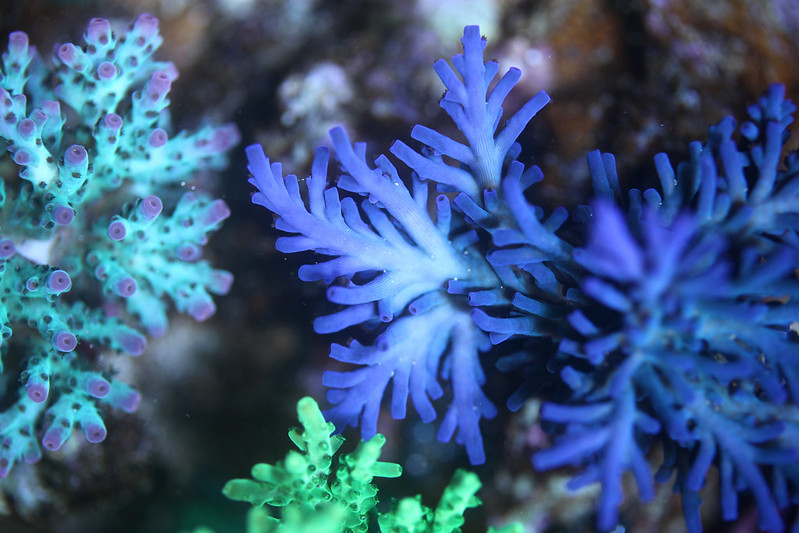
My PO4 was well over 2.5 for several months and when I overdosed PO4(by accident) the only thing I noticed was that all corals tissue became very rich and saturated in color. Any coral that has small amounts of green within a day or two showed a lot of highlights. For example, the fox flame in the picture gained the green tips overnight which were not there before the added PO4.

Over the next few months I noticed that growth was very slow and then some corals started to brown out. My pink lemonade that thrived at ,00 PO4(mid range Hanna test) now looked brown and stopped growing.

When I lowered the PO4 with some liquid PO4 remover(GFO wasn't doing the trick) it stressed out the corals and I lost of few acros. I am now around 0.4 PO4 and growth has increased again and the acros remain the deeper yet bright coloration that I enjoy.
Fox Flame 09-24-2018.jpg
 
My PO4 was well over 2.5 for several months and when I overdosed PO4(by accident) the only thing I noticed was that all corals tissue became very rich and saturated in color. Any coral that has small amounts of green within a day or two showed a lot of highlights. For example, the fox flame in the picture gained the green tips overnight which were not there before the added PO4.

Over the next few months I noticed that growth was very slow and then some corals started to brown out. My pink lemonade that thrived at ,00 PO4(mid range Hanna test) now looked brown and stopped growing.

When I lowered the PO4 with some liquid PO4 remover(GFO wasn't doing the trick) it stressed out the corals and I lost of few acros. I am now around 0.4 PO4 and growth has increased again and the acros remain the deeper yet bright coloration that I enjoy.
Fox Flame 09-24-2018.jpg
I believe this is the example the OP was looking for. Thanks for sharing
 
My PO4 was well over 2.5 for several months and when I overdosed PO4(by accident) the only thing I noticed was that all corals tissue became very rich and saturated in color. Any coral that has small amounts of green within a day or two showed a lot of highlights. For example, the fox flame in the picture gained the green tips overnight which were not there before the added PO4.

Over the next few months I noticed that growth was very slow and then some corals started to brown out. My pink lemonade that thrived at ,00 PO4(mid range Hanna test) now looked brown and stopped growing.

When I lowered the PO4 with some liquid PO4 remover(GFO wasn't doing the trick) it stressed out the corals and I lost of few acros. I am now around 0.4 PO4 and growth has increased again and the acros remain the deeper yet bright coloration that I enjoy.
Fox Flame 09-24-2018.jpg

I'm seeing similar. The acros I have look great, but their growth rate is glacial. Montipora are growing okayish, stylo and digitata are doing fine. Guess it really depends on the species.

I have a couple corals that are acting irritated. If I see them improve as my po4 goes down I'll post an update.
 
What I haven’t seen (and would like to if anybody knows of any evidence) is how exactly PO4 can cause harm to a coral. Such as, a specific pathway that gets thrown off by elevated PO4, some sort of link to PO4 acting as an inhibitor of something, whatever.

If it’s out there and somebody knows of it, please link it. Otherwise, this sort of becomes an unsolvable riddle.

You can google and read for days about phosphate impact on cellular activity. Dr. Holmes-Farley is also an expert on this. Depends on the organism, but all living tissue needs some and all living tissues can be poisoned to death by it at different levels. I am not smart enough to remember how it works at a cellular level, but it has been explained before. Coral cells are no different than other cells, especially photosynthetic plants.
 
You can google and read for days about phosphate impact on cellular activity. Dr. Holmes-Farley is also an expert on this. Depends on the organism, but all living tissue needs some and all living tissues can be poisoned to death by it at different levels. I am not smart enough to remember how it works at a cellular level, but it has been explained before. Coral cells are no different than other cells, especially photosynthetic plants.
For sure.

All cells need PO4 for ATP, phospholipid bi-layers, creatine PO4, phosphorus for numerous other metabolic functions, etc

The question is, how much is too much? In humans, a hyperphospatemic state occurs when the cells push beyond 5mg/dL. Converted, that’s 50ppm.

I don’t know what the upper threshold for coral cells is, but I would have to imagine it’s significantly higher than the 1ppm everybody is losing sleep over.

That’s not to say that PO4 1.0ppm and < is ideal, and that there wont be some complications
 
Last edited:
There are real-science, peer reviewed studies that Dr. Holmes-Farley linked in his Phosphate article that say under .03 ppm is safe and ideal. Ocean is 1/3 of that, or so. I gotta believe this (and nature) until I see actual science to say otherwise.

Phosphate of 1.0 would be certain death for most of what I keep - maybe not instantly, but over six months or a year. I only keep acropora and clams, though.

Just to be clear since people only see what they want to see... I would not chase my way to down to .03, but I would still make it a target to get there slowly, methodically and safely. I actually would not really sweat anything under .10.
 
Most of the super-high po4 tanks did not get that way while having high po4 - they got the high po4 after much of their growth and development was done.

Mine is one of the high Phosphate and nitrate tanks, 1.2 (but as high as 2.4) and 50+ respectively. Been this way roughly since 2014, and new corals seem to do just as well as old corals, and I see about the same survivorship of new corals as I have ever. I had a kalk overdose in that time and replaced all my sps, and I had a salinity issue last year, and I added a bunch of new sps.

EDIT - I'm Rich Ross. :D
 
Again... details. I had my dKh drop to about 4.0 when I did not notice my co2 tank went out... nothing was harmed when I raised it back up instantly. I did not check my salinity and it was dow to 1.020 and nothing was killed. I am talking acropora here, mostly deepwaters and not MBP&S or slimers. Are we really watching the same game where those might not have died if they were not already trying to overcome this high building blocks? Maybe, maybe not, but it matters.
 
But @jda is correct, we have no idea what RR’s specimens look like up close, and his “laziness” method has produced multiple crashes, which RR candidly discusses in the video. My point with all of this is that we tend to over react, freak out actually, when no3 and po4 have increased. I don’t believe po4 going from 0.05 to 0.10 is going to cause all the sps to die over night, so there’s no need to bring down the po4 down over night.

This often seems like an odd thing to me, and still continues even when I post close up pics and top down shots, that I think are on my 'home tank' thread here. What are people looking for in the corals I keep from looking close up? What are my corals missing that others aren't?
 
This often seems like an odd thing to me, and still continues even when I post close up pics and top down shots, that I think are on my 'home tank' thread here. What are people looking for in the corals I keep from looking close up? What are my corals missing that others aren't?
@Thales I haven’t seen up close pics of your corals or home tank. I’ve only seen the Lazy Reefer talk on YouTube. I wasn’t trying to offend.
 
Not offended at all, I am just unsure of what people are looking for up close and what people think my corals might be lacking. I don't understand and would like to. Thanks!
 
I also want to point out that people today really have no idea what heavy skimming really is. These current generation of needlewheels with bubble plates and cones are toys compared to the skimmers that we used back then. A good becket, downdraft or even a solid venturi will remove SO much more DOC than the needlewheel of today. I am overgeneralizing a bit because there are a few needlewheels that are really good, but as a whole, they are found lacking.

Have you seen this study?
https://www.advancedaquarist.com/2010/1/aafeature
 
The tank looks good from a distance to people who might not know what they are looking at, but it is not on the level of so many others. He has been an entertaining talk for years, but dig in...

JBs tank is probably a better case study for SPS folks.

Can you tell me what you are looking for up close and what 'people who do know what they are looking at' are looking for? Thanks!
 
There are real-science, peer reviewed studies that Dr. Holmes-Farley linked in his Phosphate article that say under .03 ppm is safe and ideal. Ocean is 1/3 of that, or so. I gotta believe this (and nature) until I see actual science to say otherwise.

Phosphate mof 1.0 would be certain death for most of what I keep - maybe not instantly, but over six months or a year. I only keep acropora and clams, though.

Just to be clear since people only see what they want to see... I would not chase my way to down to .03, but I would still make it a target to get there slowly, methodically and safely. I actually would not really sweat anything under .10.
No doubt. We can all agree that PO4 levels in the 0.02.-0.05 range would qualify as ‘ideal’...in other words, enough to meet the corals needs but not so much to cause issues.

From what I can tell in the relationship between PO4 and Ca in human physiology, high PO4 levels will lead to low Ca levels, putting the body in a ‘bind’, so to speak, as muscular function is impaired by low Ca (actin/myosin etc etc).

So, with PO4 binding to Ca, we could see an issue in coral growth (pretty sure that’s what most research as well as the anecdotal experiences of R2R suggest). But the question was, ‘will high PO4 harm corals?’.

I think that there is a pretty large gap in PO4 levels between inhibiting growth and being potentially lethal to corals. As I said earlier, people begin to experience issues at 50ppm. Would this be the same for coral?

All of this is a long-winded way of saying that, realistically, letting your PO4 get up to, and stay at, 2ppm is probably not a great practice, but it’s probably not lethal. At least, not any more lethal than freaking out and scrambling around constantly messing with the system when PO4 gets up to 1ppm.
 
What I am looking for is a solution that works for nearly everybody, or at least the masses. Also looking for a solution that works for whatever somebody wants to keep since desires and wants change faster than a tank can. I want people to understand that tanks with building blocks this high can be fun and cool, but they cannot do the same things that tanks with building blocks closer to NSW can do and that you will end up with the tolerant stuff surviving and won't be able to keep the less tolerant stuff. I want people to understand that there is a ceiling, and if they are OK with that ceiling, then they can have a great tank.

I know that what I keep is not kept by everybody, but I can keep whatever I want - any organism, and it will thrive. I am mostly into acropora and clams and I get that this is a nice. However, I grow bounces, jawbreakers and some tricky Z&P to help fund my hobby and they thrive too. On the converse, a lot of what I keep would die in a tank with 1.0 P and 50 N. I have seen it too many times.

There is a local here who really loves him some Red Dragon, PM and other blue deepwaters. He has seen all of the videos and posts and is convinced that he can keep a reef with 2.0P and 50+ nitrates and keep these alive. He came by 3 times and I sold him some and each time they died within about two weeks. Since he has seen some vidoes and articles of tanks with some stags, montis, birdsnests, poci and other easier SPS doing fine with higher building block levels, he thinks that he can keep any SPS, but he cannot understand that the smoothies that he covets so much will not do nearly as well if they live at all. I had to stop selling to him since he cannot keep them alive - I do not need $500 bad enough to watch the stuff die. Each time, he blames a alk swing of .2, a 1% change in his light schedule or that he needs a new dosing pump as the issue and cannot see that his tank cannot keep these kind of coral. What is amazing is that I got some really nice zoas from him that have grown about 10 heads in two years, but the one head that he gave me is about 300 now in about a year - he thinks that it is just luck or placement. He also refuses to believe that a simple coral that he CAN keep alive, like a ORA Miami Orchid, grows an inch or two for him a year, but can be the size of a cantaloupe for me in that same time.

I want people to list the nuance and detail that come with such a tank so that the guy above can know that he will face limits with the choices that he made. I want to see that people people who decide to run a 1.0 and 50+ tank can start with acropora frags and in three years fill a tank wall-to-wall with all and any kinds. I want to see corals be healthy enough to overcome some bad moments (heck, corals in the wild can live out of the water for half a day and still thrive).

We are in the SPS forum and I think that JBs tank is a better example, since he focuses mainly on SPS and acropora and keeps more of the kind of things that people in this forum want to keep... not just MBP&S and some stags and slimers... he keeps a wide range of things. His experience might still need another year or two, but it is worth watching closely.

I could let my P and N rise too (well, not sure how to get my N to rise) and I could have a tank jammed full of corals that were the size of basketballs. I know what would survive... maybe a Red Planet, Miami Orchid, Blue Slimer, Cali Tort (not sure, but maybe), the rasta zoas, maybe some Bam Bams. I know that I would slowly lose all of my smooth skinned stuff, my Gonzo/Tyree Space Monster zoas, Hallucinations. My clams would probably stay alive, but not grow as much. Tenuis would probably stay alive, but not grow as much or have as much contrast. To the masses, this might look like a successful tanks with a few huge colonies and a tank full of stuff, but to people who saw my tank before, they would tell a different story since they knew all of the things that I could keep before and could not keep now.
 
But the question was, ‘will high PO4 harm corals?’.

I don't think that there is any question about this. The question is how much will harm each type of coral. This is a great question.

The corals that I outlined above would start to grow slower at .10 ppm. They would change color at maybe stop growing much at .20-.25. Slow death could soon follow. I won't argue with people who would never keep a Purple Monster, Pink Panther, Space Monsters or other coral. My coralline pretty much shuts down new growth (spots) at about .10, but the existing stuff will spread - I won't argue with anybody who wants coralline growth to slow down since I hate the stuff, but acro growths best in the same conditions.

The converse question is also very interesting... if there is no downside to keeping them at .01 to .05 and NOTHING suffers from this, then why not make it a goal? I hate false equivalencies, but not everybody gets lung cancer from smoking, but that is not proof that it is not unhealthy. Years ago, I have stopped my soap box that we should, as keepers of living things, strive to have them thrive and not just do OK, but it kinda folds into this conversation. If some aliens came and abducted you and put you in a glass box, would you want the ones who would give you an environment to thrive, or the one that is just barely good enough?
 
I know that what I keep is not kept by everybody, but I can keep whatever I want - any organism, and it will thrive. I am mostly into acropora and clams and I get that this is a nice. However, I grow bounces, jawbreakers and some tricky Z&P to help fund my hobby and they thrive too. On the converse, a lot of what I keep would die in a tank with 1.0 P and 50 N. I have seen it too many times.

I grow pretty much anything in my tank, but my goal is not to grow the fancy/tricky thing de jour for sale. I did that for a long time, and am uninterested in it anymore. That is fine for people to do, but it isn't everyones goal.
As I have stated in a bunch of places, I don't recommend anyone do what I am doing just because.

I want people to list the nuance and detail that come with such a tank so that the guy above can know that he will face limits with the choices that he made. I want to see that people people who decide to run a 1.0 and 50+ tank can start with acropora frags and in three years fill a tank wall-to-wall with all and any kinds. I want to see corals be healthy enough to overcome some bad moments (heck, corals in the wild can live out of the water for half a day and still thrive).

I think we have different goals. I don't care if my coral grows super fast because I don't want to do the work that comes with that. I just want it to grow some and be healthy. My tank problems have been due to really bad things of my own making, not bad moments. Also, it looks like my phosphate is now down to .53 by a easy method of reduction that I have been playing with for the last year.

The converse question is also very interesting... if there is no downside to keeping them at .01 to .05 and NOTHING suffers from this, then why not make it a goal? I hate false equivalencies, but not everybody gets lung cancer from smoking, but that is not proof that it is not unhealthy. Years ago, I have stopped my soap box that we should, as keepers of living things, strive to have them thrive and not just do OK, but it kinda folds into this conversation. If some aliens came and abducted you and put you in a glass box, would you want the ones who would give you an environment to thrive, or the one that is just barely good enough?

There are downsides - labor, money, waste, and inexperience.
I think the idea that tanks that have corals that are growing more slowly than yours are barely good enough would need to be supported. Growth rates can't be the only metric. Thrive is a fuzzy word that we are all trying to make more clear.

Also, in case you missed this, it would really help me understand where you are coming from if you gave me some insight to this question about close up viewing of corals? If my corals are missing something, I would like to know what it is -
Can you tell me what you are looking for up close and what 'people who do know what they are looking at' are looking for? Thanks!

Thanks for the interesting discussion.
 
This is where I have a bit of an issue. The people who have read the stuff, been in person and listened to the video do not understand all of this. They think that this way is just as good of a method than another, even though you have said that you do not recommend it to everybody. There is not enough care given to the fact that as a presenter, author, etc. that you are seen as an authority and that what you say and present needs to be given as if nobody will never spend another thought except to believe you at face value. This is the burden of being an authority. I think that you have to wear some of the scenario above where they guy did want to be like you, but not all of it since he could have dug in more too - for better or worse, an authority needs to be held, and hold themselves, to a higher standard. This could all be better if, as an authority, it was framed along the lines of "alternative takes" or "how I beat the odds" rather than skepticism about other parts of the hobby. As an authority, you need to lead with the fact that you are an outlier and frame the reasons why stuff work around this premise.

Can you really keep any kind of coral? Do you have a wide selection of deepwaters, harder plating LPS or the Z&P that die at higher levels of building blocks? These do not have to be expensive or named coral or be popular, but any kind of smooths skinned acropora. I am not talking about high value or named stuff, just species.

BTW, .53 is not nearly the same as 1.0 or even 2.0. There are a much wider range of tanks that have successes with a variety of critters that operate in this range.

Defining thriving is very easy. You can see what this stuff is capable of in other's tank, the ocean, etc. If you think that growing coral faster to support this hobby with fragging and captive grown stuff is a waste, then we are totally on different wavelengths. You might agree more if/when this is all that we have in the hobby.

I mostly meant "close up" as a metaphor. The people who post the video and articles are only looking at the tank from 20 feet and not really reading the fine print. Before anybody decides to want to be like this, they should at least read the sentence about not recommending this just because. If you have any literal close up photos, then I always love those, but that is not what I meant. Here are a few of mine, most of the deepwaters that I constantly see die or suffer with P over .10 in nearly all tanks.
 

IF YOU HAD TO TAKE A REEFING EXAM, WOULD YOU PASS?

  • Yes!

    Votes: 32 45.7%
  • Not yet, but I have one that I want to buy in mind!

    Votes: 9 12.9%
  • No.

    Votes: 26 37.1%
  • Other (please explain).

    Votes: 3 4.3%
Back
Top