Fate of Zooxanthellae

Dana Riddle

2500 Club Member
View Badges
Joined
Sep 10, 2011
Messages
3,162
Reaction score
7,614
Location
Dallas, Georgia
What state or country do you live in
Georgia
Rating - 0%
0   0   0
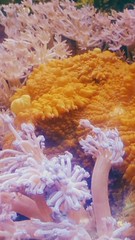
The very first article I wrote about captive corals way back in the early 90's concerned 'black dots' observed in an Elegance coral (Catalaphyllia). These dots were clusters of zoox apparently moving through micro-tubules for expulsion through the coral's mouths. I've never seen this happen with any other coral but have always wondered if zoox can migrate through a coral to a more favorable environment within the coral (say, from a highly lighted to shaded areas.) We know for sure chlorophyll concentrations/zoox density are higher in shaded areas. We also know that zoox can, in may cases, be obtained through temporary openings in coral tissue (called phagocytosis, if memory of ancient biology classes serves me.) In any case, has anyone observed such migration/expulsion? Thoughts?

 
I've experienced pigment migration where a bleached white area becomes repopulated and the pigment is a different color.

Is that what you're asking?
 
We know for sure chlorophyll concentrations/zoox density are higher in shaded areas.

Hmmm............I have a lot of acros that the underside is very pale tan to almost white on the undersides. That would seem to indicate less zoo density to me?

Just trying to get a handle on what you're asking. I doubt you could see actual zoo movement in an acro branch. My thought would be the favorable light area has zoo multiplying.

I've seen paly/zoas expel zoo from their mouths and the result is the polyp is more pale.
 
I've seen strings exiting from tips of sps before. I thought I had read this is how they get rid of excess zoox when light intensity goes up.
 
I have noticed this on my rhodactis. They have some bulbs that are sticking out. Periodically they will excrete out the mouth what I would call maybe dead zooxanthellae. Orange string/slime usually the next day the bulbs will have more white in them. I was just thinking of this last night as I watch a couple do it. I was wondering if they were adjusting to the environment or just cleaning up the zooxanthellae.(getting rid of the dead ones) I long does the zooxanthellae actually live for?
36157784910_776cf7f670_m.jpg
36433695011_5b633f0c06_m.jpg
 
Last edited:
I've experienced pigment migration where a bleached white area becomes repopulated and the pigment is a different color.

Is that what you're asking?
I don't know if this helps, but ill give it a go.
I have an Acan, and I had a filefish. Acan+Filifish= dinner. So I moved the fish out of that tank, anyways the color was a super bright orange and green. After the tissue recovered it turned a new color, where lots of the orange was it is now pink, and then orange, and then a new shade of green. Im excited to see if itll stay pink, or color back to normal
 
In any case, has anyone observed such migration/expulsion? Thoughts?
Depends on how to tell coral poop from zoox expulsion, I think. We have all observed this "poop" especially with LPS. Defining what it is though is the more difficult part.
 
The zoox pellets I saw being discharged moved rapidly (inch in minutes) towards the mouth. Studies have shown zoox are competent (healthy) when discharged and the coral bleaches. So, the coral is unhappy with its symbionts and gets rid of them. Now, to my point - is it possible, under conditions favorable to the existence of a healthy symbiotic relationship, for zooxanthellate to migrate to a portion of a coral that provides the most favorable environment? If the zoox can be discharged through the mouth(s) of a coral, why not use that same transport system to move to a more desirable location? It is a fact that zoox density/chlorophyll content can vary widely within the tissues of a coral (under low light, the portion exposed to this intensity will be brown, and the shaded portion tan/whitish. In high light, the situation is reversed - low light exposed is brown while high light is tan/white.) I have no evidence to support such a hypothesis, just want to hear of your observations/experiences. Thanks!
 
What you suspect (please correct me if I misunderstand again so the thread can be on topic :)) is that there is a possibility that the coral animal can (during some limitations) control the intensity of photosynthesis in their tissue trough moving around the zooxanthella?

edit: I read your last post again - you focus on the zoox will and capacity - I focus on the coral animal but i think that both point of view can be true

Sincerely Lasse
 
Last edited:
The answer is yes. I can't give you too much information but zoox are motile and uptaken by coral polyps from the water. There is also evidence that mass spawning events are ravenously fed on by clams.
I have paid access to index scientific articles and would be happy to look into it more if you want.
Edit: I think you are referring to zoox moving from polyp to polyp without necessarily being expelled into the water? I can look into that too but my guess is yes, considering that colonies have centralized gastrovascular systems. Here is a demonstration in montipora
https://scholarspace.manoa.hawaii.edu/handle/10125/7050
As a primer you might find this interesting. I sure did.
https://www.researchgate.net/https:...post/How_are_zooxanthellae_acquired_by_corals
 
Last edited:
[QUOTE="Lasse, post: 3966762, member: 66404"

edit: I read your last post again - you focus on the zoox will and capacity - I focus on the coral animal but i think that both point of view can be true

Sincerely Lasse[/QUOTE] found a study that infected acroporas with strains of symbiodioum that do and don't naturally cooccur. Only some strains we're retained even when supplied at lower densities than the non preferred strains. Suggests some mechanism of attraction and selection between corals and zoox (not sure which of the partners do selecting).
 
My observation is similar to yours, in that we can somewhat control the zoox populations by manipulating light intensity or DLI. WE can also repopulate pale areas of corals by changing light angles or frag angles. I am 100% certain of this.
The other factor I strongly believe from my experience is PO4 and NO3 levels play a direct role in zoox populations within the colonies. Ex (assuming all other factors are normal) Strong light or long DLI and very low PO4/NO3 will cause a loss of zoox and pale corals. Strong light or long DLI in a tank with high PO4 /NO3 will not. This is from experiences in my own systems as well as systems that I help maintain. That said I have not seen zoox migrating with my own eyes, only overall differences in corals day to day.
 
* I should say the comparison would be using the same lighting say 250w MH with T5 supp. Obviously there are limits, a 1000w MH would probably fry out the zoox regardless of PO4/NO3 levels.
 

IF YOU HAD TO TAKE A REEFING EXAM, WOULD YOU PASS?

  • Yes!

    Votes: 32 45.7%
  • Not yet, but I have one that I want to buy in mind!

    Votes: 9 12.9%
  • No.

    Votes: 26 37.1%
  • Other (please explain).

    Votes: 3 4.3%
Back
Top