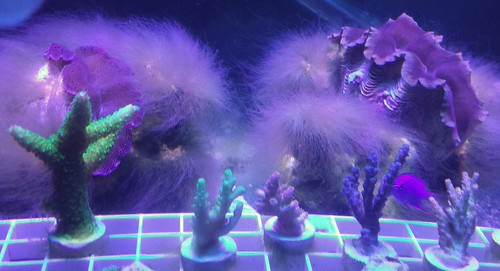
Finally came here to get help ( Green Hair Algae issue)

Without knowing anything about nutrients, you have a correctable situation solely because this is a nano and not a full size tank (accessibility) all you have to do is post a full tank shot pic. If you have a sandbed, it must be cleaned correctly and made cloudless. Use ro di or distilled for topoff and make water. That w handle nutrient issues

Don't dump peroxide in the tank it's not how we do it. Post pics

Yes to peroxide and next time don't use it last :)

Everything mentioned above regarding controls is correct, but they are installed after you work the tank. Not before

They're poopers

need to have the tank de clouded, before adding more waste producers if ever. I don't use any, and I don't have to work algae off my rocks either. the key is to guide the tank early until coralline and coral take over, and reject the algae off all the spots. we fix nano tanks without ever knowing nutrient levels; only a clean sandbed or no sandbed is needed, and a system small to access.

Waste producers go in the corrected condition tank or they contribute to the issue in many smaller reefs lacking dilution for the new waste loading. They'll make you need to clean the sand again one day, faster than last time before they were added retroactively
Much of the new grazer waste gets stored right into the sand...you have an easy tank to fix and we haven even seen it yet. Clean up crews are incidentals, I don't use em. No need, but they're ok to use in some settings. Peroxide is applied directly to algae, not tank water, to kill it off during the tank cleaning and reset.

2321c016b9d2f3f319380ee09f53646c.jpg
727ad39d5f846550f32cdc6a4842dd36.jpg
fc2e8252888a9c91b87d9d83c42e99ed.jpg
 
wonderful, we can do wonders with that, by Friday in fact. be right back sec
 
Tuxedo urchins can get rid of GHA, my frag tank is proof of that. It's not a miracle or an overnight solution, but it is a natural one. They will also eat coralline though.


clams_n_frags
by Kyl, on Flickr

That was April 12th, the rocks are bare now.
 
Add a GFO reactor. Run GFO or Rowaphos. Black out the tank for 3 days. Dying algae will release phophate which the media will capture. Once the 3 days are over get a piece of air line tubing and a toothbrush. Brush off the remaing hair algae and suck it out with the tubing.
 
very backed up at work having to work in increments:

your tank will be very easy to work with. we need to incremental test it before upscaling and taking full action...that's why this method is ideal, its mini modeled before the big job, and its invader specific. any messing with nutrients is invader + nontarget stressing, we're targeted and much faster

(we/nano keepers who have access :) )

notice on your back wall how the tank is aged enough to have accreted fanworms on the actual glass, but no green mess in the corners, along the silicone, wedged into those worms and tufted all over the glass>? that matters hugely in your overall reset methods here. it means your water/nutrients never were an issue or the algae would be located other than the places nature wants it--the rocks.

I get tanks in my message box where the glass and the rocks are invaded, yours isn't. even if you were scraping algae off glass, its not bad or your silicone and joint areas would be colored up and spotty and dark or green/black but they aren't, your invasion is where nature wants it: on rocks so a parrotfish can happen by and bite it all off, digest the plants, and poop the sand.

you have no nutrient issue in this tank if you are using decent topoff water, your invasion is due to lack of grazing and the peroxide method cheats us into grazing. I recommend hold course with nutrients, sequester no more nor less just hold course where you are and begin actual target work and this tank will comply.

*it isn't forever, its until that rock is purple with coralline, then the algae will stop given all other factors decent and fair and normal. Nature grows algae just like this in perfect reef waters, and due to that grazers have tonnes of food to eat.

you have no other issue in this tank other than lack of grazers, I would never need to know your nutrients in order to reset this tank and here's how we test that claim and build up some nice turnaround pics for our huge peroxide thread:

incremental testing to assess invader before we nuke it (we are watching for growback potential)
1. take one test rock out and lift it out of the water, and simply pour peroxide 3% from a brand new bottle across a patch of algae hitting no corals. let it sit wet in the air 2 mins, don't disturb the algae on this rock, its liquid-only efficacy testing. rinse this rock off after a couple burn minutes, and put back in tank. the algae w look the same, bubbly perhaps a little, but no big changes tonite. notice in 36 hours how that patch will look though, itll be white and falling off I bet.

2. take a second rock, or an area on the first rock that wasn't wetted w peroxide, and this time scrape the algae off the rock using pointed and careful dentistry;rasping; just pick and poke out the algae until the knife tip made that area scored free of invader, then put peroxide externally on that spot after it was cleaned. first spot was no rasping, the hail mary pass, it'll prob work fine. If not, the second test was a scoring/rasping test where the anchor points were literally dug out as a rasper would have done intently in nature, damage some rock while you are at it, this is a mean portion test in case your invader is deeply rooted and grows back really fast, but I predict it wont, and top treatment alone will look great. The rasped rock is worked with metal sharp knife tip to be algae free first, the peroxide goes on the clean spot after you worked it, to wick into any leftover holdfasts because really mean invasions take scraping to dislodge them, or they'll come back. Even snails and crabs don't rasp correctly, they're mowers, they leave the roots. it takes a rock biter in nature to be thorough, we're mimicking that.

no peroxide was dumped in tank

no non targets were affected here

its not possible to bleach out your corals or overdo starvation here, I literally work zero percent on my 12 yr old nano now on algae control, its purely cutting out stony corals to get them out of the bowl and make space that occupies my time, all you need is to hand guide your tank.

for it to have produced only that much, locally, without any real hand guiding actually means your tank will respond very well to some directed gardening

I have 5 tanks right now in private message getting turned around from this very method. Hotashes is already well past the clear and into the heavy coral stocking method to block out the former real estate that algae wanted. I never ask for, or need to know, anyones nutrient levels for nitrate and phosphate in our turnaround threads, as those items don't determine if you are invaded or not, they determine how much you must manually garden. They're preventative moves, they're not remover moves.

you will be able to see if this works, or doesn't, within a few days and from that you can upscale to the rest of the tank. You can see why this is hard for large tankers, nano keepers are truly spoiled once you figure out you can just cheat kill algae and not have to take months of hoping.

we're literally moving away from an external locus of control reefing system and into a fully 100% self accountable you choose if you are invaded or not internal locus of control system. When we're the grazer, we have final say over how the tank looks, and even though hand-scraping without peroxide is still good and will remove an invasion, it leaves too many holdfasts in place for regrowth, so the peroxide burns that part out and drastically stops regrowth, as a cheat. when coralline is there, algae will look for another spot to land and set up competition, coralline is powerful. you are awaiting that natural blocker, and you must free up space/real estate from algae so that it can adhere on the rocks, its a guiding process over time.

Its the total complete opposite of hands off approach; a nano reef is best ran clean in the beginning, farmed into compliance, then in its golden years it will run forever without biological headaches.

if your sandbed can produce a cloud if disturbed, that's algae feed, and you may want to clean that. **it affects growback, not whether or not you are invaded as a recurring theme here.

I deem this tank not a nutrient issue, but in need of man grazing, with cheat, stat
I know this is a ton of stuff to type, but we are about to adjust your approach to reefing in a small nano itself, not the algae.
 
Last edited:
lastly, no long post would be fun if it didn't come with even longer proofs :)

for perusal and prep, see these options:

largest sandbed rinse and care thread:
https://www.reef2reef.com/threads/t...ead-aka-one-against-many.230281/#post-2681445

a good sized peroxide thread live running with before n afters:
https://www.reef2reef.com/threads/reef2reef-pest-algae-challenge-thread-hydrogen-peroxide.187042/

What I typed above is those 26 pages condensed, to save ya a read :)

Our method here doesn’t conflict with any other method in reefing. It’s just an order of ops. The reason to practice hand guiding vs dosing something is because this handles all invasions and dosers are species or genus restricted. This is an enduring fall back method that always works, but as time goes on they’ll invent work saving and faster ways agreed. Learn old school hand guiding / w save ya one day. Other dosers like vibrant, fluconazole, all valid tools for sure but hand gardening is the compliant maker for all nanos...be a pro at it and use the others for work reducers in larger setups is ideal.
 
Last edited:
very backed up at work having to work in increments:

your tank will be very easy to work with. we need to incremental test it before upscaling and taking full action...that's why this method is ideal, its mini modeled before the big job, and its invader specific. any messing with nutrients is invader + nontarget stressing, we're targeted and much faster

(we/nano keepers who have access :) )

notice on your back wall how the tank is aged enough to have accreted fanworms on the actual glass, but no green mess in the corners, along the silicone, wedged into those worms and tufted all over the glass>? that matters hugely in your overall reset methods here. it means your water/nutrients never were an issue or the algae would be located other than the places nature wants it--the rocks.

I get tanks in my message box where the glass and the rocks are invaded, yours isn't. even if you were scraping algae off glass, its not bad or your silicone and joint areas would be colored up and spotty and dark or green/black but they aren't, your invasion is where nature wants it: on rocks so a parrotfish can happen by and bite it all off, digest the plants, and poop the sand.

you have no nutrient issue in this tank if you are using decent topoff water, your invasion is due to lack of grazing and the peroxide method cheats us into grazing. I recommend hold course with nutrients, sequester no more nor less just hold course where you are and begin actual target work and this tank will comply.

*it isn't forever, its until that rock is purple with coralline, then the algae will stop given all other factors decent and fair and normal. Nature grows algae just like this in perfect reef waters, and due to that grazers have tonnes of food to eat.

you have no other issue in this tank other than lack of grazers, I would never need to know your nutrients in order to reset this tank and here's how we test that claim and build up some nice turnaround pics for our huge peroxide thread:

incremental testing to assess invader before we nuke it (we are watching for growback potential)
1. take one test rock out and lift it out of the water, and simply pour peroxide 3% from a brand new bottle across a patch of algae hitting no corals. let it sit wet in the air 2 mins, don't disturb the algae on this rock, its liquid-only efficacy testing. rinse this rock off after a couple burn minutes, and put back in tank. the algae w look the same, bubbly perhaps a little, but no big changes tonite. notice in 36 hours how that patch will look though, itll be white and falling off I bet.

2. take a second rock, or an area on the first rock that wasn't wetted w peroxide, and this time scrape the algae off the rock using pointed and careful dentistry;rasping; just pick and poke out the algae until the knife tip made that area scored free of invader, then put peroxide externally on that spot after it was cleaned. first spot was no rasping, the hail mary pass, it'll prob work fine. If not, the second test was a scoring/rasping test where the anchor points were literally dug out as a rasper would have done intently in nature, damage some rock while you are at it, this is a mean portion test in case your invader is deeply rooted and grows back really fast, but I predict it wont, and top treatment alone will look great. The rasped rock is worked with metal sharp knife tip to be algae free first, the peroxide goes on the clean spot after you worked it, to wick into any leftover holdfasts because really mean invasions take scraping to dislodge them, or they'll come back. Even snails and crabs don't rasp correctly, they're mowers, they leave the roots. it takes a rock biter in nature to be thorough, we're mimicking that.

no peroxide was dumped in tank

no non targets were affected here

its not possible to bleach out your corals or overdo starvation here, I literally work zero percent on my 12 yr old nano now on algae control, its purely cutting out stony corals to get them out of the bowl and make space that occupies my time, all you need is to hand guide your tank.

for it to have produced only that much, locally, without any real hand guiding actually means your tank will respond very well to some directed gardening

I have 5 tanks right now in private message getting turned around from this very method. Hotashes is already well past the clear and into the heavy coral stocking method to block out the former real estate that algae wanted. I never ask for, or need to know, anyones nutrient levels for nitrate and phosphate in our turnaround threads, as those items don't determine if you are invaded or not, they determine how much you must manually garden. They're preventative moves, they're not remover moves.

you will be able to see if this works, or doesn't, within a few days and from that you can upscale to the rest of the tank. You can see why this is hard for large tankers, nano keepers are truly spoiled once you figure out you can just cheat kill algae and not have to take months of hoping.

we're literally moving away from an external locus of control reefing system and into a fully 100% self accountable you choose if you are invaded or not internal locus of control system. When we're the grazer, we have final say over how the tank looks, and even though hand-scraping without peroxide is still good and will remove an invasion, it leaves too many holdfasts in place for regrowth, so the peroxide burns that part out and drastically stops regrowth, as a cheat. when coralline is there, algae will look for another spot to land and set up competition, coralline is powerful. you are awaiting that natural blocker, and you must free up space/real estate from algae so that it can adhere on the rocks, its a guiding process over time.

Its the total complete opposite of hands off approach; a nano reef is best ran clean in the beginning, farmed into compliance, then in its golden years it will run forever without biological headaches.

if your sandbed can produce a cloud if disturbed, that's algae feed, and you may want to clean that. **it affects growback, not whether or not you are invaded as a recurring theme here.

I deem this tank not a nutrient issue, but in need of man grazing, with cheat, stat
I know this is a ton of stuff to type, but we are about to adjust your approach to reefing in a small nano itself, not the algae.


so you saying for me to use peroxide on a test rock if so im going to do it now lol
 
Sounds like hair algae. If it is Bryopsis it will have fern like fronds on it. Some strains have larger ferns, others have very small ones towards the end and looks like dense patches that are 1"-2" long. Fluconozale is the most effective treatment for Bryopsis imo.
upload_2018-6-25_21-6-30.png
I agree! I dosed my tank 12 days ago with Fluconazole and it is the best solution for bryopsis. It killed a couple of other things like the little bit of bubble algae too. Bubble algae can come back but the bryopsis is gone unless I get lazy and allow the contaminant in. But after I made my algae scrubber it has kept everything else pretty much at bay.
 
lastly, no long post would be fun if it didn't come with even longer proofs :)

for perusal and prep, see these options:

largest sandbed rinse and care thread:
https://www.reef2reef.com/threads/t...ead-aka-one-against-many.230281/#post-2681445

a good sized peroxide thread live running with before n afters:
https://www.reef2reef.com/threads/reef2reef-pest-algae-challenge-thread-hydrogen-peroxide.187042/

What I typed above is those 26 pages condensed, to save ya a read :)

did the test on 1 rock and its bubbling as you said lol lets wait 36 hours now and see lol
 
excellent

It’ll die quick and it doesn’t cross contaminate into anything. When we first started with peroxide you can’t believe the levels of tank animosity assumed against the bubbly :) people feared and hated it. It’s just a wrench among hammers and screwdrivers and pry bars, it’s such a handy cheat the true old schoolers dislike it still. Happiness in a day and a half heh

What about that sandbed, if you disturbed it with a stick it would cloud up I bet.

Wanna make it shiny clean, zero algae fuel (cloud) ability, this clean:
 
excellent

It’ll die quick and it doesn’t cross contaminate into anything. When we first started with peroxide you can’t believe the levels of tank animosity assumed against the bubbly :) people feared and hated it. It’s just a wrench among hammers and screwdrivers and pry bars, it’s such a handy cheat the true old schoolers dislike it still. Happiness in a day and a half heh

What about that sandbed, if you disturbed it with a stick it would cloud up I bet.

Wanna make it shiny clean, zero algae fuel (cloud) ability, this clean:

How would you do that ? Always looking to learn new things
 
It’s in that big sand rinse thread on post 29

Bed diving and cleaning is basically surgery on your reef, cleaning it to the utmost degree instantly, vs slow wait (everything in reefing was supposed to be slow/the rule) so it’s better to see others doing the work first so that order of ops can be seen. We haven’t lost any tanks so far in that thread and in fact cleaning your sandbed out is the best nutrient control you could employ

It’s nothing tricky, just basically says that no amount of rinsing sand will destabilize the tank or make it lack bacteria, it takes medication to kill bacteria, not a rinse. The most risky human trait to watch out for in bed cleaning is again hesitancy...partial rinses that leave waste which gets put back in the tank and ammonia kills some stuff. If the sand is made literally that clear above, putting it back can’t kill anything no matter how many times you do it because it’s just sand grains with no cloud. The thread shows the nuances of taking apart the tank, how the tank parts are stored during cleaning etc

If you were to search out the longest living nano reefs on the planet, say the top five oldest, you'd find busy work in four.
 
Last edited:
my water parameters are fine

I'm starting to think "fine" might translate to "look here first" in another language. :D

my phosphate as of last night was 0.02.

0.02 ppm might actually be under the accuracy range of your test kit. It might be right to consider that just 0.

If nitrates are similarly "zero-like" then you're probably starving things other than GHA....in a way promoting the algae itself.

Can you let me know what NO3 and PO4 have been like and what the most current tests show?

Also, the tank looks young.

How long have the lights been on and the major livestock been in there?

I been hand picking the GHA off the rock.

This is good!

Remember that you're the #1 member of the CUC. Until you get enough snail/herbivore helpers, it's all on you! ;)

I have been reading on the peroxide method

Whole-tank treatments should always be your last choice.

If you go with peroxide, do it like this:
Algae Cure!! Spot Treating Algae With Peroxide

Any advice or help thank you in advance.

I also will go add a big clean up crew as well this weekend.

Remember to stick with herbivores! Crabs (omnivores) and nassarius snails (detritivores) for example, aren't going to help much if at all.

Go with Turbos, Trochus, Astrea, Cerith. for example.

None at all [coarline algae]

The algae growing only on the rocks (a PO4 source) and the lack of coraline algae growth tells me that your PO4 (and maybe NO3 too) might be limiting the development of your tank.

Let me know about the rest of the test results/history and keep up the good work!! :) :)
 
Whats up guys, after 2 months of trying to fix it my self I came here for some experienced advice. So my reef tank been up and running for a lil over a year now and these past 2 months I been dealing with a gha outbreak.Its a 40 gallon breeder with a 30 gallon sump.I am running gfo and carbon as well. Its very annoying my water parameters are fine my phosphate as of last night was 0.02. I been hand picking the GHA off the rock. I have been reading on the peroxide method and was thinking to do that as my last resort.Its annoying because my star polyp has been closed for 3 days. Tank stock is 2 clown fish, 1 six line wrasse , 3 chromes, 1 cleaner shrimp, 1 sand sifting star fish and 1 Nass and 2 turbo. Any advice or help thank you in advance.
Can I put in my two cents???? I just solved a hair algae problem in my 120 gal mixed reef tank. It took 5 months to solve.I tried everything...Read books, R2R, LFS etc nothing worked. No3 5 ppm (Nyos) PO4 0.00 (Hanna). Only feed once a day. Manually removing the algae. Spent a lot of money on more CUC. Nothing worked. Then I relate really started to crashad somewhere to raise my Magnesium To 1800 ppm. (I never got it that high though). Started to raise the Magnesium. I started to remove the rocks that I could remove easily and washed them with 3% Hydrogen Peroxide. Got a big bottle with a squirt top and would squirt the rock down and let it set for about 4 minutes and put it back in the tank. Still manually removed as much as I could. Kept raising Magnesium. (it got to about 1500 pp when I stopped dosing).I was starting to win.... Then I decreased my photo period. Algae really started to crash. Kept up with the H2O2 treatments and the manual removal. I now have 99% of the Hair algae gone. But I keep asking the important question....What actually got rid of the hair algae? A combination of every thing or just one thing? If I had to guess....reducing the photo period had the biggest effect. I hope this helps.
 
2 days into this peroxide treatment and look what it has done so far it’s working
 
I JUST finished beating GHA in my tanks. My display was GHA free, however the connected frag tanks were overrun. After going through the usual suspects of cures (more water changed, less light, less food, more algae eaters, more time, more money) I decided to give fluconazole a try. I took the cup off my skimmer and dosed my tank with it. I was VERY skeptical at first and after a week I had decided that it was just another snake oil. Luckily for me after doing some additional research I resisted the urge to put the cup back on my skimmer, do a water change and put carbon into the system to clear out the fluconazole. It took 3 weeks and a few days, but now the frag tanks are completely free of GHA. The 1st week showed little if any effect, while the last week the GHA disintegrated in dramatic fashion. And most importantly, I did not have a single coral mortality during the treatment. The only thing that happened that somebody MIGHT consider negative was that my anemone split. Now that might just be pure coincidence and have nothing to do with the flucon but I felt I should at least mention it. I was so amazed at this I decided to dose my office tank as well. It didn't have an algae "problem" per se, but I wanted to give the coraline on my rocks a fighting chance to take over more territory from the hair algae on the rocks. Same results as the main tank; all algae (what little there was) receded and no mortalities whatsoever. This weekend marks 4 weeks since the treatment on my office tank and I will be going back onto a regular water change schedule, but I'm seriously considering keeping a therapeutic dose of flucon in both tanks from now on. If all else fails, I'd give this a shot after doing your own research. Good luck. -A
 

IF YOU HAD TO TAKE A REEFING EXAM, WOULD YOU PASS?

  • Yes!

    Votes: 32 45.7%
  • Not yet, but I have one that I want to buy in mind!

    Votes: 9 12.9%
  • No.

    Votes: 26 37.1%
  • Other (please explain).

    Votes: 3 4.3%
Back
Top