Fragging SPS = Faster Growth???

AbnormalReefer

Active Member
View Badges
Joined
Oct 31, 2018
Messages
237
Reaction score
188
Rating - 0%
0   0   0
Hi all,

I saw this short video clip on re-propagating elk horn and stag horn corals rapidly by so called “microfragging” them.

My first question is: Does this apply to the acropora corals in our hobby?

My second question is: If acropora in aquariums can be propagated faster by fragging, then can other SPS corals like the other members of the acroporidae family, such as montipora, pocilloporidae family and hydnophora genus also be grown quicker by fragging them more?

 
I was just talking to someone about this today! A guy gave me a colony because he was shutting his tank down after a major crash. He had tons of colonies and he told me that he would purposely break them to create growth.
 
Dr. Vaughan's video? LOL. He takes credit for techniques developed by reef hobbyists decades ago. There may some credence to his growth claims due to zooxanthellae shuffling.

Yes that’s exactly the one. When I heard of his so called “microfragging” I scoffed, haha. But I’m wondering if it’s true or not though that fragging SPS will increase growth before I try it out for myself.
 
Zooxanthellae shuffling occurs to at least some corals (some Acropora species for sure) and refers to a change dominance of a species or zooxanthella clade (Phase shift from, say, Clade A to Clade C.) This is known to occur as the coral matures (young corals could have a zoox that leaches more nutriment, an advantage when a coral planula has settled and needs to get established quickly.) I don't know if this occurs in all corals. It could also be possible that a frag grows more quickly due to no, or less, shading and/or hydrodynamic issues.
 
A lot of people miss the point in the video. It's only to create larger colonies quicker. The corals don't grow any faster from fragging. Instead of placing 20 palm sized corals across the reef they can place 50 smaller frags in one area. After a few years of growth all the frags will have fused together and will be a colony. For the same coral to cover that much area from a single frag could take many, many years. With this technique it can be done in just a few.
 
He uses"fusion" fragging there is another thread on here with the video and someone's attached a link to the actual paper and it co ers quite a few corals. They glue up to 20 small frags from the same colony to a tile and the frags grow into one another and join up to create one larger coral far quicker than anyone could grow a one fram a single frag.
 
For colonies pruning to open up the branch work for better flow and oxygen exchange in that coral would help it grow.............. for example with corals that grow dense thickets. You're also creating more flow across the tank.

I've also clipped the original stick once you get a base and it will sprout 4-5 branches from that cut where there was one before. This doesn't really promote faster growth but more branches.

28334293009_fe95a1d196_c.jpg


That center branch was cut at the base(original stick) and four branches sprouted from that.

32329776898_57dfc5ac55_c.jpg
 
I have a red staghorn that I have been growing for about two years from a tiny frag. I actually did it again last night so I could have other backup options, but it has yet to branch out and it's about 6" tall. I have cut the tip off of it about 5 or 6 times! Doesn't always work, but with tabling acros the chances are much higher you will get more branches.
 
Zooxanthellae shuffling occurs to at least some corals (some Acropora species for sure) and refers to a change dominance of a species or zooxanthella clade (Phase shift from, say, Clade A to Clade C.) This is known to occur as the coral matures (young corals could have a zoox that leaches more nutriment, an advantage when a coral planula has settled and needs to get established quickly.) I don't know if this occurs in all corals. It could also be possible that a frag grows more quickly due to no, or less, shading and/or hydrodynamic issues.
giphy.gif


Makes a lot of sense. The growth rate in practically every organism on Earth is fastest during the early stages (for a lot of obvious reasons). Nutritional demands change over time as the emphasis changes from growth to maintenance.
 
Last edited:
I somewhat took offense to the guy claiming that he invented fragging also. Funny.

That might make sense to make 100 frags, but I can tell you unequivocally that larger colonies grow faster in an exponential fashion. A micro frag might take a year to get to 1 inches, another year to get to a baseball. You can go from baseball/softball to a cantaloupe or watermelon in an additional year. Large colonies can grow so fast that you can nearly see new growth every day. Caveat is that you have room and can keep them well lit with no shadows - true colonies are not as easy as frags.

BTW - you don't see any microfragging with the SPS in this video (my apologies if I missed it) - they are all hung from strings in the ocean and are larger. The microfragging is with the LPS in the troughs. When we were in Mexico, they had some A. Palmatta hung from strings and the lady tending to them said that they like to keep them larger than 3 inches and that the hangings was more for storms and to not lose them moreso than for a different way to grow them.
 
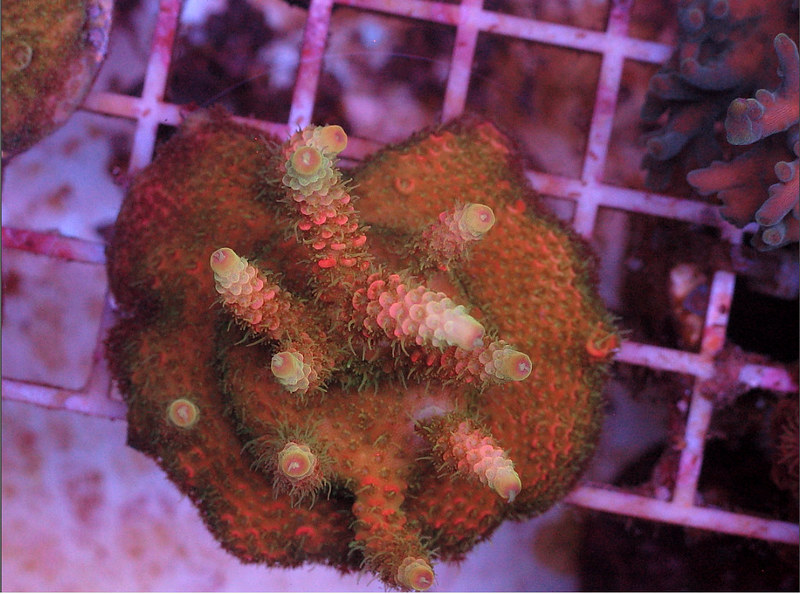
What is that piece? You have it colored crazy nice!

Thanks, it an AquaSD Rainbow Milli

I have a red staghorn that I have been growing for about two years from a tiny frag. I actually did it again last night so I could have other backup options, but it has yet to branch out and it's about 6" tall. I have cut the tip off of it about 5 or 6 times! Doesn't always work, but with tabling acros the chances are much higher you will get more branches.

I'm not sure cutting a tip of will do much, especially on a thinly branched acro............the branch diameter has to be large enough for more than one sprout to form. If you haven't tried yet, I'd cut down the branch to where it's at least a 1/4" in diameter or more.

I do agree with table and bush type corals you'll have many more sprouts from one cut than a stag horn type coral.
 

IF YOU HAD TO TAKE A REEFING EXAM, WOULD YOU PASS?

  • Yes!

    Votes: 32 45.7%
  • Not yet, but I have one that I want to buy in mind!

    Votes: 9 12.9%
  • No.

    Votes: 26 37.1%
  • Other (please explain).

    Votes: 3 4.3%
Back
Top