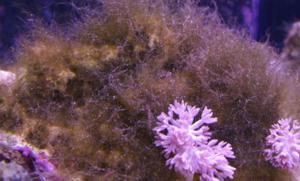
How can I be getting Algae with such a clean tank?
Phytoplankton can be airborne and has seeded cultures in bird baths inland. Most macro algaes can reproduce sexually which means spores. One drop of water contains spores, so cross contamination is always suspect. Also, I have used Texas holy rock as a base rock to attach corals and decorative macro algae. The limestone rock had been dry for a thousand years. Some of these rocks grew coralline algae. Because nature finds a way to survive, dry spores of GHA could just as easily come in as airborne or attached to dry media.
A good guide to identify most of the nuisance algae that plagues the hobby. Complete with pictures and suggested treatments

www.reefcleaners.org
Green Hair Algae
Green Hair Algae or "GHA" is really a broad term that covers hundreds of species of green simple filamentous algae. These species tend to be simple, fine in texture, and have few distinguishable features. True species level identification requires a microscope.
Distinguishing it from look-a-likes: GHA is not coarse or wiry, it should break apart easily when pulled, and should lose form quickly when removed from water. If you can make out a root structure, or a stiff branching structure it is probably not GHA.
Manual Removal: Green hair algae can be pulled out easily, and tooth brushed or scrubbed off the rock work. This is easier to do if the rock is outside of the tank. If it is growing from the sand sift it out with a net.
Clean Up Crew: Assorted Hermits, Blue Legs, Florida Ceriths, Chitons, Turbograzers, Sea Hares, Conchs, Emerald Crabs, Urchins and a few others. It is readily accepted by many herbivores, but because it grows quickly it may persist even











 ....wish I could