- Joined
- Jan 2, 2024
- Messages
- 78
- Reaction score
- 39
- Location
- Ashland, Oregon
- What state or country do you live in
- Oregon
I have a nano Macroalgae tank with a growing hair algae problem. Any tips?


Follow along with the video below to see how to install our site as a web app on your home screen.
Note: This feature may not be available in some browsers.



I’ve got hermits, dove snails, trochus, turbo, cerith, marginella snails, they don’t seem to be able to keep up with it unfortunatelyGet a robust CUC, including the operator.
Thanks -Inverts will work well, but check your nitrates and phos too. And if u don’t have many corals lowering lights also work



Syphon out as much as you can use a tooth brush to scrub while syphoningI have a nano Macroalgae tank with a growing hair algae problem. Any tips?
Syphoning is almost impossible; it’s a 5 gallon tank. By the time I get a siphon going half the waters gone lol xDSyphon out as much as you can use a tooth brush to scrub while syphoning
And add a good CUC.
Thanks for the info. It’s definitely a newer tank (4 months or so but I got it secondhand). I have some GFO but worried ill bottom out my phosphatesHow old is the tank? I tend to notice hair algae problems when my tanks are newer (under 2-3 years old). If that's the case, just run some GFO until you don't need it anymore. Problems with adding too many invertebrates for me is that once the algae issue is fixed, most of them will starve to death which is kind of cruel imo.
yes, new tank tend to run into these algae issues.sounds pretty normal to me. I never have an issue with GFO, if anything you can stop using it at any point.Thanks for the info. It’s definitely a newer tank (4 months or so but I got it secondhand). I have some GFO but worried ill bottom out my phosphates


Mine won’t eat gha, he scoots around eating any developing coraline. Had to get a pencil urchin too to take up his slack. That little guy is an algae eating machine…. Plus he doesn’t redecorate my tank tooTuxedo urchin is the star of my CUC. Consider getting one and they’re super cool little things
Very very interesting I’ll have to break out the microscope and throw some gfo in and see if that’ll wipe it out. Appreciate the insight. Maybe a dose of chemiclean and I’ll be able to get rid of it? If only life was that easy lol!That doesn't look like gha. Calothrix is def a possibility



Thanks, this is super informativeThere are quite a few differrrent variety of Cyanobacteria & GHA:
I don’t think you have Calothrix
Nuisance Algae ID Guide
A good guide to identify most of the nuisance algae that plagues the hobby. Complete with pictures and suggested treatmentswww.reefcleaners.org
Calothrix
These species of cyano often appear as a light slimy yet hairy/fuzzy nastiness that loosely attaches to your rock work. Air bubbles are usually trapped while escaping the "algae", just like in the picture to the left. Calothrix is a type of blue green algae that looks very similar to Dinos. We have them next to each other in the guide to help you distinguish the difference between the two.
Manual Removal: Remove the rock and scrub, and then fine tune with a toothbrush. Let the cleaners get the rest. It helps to use a net to collect the debris that will occur as a result of the toothbrushing.
GHA
Green Hair Algae
Green Hair Algae or "GHA" is really a broad term that covers hundreds of species of green simple filamentous algae. These species tend to be simple, fine in texture, and have few distinguishable features. True species level identification requires a microscope.
Distinguishing it from look-a-likes: GHA is not coarse or wiry, it should break apart easily when pulled, and should lose form quickly when removed from water. If you can make out a root structure, or a stiff branching structure it is probably not GHA
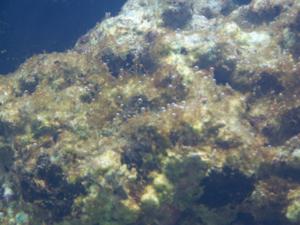
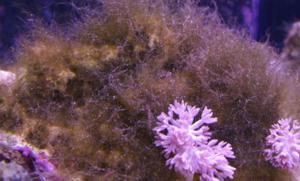
Here’s some more photos of what I’ve got going on. Certainly more “brown” than “green” but always assumed it was just GHA. I had a significant diatom bloom (microscope ID) and as soon as that subsided, this algae issue spread all over the tank. Some of the cells looked very algae like under the scope so that’s what I figured it was.There are quite a few differrrent variety of Cyanobacteria & GHA:
I don’t think you have Calothrix
Nuisance Algae ID Guide
A good guide to identify most of the nuisance algae that plagues the hobby. Complete with pictures and suggested treatmentsCalothrix
These species of cyano often appear as a light slimy yet hairy/fuzzy nastiness that loosely attaches to your rock work. Air bubbles are usually trapped while escaping the "algae", just like in the picture to the left. Calothrix is a type of blue green algae that looks very similar to Dinos. We have them next to each other in the guide to help you distinguish the difference between the two.
Manual Removal: Remove the rock and scrub, and then fine tune with a toothbrush. Let the cleaners get the rest. It helps to use a net to collect the debris that will occur as a result of the toothbrushing.
GHA
Green Hair Algae
Green Hair Algae or "GHA" is really a broad term that covers hundreds of species of green simple filamentous algae. These species tend to be simple, fine in texture, and have few distinguishable features. True species level identification requires a microscope.
Distinguishing it from look-a-likes: GHA is not coarse or wiry, it should break apart easily when pulled, and should lose form quickly when removed from water. If you can make out a root structure, or a stiff branching structure it is probably not GHA