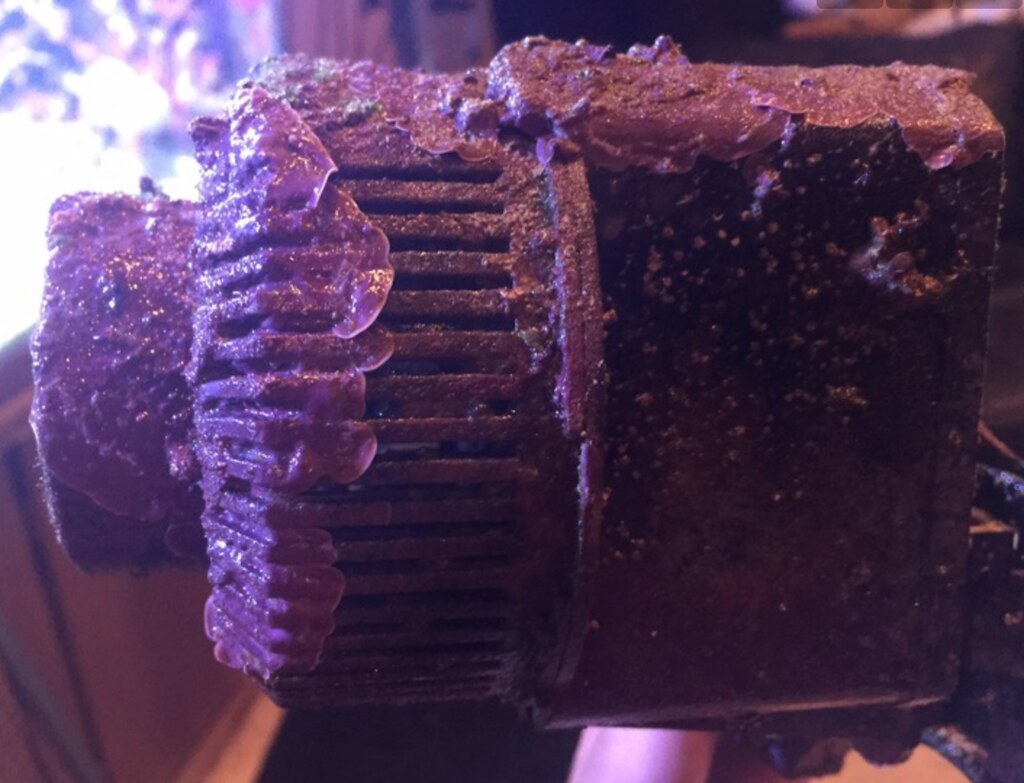
I need QUICK help. Using muaritic acid as I type this.

Next time, do it outside in a safe place like the rocks on the side of your house. You can pour in some baking soda and then just dilute with hose water. Keep it away from concrete. I like it outside since fumes are not an issue and neither is a small spill or splash.

I have found Muriatic incredibly safe and effective cleaner. It is safer on plastic than vinegar. Citric acid is fine, just not as strong.

 
Vinegar is BAD for pumps.
The acid in vinegar gets through plastic and rubber eating away at the seals of the pumps.
That's why so many have had swollen and cracked magnets and blown seals.

Muriatic acid does not eat through plastics and rubber. It's perfectly safe to use as long as you use it properly.

I just had a hard time figuring out how to dispose of it safely.
Acid is acid (H+).

Whether it is vinegar or citric or hydrochloric or sulfuric. The only thing that makes them different is the anion.
 
Acid is acid (H+).

Whether it is vinegar or citric or hydrochloric or sulfuric. The only thing that makes them different is the anion.

Yes but what the eat through is different.
Look it up.
It has been shown that vinegar soaks are bad for pumps.
 
Yes but what the eat through is different.
Look it up.
It has been shown that vinegar soaks are bad for pumps.
Then the anion for vinegar is an issue, not the cation or acid (H+)

If I were to venture a guess I would say that the cation in vinegar reacts with the plastic and when there is fissure then the acid will react with the metal.

I don't normally get calcerous build up on my pumps so I clean them normally. Honestly unless you have a pump in an ATO that you are dosing Kalk with, you are unlikely to get calcerous build ups. I wouldn't resort to cleaning anything with any acid unless I was sure that it needed it. My 2 cents.
 
I am cleaning my return pumps.

You mean, other than these types of buildups? Tooth brush and vinegar will not even make a dent.

Of course you use Muratic acid on that. :P

I also dose a mixture that is heavy with carbonate and it builds up in the lines over time. I don't want to replace the lines and it is easy to re-circulate Muratic acid to clean them up.

Return pumps and closed loops don't tend to look like your pic @jda. :P
 
RedFish BlueFish discusses the likely chemistry behind vinegar being an issue here. The thought is that it is the neutral acetic acid molecule in vinegar that brings the acid into a plastic (it is soluble in nonaqueous solvents) while other acids do not (or do so far less at equivalent pH):

 
RedFish BlueFish discusses the likely chemistry behind vinegar being an issue here. The thought is that it is the neutral acetic acid molecule in vinegar that brings the acid into a plastic (it is soluble in nonaqueous solvents) while other acids do not (or do so far less at equivalent pH):

Hi Randy,
Do you think exposure time might come into play? A 5 or 10 minute soak vs hours?
Thanks
 
Hi Randy,
Do you think exposure time might come into play? A 5 or 10 minute soak vs hours?
Thanks

You mean vinegar at long times vs vinegar at short time? Certainly seems like it should. :)

If you mean faster in HCl (because the pH is lower) vs inherently slower in vinegar, I would not suspect that is the dominant factor. If you match pH, and hence match time needed to dissolve CaCO3, I suspect vinegar is worse.

But the fact that vinegar naturally takes a long time certainly allows more penetration and damage (assuming that theory is the explanation).
 

IF YOU HAD TO TAKE A REEFING EXAM, WOULD YOU PASS?

  • Yes!

    Votes: 32 45.7%
  • Not yet, but I have one that I want to buy in mind!

    Votes: 9 12.9%
  • No.

    Votes: 26 37.1%
  • Other (please explain).

    Votes: 3 4.3%
Back
Top