Yeah, it doesn't help new research only adds to the complexity of reef ecosystems including showing there's not only species specific but
genotype specific stuff.

I started really digging into DOC a decade ago after posts about labile and refractory DOC to help understand better what's happening in my systems. About that time I stumbled across Rower's book which is still the best introduction I've found.
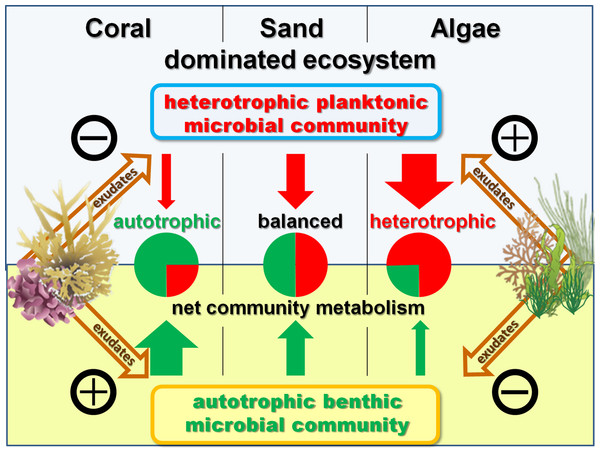
Of course, but the DOC corals and algae release are differentially promoting the microbiomes in the water. (My thinking about microbial stuff was shifted in a conversation with the director of infectious diseases of a local hospital in '97 but PaulB certainly deserves kudo's for bringing up the subject a long time ago on some of the forums.) Water changes will lower the number of microbes detrimental to corals along with detrimental DOC. Ideally, corals will be able to replenish more of the beneficial stuff in the water than the alage does the detrimental stuff. Also, coral DOC largely stays in the coral's mucus layer hopefully promoting the beneficial bacteria that are a critical components to coral immune systems whereas algae DOC promotes increased microbial loads in the water allowing microbes to utilize refractory DOC as a food source not normally available. Surprisingly, one counter intuitive finding is the increase algae DOC production results in lower and in extreme situations no DOC, labile or refractory, in a reef system (Andreas Haas, presetation to Austin Reef Club frag swap, 2015). Here's some of the links I've collected over the years:
These first five do an excellent job of introducing the subject of DOC, corals, algae and microbes and is probably all anyone planning on keeping a reef going for decades needs. Rest is mostly for obsesive types like me:
Total Organic Carbon Pt 1
Department of Chemistry, The Pennsylvania State University, University Park, PA 16802. Ken and Kelly report on their work on Total Organic Carbon and how it relates to the reef aquarium.

www.advancedaquarist.com
Total Organic Carbon Pt 2
Department of Chemistry, The Pennsylvania State University, University Park, PA 16802. Ken and Kelly continue to report on their work on Total Organic Carbon and how it relates to the reef aquarium.
www.advancedaquarist.com
Bacterial Counts in Reef Aquarium Water
What are the bacteria populations in the water column of reef tanks, and how does that value compare with bacterial counts in authentic reef water? Does carbon dosing indeed increase water column bacteria populations (i.e., is growth carbon limited)? Does mechanical filtration (protein skimming...
reefs.com
"Coral Reefs in the Microbial Seas" This video compliments Rohwer's book of the same title (Paper back is ~$20, Kindle is ~$10), both deal with the conflicting roles of the different types of DOC in reef ecosystems. While there is overlap bewteen his book and the video both have information not covered by the other and together give a broader view of the complex relationships found in reef ecosystems
Here's a data bomb on microbes and doc and sponges. If it seems overwhelming keep in mind I've taken over 10 years to collect the links so don't feel you need to read or watch them all by the end of the month. Some have to be purchased to read the entire paper but the abstract will have some essential points. (And don't think I've bought all the ones needing purchase.

)
Changing Seas - Mysterious Microbes
Nitrogen cycling in hte coral holobiont
BActeria and Sponges
Maintenance of Coral Reef Health (refferences at the end)
Indirect effects of algae on coral: algae‐mediated, microbe‐induced coral mortality

onlinelibrary.wiley.com
Influence of coral and algal exudates on microbially mediated reef metabolism.
Coral DOC improves oxygen (autotrophy), algae DOC reduces oxygen (heterotrophy).
Benthic primary producers in tropical reef ecosystems can alter biogeochemical cycling and microbial processes in the surrounding seawater. In order to quantify these influences, we measured rates of photosynthesis, respiration, and dissolved organic carbon (DOC) exudate release by the dominant...

peerj.com
Role of elevated organic carbon levels and microbial activity in coral mortality
Effects of Coral Reef Benthic Primary Producers on Dissolved Organic Carbon and Microbial Activity
Algae releases significantly more DOC into the water than coral.
Benthic primary producers in marine ecosystems may significantly alter biogeochemical cycling and microbial processes in their surrounding environment. To examine these interactions, we studied dissolved organic matter release by dominant benthic taxa and subsequent microbial remineralization in...

journals.plos.org
Pathologies and mortality rates caused by organic carbon and nutrient stressors in three Caribbean coral species.
Starch and sugars (doc) caused coral death but not high nitrates, phosphates or ammonium.
Visualization of oxygen distribution patterns caused by coral and algae
Planar optodes were used to visualize oxygen distribution patterns associated with a coral reef associated green algae (Chaetomorpha sp.) and a hermatypic coral (Favia sp.) separately, as standalone organisms, and placed in close proximity mimicking coral-algal interactions. Oxygen patterns were...
peerj.com
Biological oxygen demand optode analysis of coral reef-associated microbial communities exposed to algal exudates
Exposure to exudates derived from turf algae stimulated higher oxygen drawdown by the coral-associated bacteria.
Algae-derived dissolved organic matter has been hypothesized to induce mortality of reef building corals. One proposed killing mechanism is a zone of hypoxia created by rapidly growing microbes. To investigate this hypothesis, biological oxygen ...

www.ncbi.nlm.nih.gov
Microbial ecology: Algae feed a shift on coral reefs
Human pressures on coral reefs are giving macroalgae a competitive advantage over reef-building corals. These algae support larger, and potentially pathogenic, microbial populations that are metabolically primed for less-efficient, yet faster, carbohydrate remineralization, perpetuating a...

www.nature.com
Coral and macroalgal exudates vary in neutral sugar composition and differentially enrich reef bacterioplankton lineages.
Increasing algal cover on tropical reefs worldwide may be maintained through feedbacks whereby algae outcompete coral by altering microbial activity. We hypothesized that algae and coral release compositionally distinct exudates that differentially alter bacterioplankton growth and community...

www.ncbi.nlm.nih.gov
Sugar enrichment provides evidence for a role of nitrogen fixation in coral bleaching
onlinelibrary.wiley.com
Elevated ammonium delays the impairment of the coral-dinoflagellate symbiosis during labile carbon pollution
(here's an argument for maintaining heavy fish loads if you're carbon dosing)
Labile dissolved organic carbon (DOC) is a major pollutant in coastal marine environments affected by anthropogenic impacts, and may significantly con…

www.sciencedirect.com
Excess labile carbon promotes the expression of virulence factors in coral reef bacterioplankton
Coastal pollution and algal cover are increasing on many coral reefs, resulting in higher dissolved organic carbon (DOC) concentrations. High DOC concentrations strongly affect microbial activity in reef waters and select for copiotrophic, often potentially virulent microbial populations. High...
www.nature.com
Unseen players shape benthic competition on coral reefs.
Recent work has shown that hydrophilic and hydrophobic organic matter (OM) from algae disrupts the function of the coral holobiont and promotes the invasion of opportunistic pathogens, leading to coral morbidity and mortality. Here we refer to these dynamics as the (3)DAM [dissolved organic...
www.ncbi.nlm.nih.gov
Allelochemicals Produced by Brown Macroalgae of the Lobophora Genus Are Active against Coral Larvae and Associated Bacteria, Supporting Pathogenic Shifts to Vibrio Dominance.
Diverse microbial communities associate with coral tissues and mucus, providing important protective and nutritional services, but once disturbed, the microbial equilibrium may shift from a beneficial state to one that is detrimental or pathogenic. Macroalgae (e.g., seaweeds) can physically and...
www.ncbi.nlm.nih.gov
Macroalgae decrease growth and alter microbial community structure of the reef-building coral, Porites astreoides.
With the continued and unprecedented decline of coral reefs worldwide, evaluating the factors that contribute to coral demise is of critical importance. As coral cover declines, macroalgae are becoming more common on tropical reefs. Interactions between these macroalgae and corals may alter the...
www.ncbi.nlm.nih.gov
Macroalgal extracts induce bacterial assemblage shifts and sublethal tissue stress in Caribbean corals.
Benthic macroalgae can be abundant on present-day coral reefs, especially where rates of herbivory are low and/or dissolved nutrients are high. This study investigated the impact of macroalgal extracts on both coral-associated bacterial assemblages and sublethal stress response of corals. Crude...
www.ncbi.nlm.nih.gov
Biophysical and physiological processes causing oxygen loss from coral reefs.
Global microbialization of coral reefs
DDAM Proven
Analysis of 60 sites in three ocean basins suggests that overgrowth of fleshy algae on coral reefs supports higher microbial abundances dominated by copiotrophic, potentially pathogenic bacteria via the provision of dissolved inorganic carbon.
www.nature.com
Coral Reef Microorganisms in a Changing Climate, Fig 3
Ecosystem Microbiology of Coral Reefs: Linking Genomic, Metabolomic, and Biogeochemical Dynamics from Animal Symbioses to Reefscape Processes
Here's stuff on sponges which I think have been badly overlooked as sponges are integral to processing DOC in reef ecosystems. Steve Tyree certainly deserves kudos for promoting them. Sponges are essential recyclers in reef systems but are a double edge sword as they process DOC from corals differently than algae. To some extent they are protecting aquarists who carbon dose from the negative effects of excess labile DOC but research has shown as reef ecosystems are impacted by stressors they can form a positive feedback loop favoring algae hastening phase shifts detrimental to corals.
Element cycling on tropical coral reefs.
This is Jasper de Geoij's ground breaking research on reef sponge finding some species process labile DOC 1000X faster than bacterioplankton. (The introduction is in Dutch but the content is in English.)
Sponge symbionts and the marine P cycle
Marine sponges are ubiquitous colonizers of shallow, clear-water environments in the oceans (1, 2). Sponges have emerged as significant mediators of biogeochemical fluxes in coastal zones by virtue of respiring organic matter and facilitating both the consumption and release of nutrients (3, 4)...

www.pnas.org
Processing of Naturally Sourced Macroalgal- and Coral-Dissolved Organic Matter (DOM) by High and Low Microbial Abundance Encrusting Sponges
Sponges play a key role in (re)cycling of dissolved organic matter (DOM) and inorganic nutrients in coral reef ecosystems. Macroalgae and corals release diff...

www.frontiersin.org
Phosphorus sequestration in the form of polyphosphate by microbial symbionts in marine sponges
Coral reefs are highly productive ecosystems that raise a conundrum called “Darwin’s paradox”: How can high production flourish in low-nutrient conditions? We show here that in three abundant Caribbean sponges, the granules that have been commonly observed in sponge tissue for decades are...
www.pnas.org
Differential recycling of coral and algal dissolved organic matter via the sponge loop.
Sponges treat DOC from algae differently than DOC from corals

besjournals.onlinelibrary.wiley.com
A Vicious Circle? Altered Carbon and Nutrient Cycling May Explain the Low Resilience of Caribbean Coral Reefs
Coral reefs are economically important ecosystems that have suffered unprecedented losses of corals in the recent past. Why have Caribbean reefs in particu

academic.oup.com
Surviving in a Marine Desert The Sponge Loop Retains Resources Within Coral Reefs
Dissolved organic carbon and nitrogen are quickly processed by sponges and released back into the reef food web in hours as carbon and nitrogen rich detritus.
PDF | On Jun 23, 2015, Jasper M de Goeij and others published 2013 deGoeij Science Sponge loop | Find, read and cite all the research you need on ResearchGate

www.researchgate.net
Natural Diet of Coral-Excavating Sponges Consists Mainly of Dissolved Organic Carbon (DOC)
The Role of Marine Sponges in Carbon and Nitrogen Cycles of COral Reefs and Nearshore Environments.
Explore millions of resources from scholarly journals, books, newspapers, videos and more, on the ProQuest Platform.

search.proquest.com
BActeria and Sponges
A Vicious Circle? Altered Carbon and Nutrient Cycling May Explain the Low Resilience of Caribbean Coral Reefs
Coral reefs are economically important ecosystems that have suffered unprecedented losses of corals in the recent past. Why have Caribbean reefs in particu
academic.oup.com