ICP TEST RESULTS AFTER SOAKING TRAVERTINE TILE IN RO/DI

Dr. Jim

Valuable Member
View Badges
Joined
Nov 30, 2019
Messages
1,345
Reaction score
1,093
Location
Naples, FL
What state or country do you live in
New Jersey
Rating - 0%
0   0   0
Travertine tile is essentially CaCO3 and similar to limestone. The difference between travertine and limestone occurs in nature when the layers of sedimentary rock end up being subjected to more pressure and heat making it limestone instead of travertine. Of course there is the possibility or probability that contaminants are also present. After my recent nightmare with elevated tin in my aquarium, I am reluctant to put anything “out-of-the-ordinary” into my tank without first testing it with an ICP test. I know a lot of reefers are using this tile to mount corals and apparently aren’t having any noticeable problems, but it might be worth noting what an ICP test recently revealed when I soaked a dozen 2”x2” travertine tiles in 1 quart of RO/DI for a month.

After investigating the different types of travertine tiles, I decided to go with the tumbled, “non-plugged”, non-polished tiles, thinking that they would be least likely to harbor unwanted "additives." Here are the ones I found on Ebay.
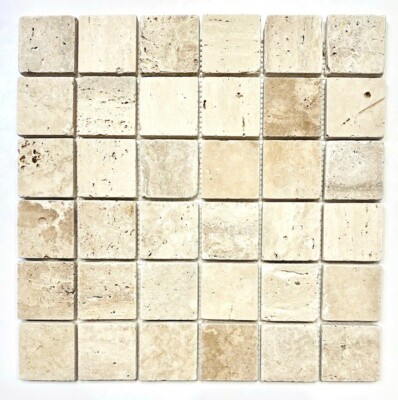
These 2x2 tiles came glued to a mesh so I had to peel them off. I could not find “loose” 2x2 tiles to purchase which would have been preferred. The tiles were easily peeled off the mesh but remnants of mesh and glue remained. These materials were completely removed with a wire brush. The opposite surface was also brushed to remove the slight sheen, in case it was coated with some compound.
Tiles grinding 9.20.20.jpg


The TABLE shows, by column:

1.The Element
detected by ICP
2. The ICP result for that element
3. The NORMAL level for that element (or, the set point used by ATI)

Since the tiles were soaked in only 1 quart of RO/DI, I extrapolated what the level would be in 40 gal and 100 gal of water in columns 4 and 5, respectively:
4. Result extrapolated for 40 gal water (This is how many gallons my 60 gal cube holds)
5. Result extrapolated for 100 gal. (To make it easy for you guys to extrapolate to your # of gallons :)

I then calculated how much of each element would theoretically/mathematically climb to in 1 year (ignoring water changes) for:
6. 40 gallons
7. 100 gallons

Potentially dangerous levels are colored in RED....(levels above NORMAL)
Close to potentially dangerous levels are colored in ORANGE


1 2 3 4 5 6
ELEMENT​
ICP Result (in 1 qt)​
NORMAL LEVEL​
EXTRAP. To 40 GAL​
EXTRAP. 100 GAL​
40 gal in
1 Year
​
100 gal in
1 Year
​
Zn​
3.50 1.900.020.0080.240.096
Sn20.48 0.480.1280.051.540.6
Al2.41 0.100.150.06 1.8 0.72
Fe3.59 0.480.020.0080.240.096
Ni5.05 0.480.030.0120.360.144
Si2276 89.7714.225.69170.668.3
Ba23.84 57.660.150.061.80.72

So, if anyone using tiles ever runs an ICP test and finds elevated levels of tin, aluminum or silicon, you may want to consider the tile leaching.

Thanks goes to @therman for “introducing” me to travertine tiles…..but after all my problems with tin, I may put this on the back-burner for a while! :)
 
As an eBay Associate we earn from qualifying purchases.

Nice! Curious if the wire brush may have left some residue on the tiles?
Cheers! Mark
No, I'm sure it didn't. And, I washed the tiles after brushing with tap water, then rinsed in RO/DI before moving to the final RO/DI "soaking container."
 
Uh.... extrapolation? Tin? This seems to be overthinking, IMO. I’ve used 3x3 travertine tiles without issue. I don’t even soak them.

Not saying it’s not your issue, but plenty of people use them without problems.
 
Uh.... extrapolation? Tin? This seems to be overthinking, IMO. I’ve used 3x3 travertine tiles without issue. I don’t even soak them.

Not saying it’s not your issue, but plenty of people use them without problems.
No, I'm not saying the tiles caused my tin problem. My problem was the green tubing that comes with the Red Sea Reefer 170. (Level was 1432). If interested you can read about it here. (Start at the end and scroll up a little to my last 2-3 posts, including a long one).
 
Interesting. I had high tin levels (35 ug/l) that caused me to lose some large acropora colonies after I tied in a new sump/frag system which included a 150 livestock tank. I was blaming the tank, but I also had a ton of travertine tiles added at the same time.

Tin was the only elevated element however.
 
If you put the tiles into an aquarium, you’d most likely do regular water changes, which would reduce the build up of the undesirable elements.

Also, wouldn’t soaking in RODI water somewhat act as a sponge (similar to reverse osmosis) where the unwanted elements are drawn out of the travertine and into the “pure” water?

I’m somewhat surprised that people go through all this work instead of just buying ”safe” frag tiles from BRS.
There’s not much work in cutting a 3x3 tile into fourths. The removal of mesh and this and that.. not much work either.

for a 9 pack of 3x3 tiles, I can get 36 frag tiles for $4.00.
 
Didn’t see any test results for either the plain tap water you used to rinse, or plain RO/DI water used to soak in, as controls. Either one could potential be sources of the identified elements, as well.

I realize there is significant cost to the icp tests & appreciate your efforts. I just thought it worth mentioning.
 
Also, wouldn’t soaking in RODI water somewhat act as a sponge (similar to reverse osmosis) where the unwanted elements are drawn out of the travertine and into the “pure” water?

I was thinking this same thing as I was reading. Would soaking them in SW make any difference?
 
Deionized water can be corrosive to metals.

Also, if left open to the air, DI water will absorb significant CO2 which ionizes to form carbonic acid. That carbonic acid will then react with the travertine & certainly release adsorbed and/or incorporated impurities.

It might be worth repeating the experiment using fresh seawater made with DI, instead of just the DI by itself. Also, as mentioned it would be worth testing the DI by itself, as a control.

Interesting thread, thx!
 
First, I'm not suggesting that the tiles cause any problem. As I said, my tin problem was from something else. I simply tested these tiles before considering using them, and my previous tin problem prompted me to do this. I have not yet even put them in my tank. I may use them some day after I am sure my tin level reverts to zero after solving my present problem caused by the green tubing discussed previously.

These tile results may be interpreted as good news for those using tiles. I'm simply reporting my findings.

During my 35 ICP tests (not related to the tile testing), I tested my RO/DI water several times and it always tested perfectly "clean" and is therefore not likely to be a factor.

RO/DI was used instead of saltwater to eliminate the possibility that contaminants might come from the salt. RO/DI is very "reactive" meaning it will "try" to draw chemicals into it. So, IMO, it is better to use just RO/DI than saltwater to see if we can 'make' something leach. (I did use saltwater when I first started exploring my tin problem many months ago, unrelated to this "tile experiment," until deciding that use of RO/DI would be better for such experiments).
 
Also, if left open to the air, DI water will absorb significant CO2 which ionizes to form carbonic acid. That carbonic acid will then react with the travertine & certainly release adsorbed and/or incorporated impurities.

If that is true, then that might be more of a reason to use RO/DI. Anything we can do to make it "easier" to draw impurities out of the tiles, for testing purposes, would be a good thing. After all, the idea is to see if whatever object we are "testing" contains any impurities that may eventually leach into our tank. (It might be better to "falsely" draw them out so we know they are there rather than being fooled by not soaking long enough, for example).
 
If that is true, then that might be more of a reason to use RO/DI. Anything we can do to make it "easier" to draw impurities out of the tiles, for testing purposes, would be a good thing. After all, the idea is to see if whatever object we are "testing" contains any impurities that may eventually leach into our tank. (It might be better to "falsely" draw them out so we know they are there rather than being fooled by not soaking long enough, for example).

For a worst case, agreed.

I would still like to see results for both DI, & DI + salt. Just to know, as I am intrigued.
 
Very interesting! and thank you for doing this little experiment and sharing the results with us !

Might reconsider using the tile in the future.
 
Interesting results. FWIW I've been using hundreds of travertine tiles in my system for the past 10+ years, and have had undetectable tin, low levels of aluminum, and silicon that has varied over the past ~4 years I've done ICP testing (I've read various things in the past about elevated silica levels actually being beneficial, so this has never concerned me).

That being said, I submitted my well water for ICP and became seriously freaked out when it came back with high uranium and a bunch of other toxic weird heavy metals. When I submitted it to a state certified lab it came back with nothing of the sort detected. After that I decided that chasing numbers based on ICP results was a waste of money and quite possibly detrimental to my system and my sanity, so I rarely send them any more. I remember reading a writeup of someone else doing a rigorous check of ICP testing and coming back with hugely unreliable results as well, which confirmed my experience and conclusions (might have been Richard Ross?).

I do imagine that quality of those tiles can vary hugely based on the source, cleaning technique, filler, etc. To clean off the glue I peel off the backing and then microwave a bunch of tiles in a bowl of RO for ~4 min to heat and soften it. I scrub it off with a dish brush under running water and 99% of it easily comes off. It seems to be an "Elmer's" type water soluble white glue. Maybe my boiling in hot RO leaches out some of the impurities you detected?

Clearly your mileage may vary. My system is rather large and fully of so many rapidly growing SPS colonies that a lot of trace elements could get sucked up in skeletal growth before they would cause noticeable effects or persist in the water column long enough for a test to detect them.
 
There’s not much work in cutting a 3x3 tile into fourths. The removal of mesh and this and that.. not much work either.

for a 9 pack of 3x3 tiles, I can get 36 frag tiles for $4.00.

You can get 20 REEF SAFE tiles for $6 online. Probably could find them for less if you shop around. If a few bucks breaks you in this hobby, I think you might be in the wrong hobby!
 
You can get 20 REEF SAFE tiles for $6 online. Probably could find them for less if you shop around. If a few bucks breaks you in this hobby, I think you might be in the wrong hobby!
Just curious....which are these reef-safe tiles that you mentioned.....and how do you know they are truly reef-safe (without testing them)?
 
Interesting results. FWIW I've been using hundreds of travertine tiles in my system for the past 10+ years, and have had undetectable tin, low levels of aluminum, and silicon that has varied over the past ~4 years I've done ICP testing (I've read various things in the past about elevated silica levels actually being beneficial, so this has never concerned me).

That being said, I submitted my well water for ICP and became seriously freaked out when it came back with high uranium and a bunch of other toxic weird heavy metals. When I submitted it to a state certified lab it came back with nothing of the sort detected. After that I decided that chasing numbers based on ICP results was a waste of money and quite possibly detrimental to my system and my sanity, so I rarely send them any more. I remember reading a writeup of someone else doing a rigorous check of ICP testing and coming back with hugely unreliable results as well, which confirmed my experience and conclusions (might have been Richard Ross?).

I do imagine that quality of those tiles can vary hugely based on the source, cleaning technique, filler, etc. To clean off the glue I peel off the backing and then microwave a bunch of tiles in a bowl of RO for ~4 min to heat and soften it. I scrub it off with a dish brush under running water and 99% of it easily comes off. It seems to be an "Elmer's" type water soluble white glue. Maybe my boiling in hot RO leaches out some of the impurities you detected?

Clearly your mileage may vary. My system is rather large and fully of so many rapidly growing SPS colonies that a lot of trace elements could get sucked up in skeletal growth before they would cause noticeable effects or persist in the water column long enough for a test to detect them.
I agree that it is unlikely that the tiles are harmful, especially in a large tank with a lot of growing corals that might, as you suggested, incorporate any unwanted metals in their skeletons. I will hold off using them though in my small 40 gal tank, especially because of all the problems I've been having with so many variables. But once my house sells and I move, I'm sure I will not hesitate to use them in my next system (which will be 300-500 gallons most likely).

One thing I'd have to wonder, in regard to the discrepancy between the state lab and ICP results that you mentioned: how do you know that the state lab is using equipment more accurate or as sophisticated as ICP? (No need to answer....just throwing this out there). Thanks for your comments.
 
Travertine tile is essentially CaCO3 and similar to limestone. The difference between travertine and limestone occurs in nature when the layers of sedimentary rock end up being subjected to more pressure and heat making it limestone instead of travertine. Of course there is the possibility or probability that contaminants are also present. After my recent nightmare with elevated tin in my aquarium, I am reluctant to put anything “out-of-the-ordinary” into my tank without first testing it with an ICP test. I know a lot of reefers are using this tile to mount corals and apparently aren’t having any noticeable problems, but it might be worth noting what an ICP test recently revealed when I soaked a dozen 2”x2” travertine tiles in 1 quart of RO/DI for a month.

After investigating the different types of travertine tiles, I decided to go with the tumbled, “non-plugged”, non-polished tiles, thinking that they would be least likely to harbor unwanted "additives." Here are the ones I found on Ebay.

These 2x2 tiles came glued to a mesh so I had to peel them off. I could not find “loose” 2x2 tiles to purchase which would have been preferred. The tiles were easily peeled off the mesh but remnants of mesh and glue remained. These materials were completely removed with a wire brush. The opposite surface was also brushed to remove the slight sheen, in case it was coated with some compound.
Tiles grinding 9.20.20.jpg


The TABLE shows, by column:

1.The Element
detected by ICP
2. The ICP result for that element
3. The NORMAL level for that element (or, the set point used by ATI)

Since the tiles were soaked in only 1 quart of RO/DI, I extrapolated what the level would be in 40 gal and 100 gal of water in columns 4 and 5, respectively:
4. Result extrapolated for 40 gal water (This is how many gallons my 60 gal cube holds)
5. Result extrapolated for 100 gal. (To make it easy for you guys to extrapolate to your # of gallons :)

I then calculated how much of each element would theoretically/mathematically climb to in 1 year (ignoring water changes) for:
6. 40 gallons
7. 100 gallons

Potentially dangerous levels are colored in RED....(levels above NORMAL)
Close to potentially dangerous levels are colored in ORANGE


1 2 3 4 5 6

ELEMENT​
ICP Result (in 1 qt)​
NORMAL LEVEL​
EXTRAP. To 40 GAL​
EXTRAP. 100 GAL​
40 gal in
1 Year
​
100 gal in
1 Year
​
Zn​
3.50 1.900.020.0080.240.096
Sn20.48 0.480.1280.051.540.6
Al2.41 0.100.150.06 1.8 0.72
Fe3.59 0.480.020.0080.240.096
Ni5.05 0.480.030.0120.360.144
Si2276 89.7714.225.69170.668.3
Ba23.84 57.660.150.061.80.72


So, if anyone using tiles ever runs an ICP test and finds elevated levels of tin, aluminum or silicon, you may want to consider the tile leaching.

Thanks goes to @therman for “introducing” me to travertine tiles…..but after all my problems with tin, I may put this on the back-burner for a while! :)
Just wanted to mention that PVC can also contain tin.
 
As an eBay Associate we earn from qualifying purchases.

IF YOU HAD TO TAKE A REEFING EXAM, WOULD YOU PASS?

  • Yes!

    Votes: 30 44.8%
  • Not yet, but I have one that I want to buy in mind!

    Votes: 9 13.4%
  • No.

    Votes: 25 37.3%
  • Other (please explain).

    Votes: 3 4.5%
Back
Top