Navigation
Install the app
How to install the app on iOS
Follow along with the video below to see how to install our site as a web app on your home screen.
Note: This feature may not be available in some browsers.
More options
You are using an out of date browser. It may not display this or other websites correctly.
You should upgrade or use an alternative browser.
You should upgrade or use an alternative browser.
ID please
- Thread starter DavidJTawil
- Start date
- Tagged users None





Aquilonastra starfish - some people consider them pests, some people consider them CUC (see below).
Just to add some info on these stars to the discussion (pasted from another of my posts):
Yeah, asterina starfish (technically Aquilonastra, but known in the hobby as Asterina). Personally, I like them, but they do reproduce quickly (very quickly), and some people believe they eat corals (see my quotes below).
Just to add some info on these stars to the discussion (pasted from another of my posts):
Yeah, asterina starfish (technically Aquilonastra, but known in the hobby as Asterina). Personally, I like them, but they do reproduce quickly (very quickly), and some people believe they eat corals (see my quotes below).
The quote I referred to in my quote above:ISpeakForTheSeas said:
With regards to whether or not they eat corals, it might be a species specific thing, it might be a you have way too many starfish so they're out of other food options thing, or it might be they're eating the slime coat/mucus on the coral rather than the coral itself (see below).
Timfish said:
It's an Aquilonastra spp. starfish and is a great scavenger. I see them with anywhere from 4 to 12 legs. The whole discusion around them seems to me excellent examples of misidentification, mistaken behaviour and assumed causality based just on heresay without looking at the research. Asterina spp starfish are preditary but only reproduce sexually and are shortlived so while it's possible some might get into a tank even if it did happen it's not going to be around long. Aquilonastra are one of the uncommon species that reproduce fissiparous or by splitting so are easy to identify by the different sized legs regrown after splitting. They perform an important function not only feeding off algae films but also feeding off microbial films including those on corals (at least ones that don't sting). FYI the mucus coating on corals ages and corals have to periodicely shed it to renew it and maintian healthy microbial processes (Ref 1, Ref 2). If Aquilonastra are feeding on zoas or softies I'll argue they are either benign or even beneficial as they may be reducing the unhealthy older mucus which can be full of unhealthy microbes which the animal is trying to get rid of and are far more likely to be the actual problem.
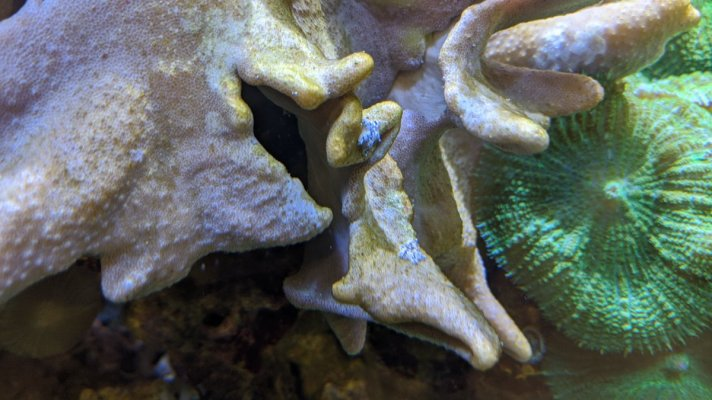
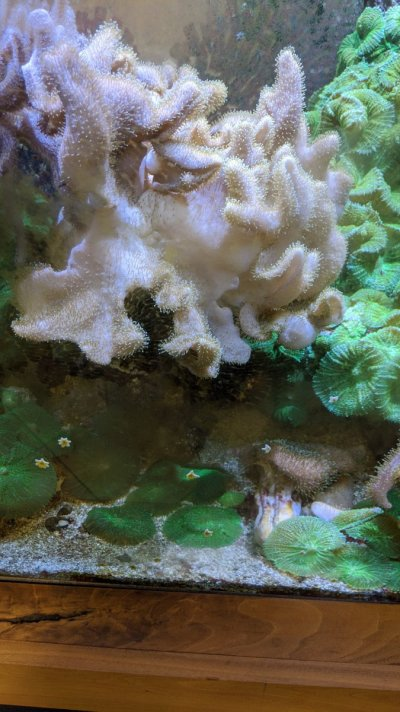
Here's an example, this Toadstool is doing one of it's periodic sheddings. The Aquilonastra have been in this system for years but only climb onto the Toadstool when it's shedding. In the first picture you can see the old mucus film, Aquilonastra starfish and areas they have cleaned off. The second picture shows the Toadstool a week later.
- Joined
- Nov 26, 2019
- Messages
- 223
- Reaction score
- 77
Thanks. I pulled it out thinking they're hitchhikers that eat zoas. Now i'm considering putting it back in and getting a harlequin shrimp if they get out of hand. Help me decide.Aquilonastra starfish - some people consider them pests, some people consider them CUC (see below).
Just to add some info on these stars to the discussion (pasted from another of my posts):
Yeah, asterina starfish (technically Aquilonastra, but known in the hobby as Asterina). Personally, I like them, but they do reproduce quickly (very quickly), and some people believe they eat corals (see my quotes below).
The quote I referred to in my quote above:


I vote leave it OUT.
I've seen a nice tank in the entry at my LFS go from zero to hundreds in just a couple of weeks.
They look cool individually but infestation doesn't look so nice. (My opinion only)
I've seen a nice tank in the entry at my LFS go from zero to hundreds in just a couple of weeks.
They look cool individually but infestation doesn't look so nice. (My opinion only)

One of those situations that it’s a classic it all depends on the tank. I have a 180 and a 90 both of which have been partially supported by Keys rock, and or large frags from LFSs, and in both tanks over a couple of years I think I have seen three Asterina. One of them is the same over a long period of time based on its leg pattern.
I also hear the stories of them completely taking over tanks.
No clear answer here, but if i had an explosion, i would set up a pico for a Harlequin
I also hear the stories of them completely taking over tanks.
No clear answer here, but if i had an explosion, i would set up a pico for a Harlequin
I started this hobby believing that most hitchhikers, including asterinas, we’re pests. I have them in all my nano and pico tanks and I rarely see them. They haven’t reproduced at the alarming rate that most reefers experience. I’ve kept them out of my larger tank just for aesthetic purposes, but I haven’t had any issues with them in my small tanks.
I’ve had the blue ones that supposedly eat zoas as well as the sand-colored ones; neither have harmed anything in my tanks.
I’ve had the blue ones that supposedly eat zoas as well as the sand-colored ones; neither have harmed anything in my tanks.

You'll find a lot of mixed opinions on this, but - personally - I like them, so I'd say keep them and give them away or get a harlequin shrimp as needed. Plus, as mentioned above, they don't always explode in population, so it might not even be an issue for you.Thanks. I pulled it out thinking they're hitchhikers that eat zoas. Now i'm considering putting it back in and getting a harlequin shrimp if they get out of hand. Help me decide.

This is interesting. I have left them in my system as well, once and only once did I see one on the GSP glued to my back wall - wonder if that was the case. Otherwise they seem to be great CUC, they fit into all sorts of small spaces.Aquilonastra starfish - some people consider them pests, some people consider them CUC (see below).
Just to add some info on these stars to the discussion (pasted from another of my posts):
Yeah, asterina starfish (technically Aquilonastra, but known in the hobby as Asterina). Personally, I like them, but they do reproduce quickly (very quickly), and some people believe they eat corals (see my quotes below).
The quote I referred to in my quote above: