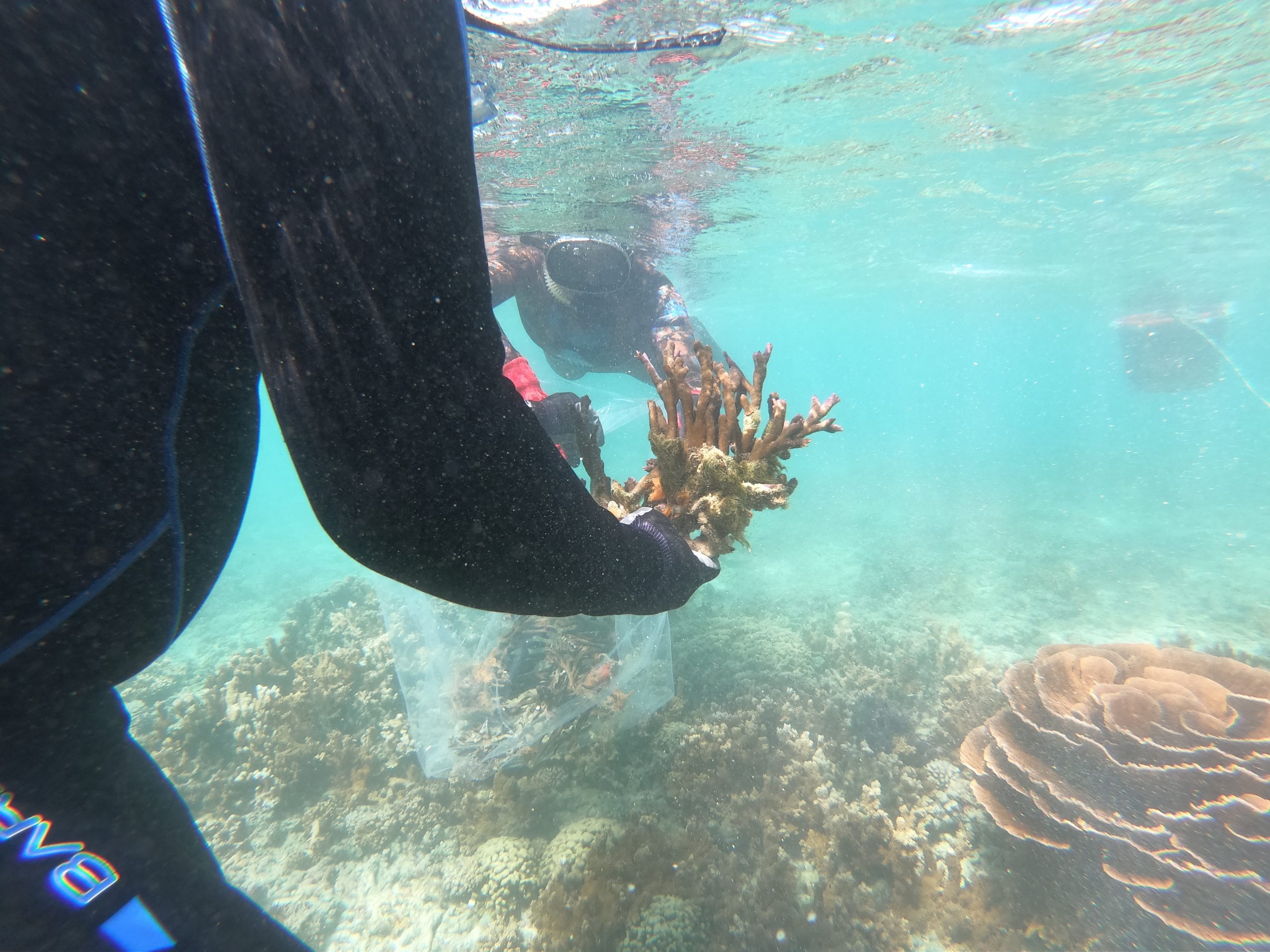
Invasive SPS Removed

VR28man

Valuable Member
View Badges
Joined
May 16, 2017
Messages
1,178
Reaction score
1,052
Rating - 0%
0   0   0
Thanks to @Jake Adams for posting this original in the RB subforum, and @ElussssvReefSD and @BighohoReef for posting there. Cross posting here for more visibility because I think it's interesting.

So in Kaneohe Bay, Oahu, Hawaii they found Montipora foliosa, digitata, and stellata. These corals are not found in Hawaii, though they're extremely common most other parts of the Pacific, and like most corals are usually not terribly colorful. One could argue that they came naturally by waves (it's been known to happen; the main Hawaiian islands even have some Acropora colonies because of this) BUT a) the middle of a bay lagoon is an unlikely location for such a random introduction (it would most likely come in an outer reef somewhere) b) two of these particular coral's color morphs look like the red/oranga "monti cap" and purple digi that are very common in our hobby (since they grow so well). I can't ID the third green one.

So it seems that not only is someone illegally keeping hard corals on Oahu (almost certainly near Kaneohe bay), but whoever it was decided to start their own coral farm in the middle of the bay.

Not a huge fan of them removing the corals - it would have been an interesting experiment and most Hawaiian corals, major exceptions being Porites compressa that's all over Kaneohe bay, are a very small fraction of what is found worldwide.

But I think removing them was almost certainly the right move.

Vimeo:

Reefbuilders:
Hawaii DLNR report:
 
Honestly, I don't really see the harm in leaving the corals there. For all we know the "native" corals of Hawaii all came in as non-native at one point in time. Are there any stony corals that are exclusively found in the Hawaiian islands? Imo any corals found in the South Pacific could end up in Hawaii. Just don't see the justification for removal, but I'm not a scientist.
 
Honestly, I don't really see the harm in leaving the corals there. For all we know the "native" corals of Hawaii all came in as non-native at one point in time. Are there any stony corals that are exclusively found in the Hawaiian islands? Imo any corals found in the South Pacific could end up in Hawaii. Just don't see the justification for removal, but I'm not a scientist.

I think I'm more with you @lemonade . While I agree that preserving native ecosystems is important, I think in this case, it should be balanced against the fact that corals are dying out across the globe. I think I had mentioned before that I live in Florida, and down in the Keys, staghorn and elkhorn corals are critically endangered and the remaining reefs are by and large extremely degraded. If a Pacific species of Acropora popped up and proved to more resilient and help to rebuild a previously decimated reef, should that coral be ripped up too because it's "not-native"? I know its not an apples-to-apples comparison, but you see my point?
 
If the introduced coral may outgrow the natives so the reef might end up with no natives and a monoculture of the successful introduction. That is the concern of introduced species among scientists. The ecosystem that was injured before the introduction doesn't need extra perturbations to deal with.

The other question is why are introduced species moved from one ocean to another by the effort of man "artificial" introductions but if the same coral arrives on the currents it is a natural occurrence that can be tolerated, in theory?

For disclosure, I do support the removal of these corals from the HI environment. Please don't release your pets into the wild. There have been some really ecologically damaging introductions by pet owners (and fishermen) who decided to release non-natives into new environments that have turned out bad for the natives.
 
If the introduced coral may outgrow the natives so the reef might end up with no natives and a monoculture of the successful introduction. That is the concern of introduced species among scientists. The ecosystem that was injured before the introduction doesn't need extra perturbations to deal with.

The other question is why are introduced species moved from one ocean to another by the effort of man "artificial" introductions but if the same coral arrives on the currents it is a natural occurrence that can be tolerated, in theory?

For disclosure, I do support the removal of these corals from the HI environment. Please don't release your pets into the wild. There have been some really ecologically damaging introductions by pet owners (and fishermen) who decided to release non-natives into new environments that have turned out bad for the natives.

I guess my point was more along the lines of, "if the natives are dying, is it better to have a dead native reef, or a live invasive reef". But your point is well-taken.
 
I thought that too at first when i read about similar occurences at some japanese coast, but the thing is, a few invasive corals don't make an ecosystem. They have no genetic diversity, but more importantly, all the specialised tiny crabs and fishes and other stuff that evolved to live in harmony with that particular coral isn't there. And evolution is too slow for the local fauna to just switch over, so it's more likely that you'll get a collapse instead of a replacement.
 
If the introduced coral may outgrow the natives so the reef might end up with no natives and a monoculture of the successful introduction. That is the concern of introduced species among scientists. The ecosystem that was injured before the introduction doesn't need extra perturbations to deal with.

The other question is why are introduced species moved from one ocean to another by the effort of man "artificial" introductions but if the same coral arrives on the currents it is a natural occurrence that can be tolerated, in theory?

For disclosure, I do support the removal of these corals from the HI environment. Please don't release your pets into the wild. There have been some really ecologically damaging introductions by pet owners (and fishermen) who decided to release non-natives into new environments that have turned out bad for the natives.

The reason I'd argue this is because the corals in Hawaii are also native to most of the locations the species removed are from. None dominating the other in those regions. If they occur naturally in one area together then what harm can be done if they are together in another?

It would be interesting to know if the people behind removing the corals did any studies into what potential threat they cause. If there is a species exclusive to the Hawaii islands that was in danger of being outgrown by these species on Montipora then I would completely agree with their removal.
 
If they want to introduce corals in Florida I would vote for some planned Indo introductions so that we don't have to rely on foreign imports to bring in all the beautiful corals we have to pay so much to get now! :) (No, I'm not serious. But the thought has crossed my mind)

The introductions of bland montipora in Hawaii isn't going in the right direction either.

I think most folks have heard that Caulerpa is not to be played with. Non-native coral introductions could have similar impacts and these kinds of introductions have been studied and reports of negative impacts generally outweigh any improvements (for natives) when introductions occur. Bad weed article

Woops, wrong link, fixed.
 
I understand why it was removed and really have no problem with it.
What I did not know (been away from hobby a long time) was that Hawaii does not allow SPS on the island as part of the pet trade.
Again, I know what the temptations are but didn't know just the same.
 
I pulled out my copy of Corals of Hawaii. It lists a few species only found in those islands, but not only are they fairly uncommon, but Corals of the World lists them as "confirmed: in other areas. (with again the exception of Porites compressa, which admittedly has had lots of die offs in Hawaii, even in places like Kaneohe bay where it's probably the dominant species common)

Most of Hawaii's species are very common worldwide (Porites lobata, evermanni, Pocillopora eydouxi, damicornis, meandrina, Montipora capitata).

I think this was actually a pretty knee jerk decision, since I'm not so sure that even if it overran Kaneohe bay that would not necessasrily be a disaster for worldwide biodiversity. But at the same time this was almost certainly placed there by a nearby illegal SPS keeper. If it had been planted by common assent, or if it had come on the currents (it did not; those color morphs -called in our hobby red monti cap and ORA purple digi - are not by themselves terribly common, though their parent species are extremely common almost everywhere in the tropical pacific - except for Hawaii), those would be OK.

Anyway, it's a shame. That was a nice big red monti cap colony. I'm fairly certain the Waikiki aquarium does not have space for it, unless they put it in their coral pond outside.

Again, non-introduced acropora cytherea colonies afaik have not been removed. I can't really argue against removing species introduced without any authorization by some random person.

The introductions of bland montipora in Hawaii isn't going in the right direction either.

Red monti cap and ORA purple digis are actually quite colorful compared to 90+% of their parent species. To say nothing of the most common monti in Hawaii:


(in the vimeo thumbnail you acually can see M. capitata just to the right of the ORA purple digi)
 
Last edited:
I can see both points of view on this. On one hand an invasive species could be bad for the indigenous ecosystem. On the other hand everything in Hawaii was an invasive species at one point.

I wonder if it would be beneficial to introduce genetically distant examples of the same species to try and get a more robust population. We see it in dog breeding where type of dog such as the German Shepherd grows weak over the decades due to inbreading. However if you introduce it to a genetically unrelated pool of dogs the offspring are generally stronger. Hence why mutts have fewer health problems than pure breds
 
I wonder if it would be beneficial to introduce genetically distant examples of the same species to try and get a more robust population. We see it in dog breeding where type of dog such as the German Shepherd grows weak over the decades due to inbreeding. However if you introduce it to a genetically unrelated pool of dogs the offspring are generally stronger. Hence why mutts have fewer health problems than pure breds

I agree that captive animals can benefit from diversity in the gene pool. I think it is a great idea to use genetics for propagation of corals for the aquarium trade in captivity.

One of the brewing disasters in reef management (imo) could be the replanting of aquacultured coral frags onto "decimated" reefs. Sure you can get positive (positive = new coral colonies) growing by transplanting, but the process artificially selects for coral that originated at another location meters or miles away from the outplanting site. The farmer plants that non-native frag in a location deemed good by the planter. This process eliminates natural propagation (and any natural selection) that would occur in nature if the farmer waited for nature to do what nature does best.

This is a whole new can of worms that is perhaps ironically factored into the decision process that removed the non-native coral in Hawaii (by scientist) while scientists in another part of the state (or perhaps the world?) are gleefully planning coral propagation schemes for reefs replenishment that doesn't include selecting for more colorful species, just "natives." Farmed "native" coral doesn't replace naturally spawned and settled corals.

I think that the reefs should be protected from pollution and man-made mechanical damage first, and left alone for the most part to do what they would do without much artificial intervention.


@VR28man Yes, the coral trade is focused upon beauty while in the wild we find lots of brownies that don't excite a lot of love in the aquarium world. I think that the best reason for not allowing random or planned introductions is the fact that we don't know near enough about how all the many parts of the ecosystem function together to "make it better" than the original. Introductions in our closed systems only threaten our closed systems vs adding something pretty to improve the ugly brown ecosystem, something we have done on land with plants, isn't reliably a good idea.

The movement and manipulation of corals on reefs by resource managers should not be allowed on a wide scale. Look at the Reef2Reef tank build threads and the pest threads and then think about how easy it is to make a simple mistake that crashes a tank. How does selection of coral for propagation and selection of out-planting spots impact natural coral settlement? The argument that nature needs our help to speed up the process of recovery is believable when we are focusing upon reducing farm and urban run-off and those kinds of management goals. Planting propagated corals on a wild reef is a different story and I think our captive reefs should be where we keep artificially propagated corals and let nature handle the wild spawning.
 
That's fair @KrisReef . That said, I'm pretty sure that most coral farms raise the same species of corals as are found locally. If there was a massive bleaching event or somesuch, I don't see much harm planting such frags prior to corals landing and growing on site again. Heck, if every A. tenuis on a reef died, theoretically replacing the one for one with "Walt Disney" tenuis frags would be fine, though who knows where the original WD came from and what effect that might have.........

Despite all the coral repropagation projects, I'm not sure that we have any good case the long term effects of such programs.
 
Last edited:

IF YOU HAD TO TAKE A REEFING EXAM, WOULD YOU PASS?

  • Yes!

    Votes: 32 45.7%
  • Not yet, but I have one that I want to buy in mind!

    Votes: 9 12.9%
  • No.

    Votes: 26 37.1%
  • Other (please explain).

    Votes: 3 4.3%
Back
Top