Navigation
Install the app
How to install the app on iOS
Follow along with the video below to see how to install our site as a web app on your home screen.
Note: This feature may not be available in some browsers.
More options
You are using an out of date browser. It may not display this or other websites correctly.
You should upgrade or use an alternative browser.
You should upgrade or use an alternative browser.
Is this a sea star?
- Thread starter RIC13
- Start date
- Tagged users None





- Joined
- Jul 24, 2016
- Messages
- 1,126
- Reaction score
- 744
- Location
- Maine, USA
- What state or country do you live in
- Maine
+1 Asterina. I used to pull over 50 a day from my 180. I haven’t seen them cause any damage; however, they reproduce asexually and can quickly become an eye sore.

Yes, it's a personal decision, They are scavengers, some are more of a pest than others. Probably not the first time you will see one. I personally would keep it. But those are the types of tanks I have.

- Joined
- Feb 13, 2017
- Messages
- 5,660
- Reaction score
- 6,632
- Location
- Los Angeles (SFV)
- What state or country do you live in
- California
Aquilonastra, consumers of algae (good and bad algae). Their numbers can increase over time, but I don’t mind as they eat algae.

OP
OP

- Joined
- Sep 21, 2019
- Messages
- 236
- Reaction score
- 100
- What state or country do you live in
- Indiana
I don’t have these in my DT and I’ve only found this one in my QT. For those of you who have found multiple and wanted to eliminate them, what are your options?

- Joined
- Oct 3, 2018
- Messages
- 3,605
- Reaction score
- 4,632
They do in fact also eat acros

Most people just “rent” a harlequin shrimp or two if the population gets too out of hand - otherwise manual removal is pretty much the only other option.I don’t have these in my DT and I’ve only found this one in my QT. For those of you who have found multiple and wanted to eliminate them, what are your options?
Yeah, asterina starfish (technically Aquilonastra, but known in the hobby as Asterina). Personally, I like them, but they do reproduce quickly (very quickly), and some people believe they eat corals (see my quotes below).
The quote I referred to in my quote above:ISpeakForTheSeas said:
With regards to whether or not they eat corals, it might be a species specific thing, it might be a you have way too many starfish so they're out of other food options thing, or it might be they're eating the slime coat/mucus on the coral rather than the coral itself (see below).
Timfish said:
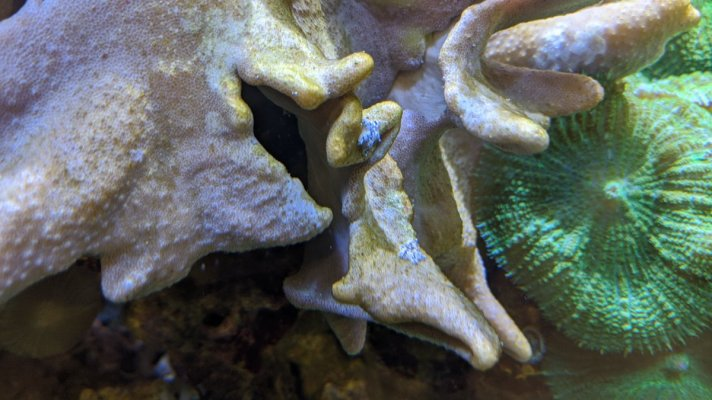
It's an Aquilonastra spp. starfish and is a great scavenger. I see them with anywhere from 4 to 12 legs. The whole discusion around them seems to me excellent examples of misidentification, mistaken behaviour and assumed causality based just on heresay without looking at the research. Asterina spp starfish are preditary but only reproduce sexually and are shortlived so while it's possible some might get into a tank even if it did happen it's not going to be around long. Aquilonastra are one of the uncommon species that reproduce fissiparous or by splitting so are easy to identify by the different sized legs regrown after splitting. They perform an important function not only feeding off algae films but also feeding off microbial films including those on corals (at least ones that don't sting). FYI the mucus coating on corals ages and corals have to periodicely shed it to renew it and maintian healthy microbial processes (Ref 1, Ref 2). If Aquilonastra are feeding on zoas or softies I'll argue they are either benign or even beneficial as they may be reducing the unhealthy older mucus which can be full of unhealthy microbes which the animal is trying to get rid of and are far more likely to be the actual problem.
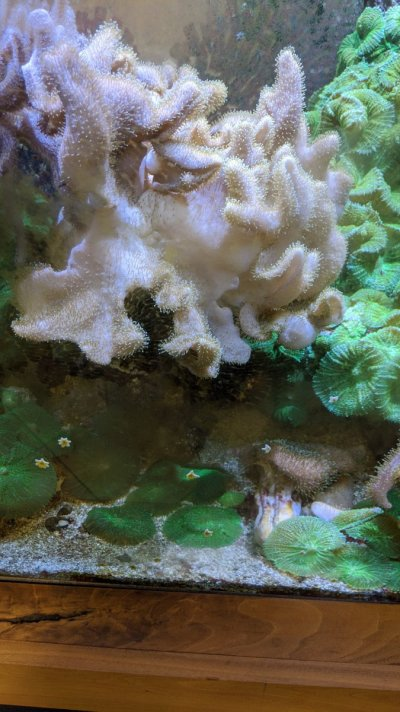
Here's an example, this Toadstool is doing one of it's periodic sheddings. The Aquilonastra have been in this system for years but only climb onto the Toadstool when it's shedding. In the first picture you can see the old mucus film, Aquilonastra starfish and areas they have cleaned off. The second picture shows the Toadstool a week later.


vetteguy53081
Well known Member and monster tank lover
View Badges
Partner Member 2024
Excellence Award
Reef Tank 365
RGB
Article Contributor
Tampa Bay Reef Keepers
West Palm Beach Reefer
Hospitality Award
Ocala Reef Club Member
305 Reef Club
Wisco Reefers
Midwest Reefer
Fish Medic
MAC of SW Florida
Rock Pool Reef Keepers
R2R Secret Santa 2023
My Tank Thread
My Aquarium Showcase
I simply remove by hand or 2" net and discard them. They can multiply like mice and often end up on zoa munching on them
OP
OP
- Joined
- Sep 21, 2019
- Messages
- 236
- Reaction score
- 100
- What state or country do you live in
- Indiana
Yikes!They do in fact also eat acros

- Joined
- Jul 4, 2021
- Messages
- 706
- Reaction score
- 782
- Location
- Charlotte,
- What state or country do you live in
- North Carolina
When you have many buy an Arlequin shrimp. That the only thing they eat. I had tons, when the arlequin ate them all I returned it to my LFS. I called that renting a shrimp. From very tiny it became quite big. My collection is coming back, and I will repeat the process. The Arlequin shrimp are fun to watch and very pretty. These stars never hurt anything in my aquarium, just ate the algae on the glass, but too many is too many.