Kalkwasser container breakdown

YankeeTankee

Active Member
View Badges
Joined
Nov 15, 2019
Messages
481
Reaction score
1,046
Rating - 0%
0   0   0
I'm no chemist but since kalk solution has a ph over 12, I can't help but think that over time it might degrade the container and maybe cause some leaching, or maybe not?

Are there certain types of plastic that would hold up better holding this strong base? Is glass a better option for storage? I realize there may not be a clear answer but perhaps you science minded people can theorize :-)

Even if you're unsure, what would you go with if all were of equal cost? HDPE, Glass, acrylic, something else?

 
The one I use is HDPE. I've had no issues at all with limewater attacking the container in almost three years.

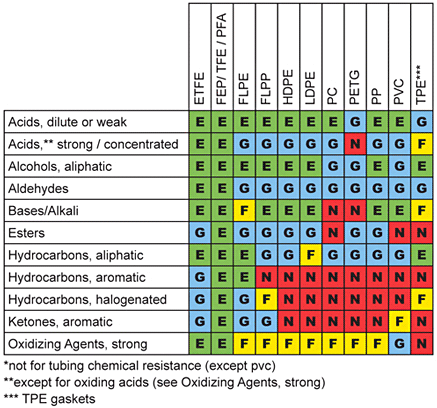
HDPE has excellent resistance to bases:
Chemical_Reference_Summary-small.gif
 
Here's a portion of the compatibility table (see saturated calcium hydroxide at the end):
LDPE & HDPE resistance listed by chemical
1.4-dioxaneLDPE / HDPE at 20°C: little or no damage after 30 days.
LDPE at 50°C: shows some effect after 7 days.
AcetaldehydeLDPE / HDPE at 20°C: little or no damage after 30 days.
HDPE at 50°C: shows some effect after 7 days.
LDPE at 50°C: immediate damage may occur.
Acetic Acid 5 %LDPE / HDPE at 20°C-50°C: little or no damage after 30 days.
Acetic Acid, glacial 50%LDPE / HDPE at 20°C: little or no damage after 30 days.
LDPE at 50 °C: immediate damage may occur.
AcetoneLDPE / HDPE at 20°C-50°C: damage may occur.
Not recommended for continuous use.
Allyl AlcoholLDPE / HDPE at 20°C-50°C: little or no damage after 30 days.
Aluminum saltsLDPE / HDPE at 20°C-50°C: little or no damage after 30 days.
Amino acidsLDPE / HDPE at 20°C-50°C: little or no damage after 30 days.
AmmoniaLDPE / HDPE at 20°C-50°C: little or no damage after 30 days.
Ammonium carbonate saturatedLDPE / HDPE at 20°C-50°C: little or no damage after 30 days.
Ammonium phosphateLDPE / HDPE at 20°C-50°C: little or no damage after 30 days.
Ammonium sulphateLDPE / HDPE at 20°C-50°C: little or no damage after 30 days.
Amyl chlorideHDPE at 20°C: shows some effect after 7 days.
HDPE at 50°C & LDPE at 20°C-50°C: immediate damage may occur.
Not recommended for continuous use.
AnilineLDPE / HDPE at 20°C: little or no damage after 30 days.
HDPE at 50°C: shows some effect after 7 days.
BenzeneLDPE / HDPE at 20°C-50°C: damage may occur.
Not recommended for continuous use.
Benzyl alcoholLDPE / HDPE at 50°C: immediate damage may occur.
HDPE at 20°C: shows some effect after 7 days.
Boric acidLDPE / HDPE at 20°C-50°C: little or no damage after 30 days.
BromineLDPE / HDPE at 50°C: immediate damage may occur.
HDPE at 20°C: shows some effect after 7 days.
Butyric acidLDPE / HDPE at 50°C: immediate damage may occur.
HDPE at 20°C: shows some effect after 7 days.
Calcium chlorideLDPE / HDPE at 20°C-50°C: little or no damage after 30 days.
Calcium hydroxide saturatedLDPE / HDPE at 20°C-50°C: little or no damage after 30 days.
 
I just use a 10g glass aquarium on my nano system, and a 20g high on my larger system. I usually clean them out once a month or so. No problems at all
 
The one I use is HDPE. I've had no issues at all with limewater attacking the container in almost three years.

HDPE has excellent resistance to bases:
Chemical_Reference_Summary-small.gif

Wow the 2nd column (FEP TFE PFA) is completely green, are there more common names for these?

Tendency to leach over time is not part of this right? Of those 3, if I found a food grade, would the be the best of the best?
 
Wow the 2nd column (FEP TFE PFA) is completely green, are there more common names for these?

Tendency to leach over time is not part of this right? Of those 3, if I found a food grade, would the be the best of the best?
Perfluoroalkoxy (PFA) and polytetrafluoroethylene (TFE) are teflon....very inert to most materials. IMO, overkill for your application (and expensive!).

The HDPE container I use is actually a potable water container I modified:
w520_1.jpg


All three of those grades are teflon...I would expect them to perform similarly in this application.
 
Perfluoroalkoxy (PFA) and polytetrafluoroethylene (TFE) are teflon....very inert to most materials. IMO, overkill for your application (and expensive!).

The HDPE container I use is actually a potable water container I modified:
w520_1.jpg


All three of those grades are teflon...I would expect them to perform similarly in this application.

How would good old glass work, very well right?
 
Wow the 2nd column (FEP TFE PFA) is completely green, are there more common names for these?

Tendency to leach over time is not part of this right? Of those 3, if I found a food grade, would the be the best of the best?

don’t get crazy on unusual plastics. Polyethylene and polypropylene are perfect. Polycarbonate is the common one to avoid.
 
I put back up this topic, so polycarbonate/lexan is a no go for kalk? What about acrylic?
 
sorry for bringing up an old post but i was fortunate to find this one.
I had a 2.5g container from walmart as kalkwasser top off water for only about a month and it just cracked one day on it's own.
then i read about kalkwasser breakdown and i had an "aaahhh" moment..

I'm using a Budeezz cereal container now and was wondering if that is any better?
thoughts?
 
sorry for bringing up an old post but i was fortunate to find this one.
I had a 2.5g container from walmart as kalkwasser top off water for only about a month and it just cracked one day on it's own.
then i read about kalkwasser breakdown and i had an "aaahhh" moment..

I'm using a Budeezz cereal container now and was wondering if that is any better?
thoughts?
Is space an issue?

A simple 5g glass aquarium would probably run around the same price, and give 2x the capacity

Or a 5g bucket from lowes or home depot, they are $3-$4.
 
sorry for bringing up an old post but i was fortunate to find this one.
I had a 2.5g container from walmart as kalkwasser top off water for only about a month and it just cracked one day on it's own.
then i read about kalkwasser breakdown and i had an "aaahhh" moment..

I'm using a Budeezz cereal container now and was wondering if that is any better?
thoughts?

Unless the manufacturer states the type of plastic, the best way to know is to check the recycling code stamped on the bottom and see what type of plastic it is.
 

IF YOU HAD TO TAKE A REEFING EXAM, WOULD YOU PASS?

  • Yes!

    Votes: 32 45.7%
  • Not yet, but I have one that I want to buy in mind!

    Votes: 9 12.9%
  • No.

    Votes: 26 37.1%
  • Other (please explain).

    Votes: 3 4.3%
Back
Top