

- Joined
- Nov 6, 2017
- Messages
- 290
- Reaction score
- 232
- What state or country do you live in
- Indiana
Oh, one more question. Is the shimmer basically taking measurements with pumps/powerheads on, and no shimmer with them off?


Follow along with the video below to see how to install our site as a web app on your home screen.
Note: This feature may not be available in some browsers.



The aquarium used for testing is a 120-gallon, 48"x24"x24", with overflows at each end. The light was centered over the tank at 12" from the right side (this positioned the light squarely between the right side glass and the top's center brace.) Maybe this photo will help:OK, I just studied the graph again. It's the 10in mark that is the center of the light right? Also, I would say to the OP, that Reefwiser(love that name) is right that you won't get enough light intensity down low in that tank, but you can compensate for that with your aquascape. SPS will have to be up high and more towards the center of each puck. You would need to build up your aquascape considerably in the vertical direction. That could make for a neat aquascape! Then you would want some low light corals down lower. You can make it work with what you have, but you should supplement those Kessils with 2x80w T5's on either side.

I initially checked PPFD and saw a drop beyond 60% on the Color dial (and Intensity at 100%.) This was a quick test and I thought it was possibly an error due to positioning. A second test (using jigs to hold everything in place) confirmed the initial results. Wattage shows differences at various settings as well, so I don't think it's largely due to PAR sensor response.



Yes, correct. Tunze pump on and off. Just to make sure you're looking at the charts correctly: The measurements were taken at a depth of 18" on a horizontal plane (the eggcrate you see on the bottom was the grid used to position the PAR sensor. I used a Magic Marker to outline a square every 4 inches on center.) It would be easy to think the measurements were taken at various depths - not so, amplitudes represent light intensities, dot septh.)Oh, one more question. Is the shimmer basically taking measurements with pumps/powerheads on, and no shimmer with them off?
OK, got it. That makes sense. I see what your saying about the Y axis being PAR level and not depth. Knowing the placement now makes this even more interesting. The effect of reflection off the side glass, and the effect of shimmer are amazing!Yes, correct. Tunze pump on and off. Just to make sure you're looking at the charts correctly: The measurements were taken at a depth of 18" on a horizontal plane (the eggcrate you see on the bottom was the grid used to position the PAR sensor. I used a Magic Marker to outline a square every 4 inches on center.) It would be easy to think the measurements were taken at various depths - not so, amplitudes represent light intensities, dot septh.)
Yes, I was a little surprised by the effects of reflection and shimmer. Live and learn.OK, got it. That makes sense. I see what your saying about the Y axis being PAR level and not depth. Knowing the placement now makes this even more interesting. The effect of reflection off the side glass, and the effect of shimmer are amazing!


Would have liked to see Kessil logic being more.. err ..efficient..but only looks like about 10W difference
add differences in diode L/w efficiency..
could have something to do w/ the spacial placement of the diodes in relation to the lens..though doesn't completely explain the 50/50 but is the most "watts"
collection of variables..
The array doesn't just dim individual diodes, it also turns certain diodes (and banks of diodes) on/off with varying colors and intensities.
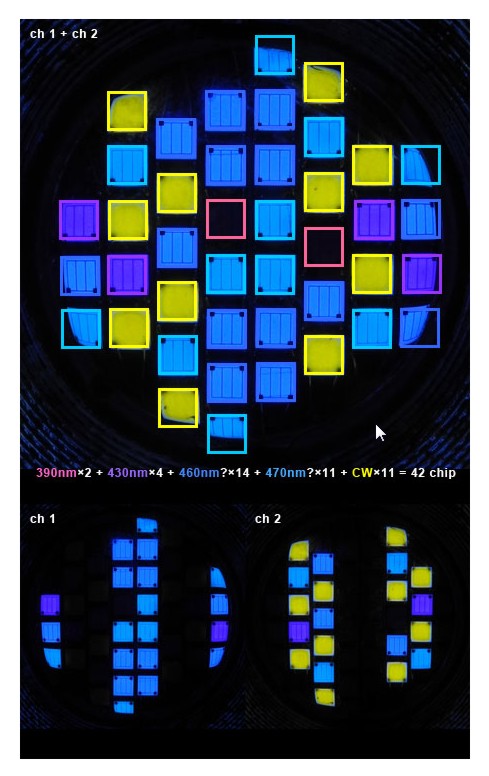
Why would you believe it would be built so ridiculously complicated?
A350 but doubt if it is much different in the 360..except possibly rearranging the 2 rows a bit..
Changing the current between ch1 and 2 is enough to do what they want..






Which is the 2 (3) "blue" wavelengths and the one true UV approx..The 360W E-series at its 'bluest' setting:


If I understand the question correctly, wavelength peaks are 384, 423, and 464nm.Which is the 2 (3) "blue" wavelengths and the one true UV approx..
390,430,460,470..... guesses according to the Japanese SPECTRA 1.023 blog and of course the 350...

Actually it means didly BUT.. they implied actually 3 "blue" one UVIf I understand the question correctly, wavelength peaks are 384, 423, and 464nm.
370nm, 390nm, 427nm, 440nm, 456nm, 467nm











