Light Transmission - Oceanic Type III Water

Dana Riddle

2500 Club Member
View Badges
Joined
Sep 10, 2011
Messages
3,162
Reaction score
7,614
Location
Dallas, Georgia
What state or country do you live in
Georgia
Rating - 0%
0   0   0
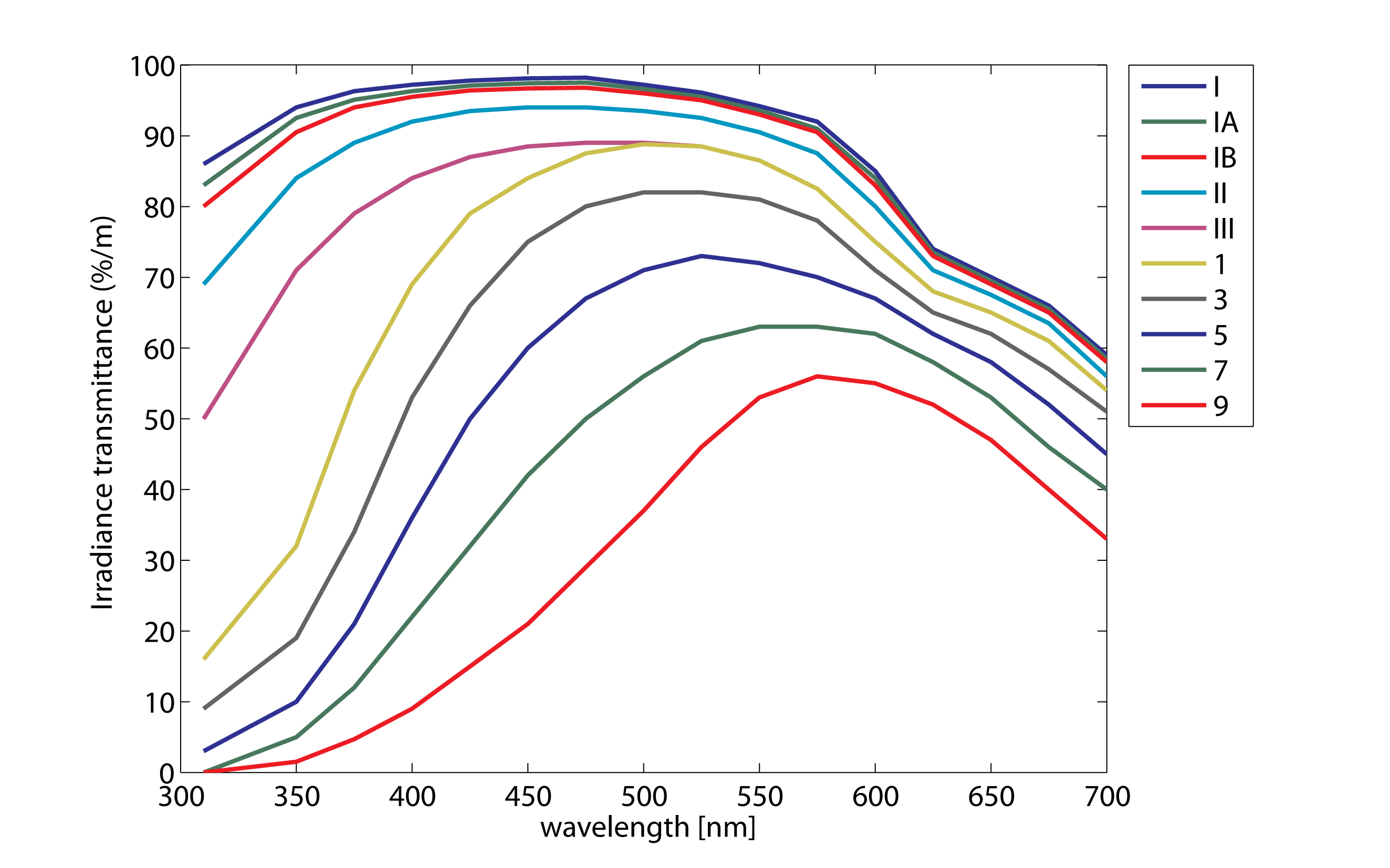
Here's a graph showing light transmission in Oceanic Type III water (the poorest quality 'blue' ocean water. From Jerlov's works.) I'll post later a chart for 'green' coastal water, such as that seen in parts of coastal Florida.
upload_2019-2-6_6-38-25.png
 
Is there a chart that shows the different optical types (I'm googling but havent come across one yet)? I didnt know this was done, much less in 1890 LOL.
 
I'm curious, and please educate me; The graph clearly demonstrates the emphasis between 500 to 550 nm wavelengths, so why majority (if not all) reef LED fixtures emphasizes the 450 - 460 nm range? If the reefs are bathing in green and cyan spectrums, why the zooxanthellae would not be able to use it in photosynthesis? Biologically thinking this does not make sense to me. Are we overestimating the importance of blue light for coral well-being?
 
I'm curious, and please educate me; The graph clearly demonstrates the emphasis between 500 to 550 nm wavelengths, so why majority (if not all) reef LED fixtures emphasizes the 450 - 460 nm range? If the reefs are bathing in green and cyan spectrums, why the zooxanthellae would not be able to use it in photosynthesis? Biologically thinking this does not make sense to me. Are we overestimating the importance of blue light for coral well-being?

Most of the answer is personal preference (look) and yes they use blue/cyan in photosynthesis..

There is no problem over emphasizing blue. The question really is under emphasizing other parts..;)
VERY simplistic answer btw..

F4.medium.gif
 
What is intensity here?
Intensity is, in this case, a count of photons as reported by the Ocean Optics spectrometer. I didn't catch that when I posted the chart, and I should have, and will, post a chart using PPFD. My bad, sorry.
 
I'm curious, and please educate me; The graph clearly demonstrates the emphasis between 500 to 550 nm wavelengths, so why majority (if not all) reef LED fixtures emphasizes the 450 - 460 nm range? If the reefs are bathing in green and cyan spectrums, why the zooxanthellae would not be able to use it in photosynthesis? Biologically thinking this does not make sense to me. Are we overestimating the importance of blue light for coral well-being?
An accessory pigment in zooxanthellae - peridinin - absorbs light up to about 550nm, and this is often overlooked by lighting companies. I don't think we overestimate the importance of blue, but green is not appreciated enough.
 
Is there a chart that shows the different optical types (I'm googling but havent come across one yet)? I didnt know this was done, much less in 1890 LOL.
Here you go - (I through III are Oceanic waters (blue) and 1 through 9 are Coastal waters (green):
Jerlov_WaterTypes.png
 
There is no problem over emphasizing blue. The question really is under emphasizing other parts..;)

An accessory pigment in zooxanthellae - peridinin - absorbs light up to about 550nm, and this is often overlooked by lighting companies. I don't think we overestimate the importance of blue, but green is not appreciated enough.

Thank you for the explanations and interesting viewpoints. Maybe this is something that will change in the future generation fixtures. I have the impression, that now the emphasis is to get the most "pop" rather than adding wavelenghts which could be beneficial to corals, but does not bring as much pop. I recall, that at some point green leds were not considered as efficient, however I do not know if that has been resolved...
 
Here you go - (I through III are Oceanic waters (blue) and 1 through 9 are Coastal waters (green):

Awesome, thank you. I stumbled across that one but got a bit confused because there wasn't 21 types. I'm assuming type I would be the clearest waters since they have the highest transmittance?
 
I recall, that at some point green leds were not considered as efficient, however I do not know if that has been resolved...

Well it has been "resolved" using blue plus green-ish phosphors (luxeon lime, mint and pc amber (just another example))
but "natural" green LED's are still lower in efficiency than most.

BUT.. don't blink.. ;)
https://compoundsemiconductor.net/article/104259/Osram_Increases_Green_LED_Efficiency_By_40_Percent

"Until recently, these efficiency values seemed unattainable for green direct emitting InGaN LEDs. We are now moving into areas that up to now have been achievable only with phosphor conversion emitters but with significantly reduced spectral quality. Thanks to the success of our development team we have been able to drastically reduce the green gap phenomenon for our customers," said project manager Adam Bauer from Osram Opto Semiconductors.
 
Thank you for the explanations and interesting viewpoints. Maybe this is something that will change in the future generation fixtures. I have the impression, that now the emphasis is to get the most "pop" rather than adding wavelenghts which could be beneficial to corals, but does not bring as much pop. I recall, that at some point green leds were not considered as efficient, however I do not know if that has been resolved...
Yes, you are correct - green LEDs aren't all that efficient, but numbers and focusing can overcome that.
 
Awesome, thank you. I stumbled across that one but got a bit confused because there wasn't 21 types. I'm assuming type I would be the clearest waters since they have the highest transmittance?
Yes, Type I Oceanic is the 'clearest' of ocean waters. How's that tank build going? I'm transferring everything over to a 120. Live and dead rock are curing... The 90-gallon was a disaster after suffering from a 2-day power outage during a snowstorm, misdiagnosed diatom outbreak, incompetent care while I was traveling... This time...
 
Yes, Type I Oceanic is the 'clearest' of ocean waters. How's that tank build going? I'm transferring everything over to a 120. Live and dead rock are curing... The 90-gallon was a disaster after suffering from a 2-day power outage during a snowstorm, misdiagnosed diatom outbreak, incompetent care while I was traveling... This time...

Uh, good... not really LOL. I've bought a few tools (miter saw, table saw, etc) to start framing in the basement fish room but havent done anything in over a month. I gotta get cracking, a few of the corals are outgrowing the 75g rapidly now.
 
Please educate
I assume you're referring to the first chart? Ocean waters have different optical qualities. The 'Oceanic' waters are the 'clearest' (low turbidity, low color, and high light transmission qualities) while 'Coastal' waters are often under the influence of rivers' discharges, meaning colored water (usually 'yellow' color that preferentially absorbs UV, violet and blue wavelengths), high turbidity (where suspended particles scatter light), and high chlorophyll content (where photopigments absorb those wavelengths needed for photosynthesis.) The Big Island of Hawaii (Kona side) has Oceanic blue water while most eastern seaboard US coastlines are considered 'green' Coastal waters.
 
I assume you're referring to the first chart? Ocean waters have different optical qualities. The 'Oceanic' waters are the 'clearest' (low turbidity, low color, and high light transmission qualities) while 'Coastal' waters are often under the influence of rivers' discharges, meaning colored water (usually 'yellow' color that preferentially absorbs UV, violet and blue wavelengths), high turbidity (where suspended particles scatter light), and high chlorophyll content (where photopigments absorb those wavelengths needed for photosynthesis.) The Big Island of Hawaii (Kona side) has Oceanic blue water while most eastern seaboard US coastlines are considered 'green' Coastal waters.
Ah thank you kindness!
 
If the reefs are bathing in green and cyan spectrums, why the zooxanthellae would not be able to use it in photosynthesis?
The zooxanthellae can use the 500 -550nm spectrum. But under the same intensities of light, corals calcify faster and have greater fluorescence under 450-460nm blue alone than green, red or full spectrum.
 
The zooxanthellae can use the 500 -550nm spectrum. But under the same intensities of light, corals calcify faster and have greater fluorescence under 450-460nm blue alone than green, red or full spectrum.
Is that Tim Wijgerde's work? Someone else's, perhaps yours?
 

IF YOU HAD TO TAKE A REEFING EXAM, WOULD YOU PASS?

  • Yes!

    Votes: 32 45.7%
  • Not yet, but I have one that I want to buy in mind!

    Votes: 9 12.9%
  • No.

    Votes: 26 37.1%
  • Other (please explain).

    Votes: 3 4.3%
Back
Top