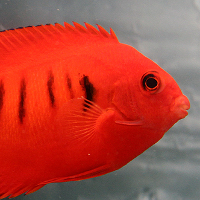
Pick this up. customer gave to my LF S from tank shut down


Follow along with the video below to see how to install our site as a web app on your home screen.
Note: This feature may not be available in some browsers.





I’d be putting that into my own reef. I couldn’t care less about coral if I had a flame that pretty!Pick this up. customer gave to my LF S from tank shut down


Are the nearly-white blotches around its face HLLE?Almost looks like a hypomelantistic specimen, but the black along the trailing edges of the dorsal and anal fins means it isn't one of those.
Could it be a rusty/flame hybrid? If not, then I think it is one from the Marquesas that is just a bit more faded.
Jay
It’s a female flame angel. They turn male and look more pretty. I always wanted to get my hands on a female for mating.Pick this up. customer gave to my LF S from tank shut down


I wanted to breed flame angels the females have smaller blue bands like in the picture and have less color then the full males.Angelfish seem to vary a lot. Coral beauty’s seem all over the map, flames with thick bars, thin bars, more orange and not so yellow background. Pygmy angels that are almost entirely blue and so on.
Not sure how big it is but reminds me of one of the juvi flame angelfish we saw when they captive bred them.

I’ve kept Flames since 1973, and I don’t think so, based on colors aloneIt’s a female flame angel. They turn male and look more pretty. I always wanted to get my hands on a female for mating.
I’ve kept Flames since 1973, and I don’t think so, based on colors alone

Could be albino or genetic disorder?I’ve kept Flames since 1973, and I don’t think so, based on colors alone
Fins alone look femaleI’ve kept Flames since 1973, and I don’t think so, based on colors alone


Females don’t usually have a different colour to the males. The only obvious difference is the fins.Fins alone look female
not sureAre the nearly-white blotches around its face HLLE?
 www.youtube.com
I'm
not sure
Thanks everyone, He/She in my 75g softy tank
- YouTube
Enjoy the videos and music you love, upload original content, and share it all with friends, family, and the world on YouTube.


Pick this up. customer gave to my LF S from tank shut down
 reefs.com

I think so also.....hey I came across this description that sounds like your fish.
Another phenotype occurs in French Polynesia and the Marquesas, where the body is again orange, but with only pale indications of barring and a single prominent blotch near the pectoral fin.
Hawaii’s Angelfish Diversity: Part 1
Hawaii is an immensely fascinating archipelago to study in terms of the biogeography and evolution of its shallow water marine fishes. These isolated volcanic i