low voltage warning

So would a meanwell adapter be better suited something like this one - https://www.mouser.com/ProductDetail/MEAN-WELL/GST60A12-P1J?qs=odmYgEirbwzBCeXKJrW1mg==

sorry @Sinibotia didn't mean to thread jack but I have had the same issue and would like to find a better solution, should I be looking at defferent power supplies or different buck converters..inquiring minds want to know :)

Not an issue! Better to have two parallel looks at the issue to get a better understanding and create a reference for those who might have this issue in the future!
 
So would a meanwell adapter be better suited something like this one - https://www.mouser.com/ProductDetail/MEAN-WELL/GST60A12-P1J?qs=odmYgEirbwzBCeXKJrW1mg==

sorry @Sinibotia didn't mean to thread jack but I have had the same issue and would like to find a better solution, should I be looking at defferent power supplies or different buck converters..inquiring minds want to know :)

Here is the one I am using, UL listed etc...

PXL_20230228_205440932.jpg


Adapters like that should be fine.

What you're probably running into is a combination of the buck converter modules load transient response being garbage, and wiring lengths for the converter. A modern CPU is a pretty elastic power consumer and will move between power states pretty quick, which can make all sorts of interesting power problems.

The best short term recommendation is to use a dedicated 5V supply for the Pi - something like an Anker or reasonable other brand of USB 5V 2-3A class supplies. Just go straight into the Pi on its USB input, and disconnect the 5V line from the header (keep the grounds tied here).

Other options include placing some bulk ceramic capacitors where the 5V enters the Pi (4.7uF, 10uF+).

A better buck converter module is also absolutely an option. E.g., https://www.mouser.com/ProductDetail/Texas-Instruments/PTH12000WAD (have not tested or used) - you'll need to provide a resistor to set the voltage output yourself, as well as a bulk input capacitor (100uF aluminum) but its several generations more modern than the setup used in the common "import" converters.
 
Being nosy and just throwing this in for reference.. ;)


Oddly sounds like a pretty common issue..
WORST case..
I have several Pi 3s with dates on them from 2015 onwards. Some of these complain with the low power warning and some dont - and this is with me swapping the Pi 3 out completely using the same setup - and even the same SD card.

One more..
Using an out of date firmware has been known to report incorrect low voltage warnings due to effectively misconfiguration.

Software Engineer at Raspberry Pi Ltd. Views expressed are still personal views.
And
err..never mind that one
I'll add the funny one..
Checking the voltage with a multimeter isn't that useful. If it shows high that is a integrated measurement made at a point of time. It tells you nothing about the voltage which triggered the low voltage warning.
Try the following
  1. a different power supply
  2. a different power cable
  3. a different Pi
 
Last edited:
Possible alternate power connection.
Bypasses USB port and is fused unlike the gpio pins.

With a little bit of hacking, it's possible to bypass the USB to power your board while still going through the fuse.

Solder wires to PP1 (5V) and PP5 (GND) on the bottom side of the PCB and run to your supply.
 
Adapters like that should be fine.

What you're probably running into is a combination of the buck converter modules load transient response being garbage, and wiring lengths for the converter. A modern CPU is a pretty elastic power consumer and will move between power states pretty quick, which can make all sorts of interesting power problems.

The best short term recommendation is to use a dedicated 5V supply for the Pi - something like an Anker or reasonable other brand of USB 5V 2-3A class supplies. Just go straight into the Pi on its USB input, and disconnect the 5V line from the header (keep the grounds tied here).

Other options include placing some bulk ceramic capacitors where the 5V enters the Pi (4.7uF, 10uF+).

A better buck converter module is also absolutely an option. E.g., https://www.mouser.com/ProductDetail/Texas-Instruments/PTH12000WAD (have not tested or used) - you'll need to provide a resistor to set the voltage output yourself, as well as a bulk input capacitor (100uF aluminum) but its several generations more modern than the setup used in the common "import" converters.
eh that link no longer works, I would be interested in a better buck converter thats for sure...
 
A small update: i tested the pi 3A using an official power supply via the micro usb power port and still got an under voltage warning. I also ran it with the higher amp power adapter and the error mostly went away (popped up a handful of times while working on things). I'm going to accept that as as good as it's gonna get considering everything seems to be working well otherwise.
 
A small update: i tested the pi 3A using an official power supply via the micro usb power port and still got an under voltage warning. I also ran it with the higher amp power adapter and the error mostly went away (popped up a handful of times while working on things). I'm going to accept that as as good as it's gonna get considering everything seems to be working well otherwise.
Yeah I think some rpi's are just have the issue, I have one that appears to do the same thing but appears to run just fine, has been up and running for over 2 years but I get the log messages daily, so I think your doing the right thing and just moving on...
 
Would concur then. Could a weak regulator on the Pi its self (it needs numerous internal voltages, such as 3.3V, 2.5V, 1V etc) but those are all managed as part of the Broadcom/CPU power management controller. Not much you can do at that juncture.
 
Would concur then. Could a weak regulator on the Pi its self (it needs numerous internal voltages, such as 3.3V, 2.5V, 1V etc) but those are all managed as part of the Broadcom/CPU power management controller. Not much you can do at that juncture.
oYTkQ.png

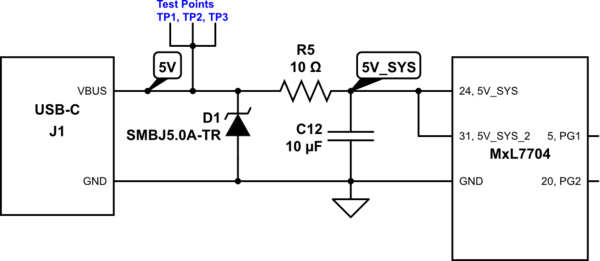
The newer Pi(3/2/B+) have a voltage monitor chip (APX803) which triggers at 4.63±0.07V. The Pi3B+, Pi3A+, Pi4B uses a MxL7704 PMIC chip to manage power, which has the same nominal trigger point
 
Last edited:
Oops..had to start over .

First pi zero does not have the input voltage monitoring ic

Second another take on the issue.
Conclusion
The conventional one-size-fits-all wisdom that "it's yer dodgy power supply" might have a grain of truth but, sometimes, there might be a bit more to it. Your PSU might be fine. It could just be that you have a dodgy Raspberry Pi with an internal regulator that isn't up to the job being asked of it.
 

IF YOU HAD TO TAKE A REEFING EXAM, WOULD YOU PASS?

  • Yes!

    Votes: 32 45.7%
  • Not yet, but I have one that I want to buy in mind!

    Votes: 9 12.9%
  • No.

    Votes: 26 37.1%
  • Other (please explain).

    Votes: 3 4.3%

New Posts

Back
Top