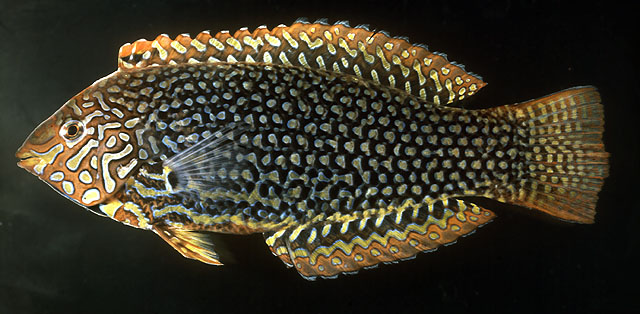
male meleagris or ornate leopard wrasse

Rrwilson1223

Active Member
View Badges
Joined
Jan 9, 2020
Messages
249
Reaction score
330
Location
Santa Rosa CA
What state or country do you live in
California
Rating - 0%
0   0   0
Hi everyone,

I found a nice leopard wrasse at my LFS for $39. They thought it was a male meleagris leopard wrasse. But it really looks like an ornate to me. Any experts out there that could help me figure this out?

Here are some pics from QT:

161A0F08-4CC6-4F9D-9D0C-948FA226D0C9.jpeg 853F2749-4F84-4039-A367-0860B0DDFA6B.jpeg
 
Is it orange. It looks like a female potters but might be the lighting
 
Very cool. Thank you all for letting me know. Now for the tougher question, does anyone know how to determine sex on an ornate? I’ve not seen anything online.
 
Will this make it difficult to have other leopards? I’m thinking of adding 3 female meleagris with it in a 200.
There could be some risk. The old answer of "it depends", here on the attitude of your individual specimen.
 
(Yours is male)
Hi again,

I’ve been going back over the old posts trying to understand how to properly identify the sex of ornate leopards. Just for my own education, could you please tell me how you came to the conclusion mine is a male? I’m always trying to learn more in this hobby and am a little confused.
 
Hi again,

I’ve been going back over the old posts trying to understand how to properly identify the sex of ornate leopards. Just for my own education, could you please tell me how you came to the conclusion mine is a male? I’m always trying to learn more in this hobby and am a little confused.
The real only way to tell the difference is a black dot, yes a black dot, LOL. Yours seems to have a black dot on it's dorsal fin, so it could be a female. These are one of the hardest wrasse to sex.
"All are born female and change as the need arises. The coloration of the male and female is the same with one exception, the female has a black spot on the spine aligned with the base of pectoral fin. Interestingly, once this wrasse turns into a male, the change cannot be reversed. A harem consists up to 7 to 10 females."
source

 
Last edited:
The real only way to tell the difference is a black dot, yes a black dot, LOL. Yours seems to have a black dot on it's dorsal fin, so it could be a female. These are one of the hardest wrasse to sex.
"All are born female and change as the need arises. The coloration of the male and female is the same with one exception, the female has a black spot on the spine aligned with the base of pectoral fin. Interestingly, once this wrasse turns into a male, the change cannot be reversed. A harem consists up to 7 to 10 females."
source


I appreciate the info. Yeah, I’m just trying to figure out if this little guy/lady will go with some other female melagris leopards I’m going to be adding. So far, all the info on I’ve found has been on here. The black dot is interesting and so is the lack of dark bars on the tail.

I included a couple of new pics with the dorsal fin showing:

259E17F3-BBE5-41C7-9D59-77BCD567F1EF.jpeg 7DFA5096-5097-4811-AC93-0CF9053BE3D7.jpeg
Like I said it's hard, these are one of the hardest to judge. Because of the black dot by the dorsal fin i would say this is a female, but could be wrong. My female ornate also has the dark spot and paired up with my Male Dusky Wrasse. Weird thing to do, they shouldn't pair up.(picture below, they are center right mid tank) LOL.

tank june 2020.jpg
 
I rely more on the pattern on the gill plate to determine sex. In juveniles and females the pattern is spotted. As they mature those spots elongate and connect giving a more lined pattern on the gill plate.
 
Hi again,

I’ve been going back over the old posts trying to understand how to properly identify the sex of ornate leopards. Just for my own education, could you please tell me how you came to the conclusion mine is a male? I’m always trying to learn more in this hobby and am a little confused.
More below, in a moment.
The real only way to tell the difference is a black dot, yes a black dot, LOL. Yours seems to have a black dot on it's dorsal fin, so it could be a female. These are one of the hardest wrasse to sex.
"All are born female and change as the need arises. The coloration of the male and female is the same with one exception, the female has a black spot on the spine aligned with the base of pectoral fin. Interestingly, once this wrasse turns into a male, the change cannot be reversed. A harem consists up to 7 to 10 females."
source

That information and video are incorrect.
Like I said it's hard, these are one of the hardest to judge. Because of the black dot by the dorsal fin i would say this is a female, but could be wrong. My female ornate also has the dark spot and paired up with my Male Dusky Wrasse. Weird thing to do, they shouldn't pair up.(picture below, they are center right mid tank) LOL.

tank june 2020.jpg
You may be witnessing rival male behavior, and have confused it as courting.
I rely more on the pattern on the gill plate to determine sex. In juveniles and females the pattern is spotted. As they mature those spots elongate and connect giving a more lined pattern on the gill plate.
And that's what I look for too.


Here's a more in-depth look:

These are holotype pictures (dead fish), so don't get too hung up on the coloration, but I'll draw attention to the patterns/features of both.

Male M. ornatus:
Maorn_m0.jpg


Female M. ornatus:
Maorn_f1.jpg


First, look at the patterns around the eyes and also on the gill plates (cheeks, if you'd rather). You'll note that the male has nice bold, solid lines, whereas the female has much more of a broken, spotted pattern. Next, look at the pattern on the sides of the body. The male has much more uniform, orderly circles than the female. And lastly, I'll draw your attention to the caudal (tail). Two big things here. First, the male much bigger spots, nicely arranged in a "fan array" style. The female has much smaller, less orderly spots. And then, there's the bold margins with the distinct iridescent edge on the male's caudal v. the female.
 
More below, in a moment.

That information and video are incorrect.

You may be witnessing rival male behavior, and have confused it as courting.

Please do not respond to me again, ive asked you once already. I do not want your info, i do not care for it, hell i wish i could block you.
 

IF YOU HAD TO TAKE A REEFING EXAM, WOULD YOU PASS?

  • Yes!

    Votes: 32 45.7%
  • Not yet, but I have one that I want to buy in mind!

    Votes: 9 12.9%
  • No.

    Votes: 26 37.1%
  • Other (please explain).

    Votes: 3 4.3%
Back
Top