
Meh... it just depends... most folks think my tank is lit by metal halides....fun fact its notFor me leds look too chromatic. I really dislike that unnatural look. Metal halides look more like natural sun to me, especially the shimmer.


Follow along with the video below to see how to install our site as a web app on your home screen.
Note: This feature may not be available in some browsers.

Meh... it just depends... most folks think my tank is lit by metal halides....fun fact its notFor me leds look too chromatic. I really dislike that unnatural look. Metal halides look more like natural sun to me, especially the shimmer.


Looks like kessils?Meh... it just depends... most folks think my tank is lit by metal halides....fun fact its not
Orphek icons.....with a couple of kessilsLooks like kessils?

I would love to have a big old tank in my living room. I bet it was nice. See this is a great case in point. Like I said, I try to stick with incandescents.I had a 135G lit with 3x 20K 400W MH in my living room for 8 years, then another 12 years of T5 including blues and actinics. Couch right by the tank. Somehow my eyesight has not changed since 1992. Guess I'm one of the lucky ones!
You use incandescent bulbs? Look up yuji led if you want full spectrum leds.I would love to have a big old tank in my living room. I bet it was nice. See this is a great case in point. Like I said, I try to stick with incandescents.
However It seems the biggest issue is with light emitting diodes. They don’t just give out constant steady light. It looks that way but actually they are flashing, really fast, and you brain does see that. It’s why the new Christmas lights look funny, especially the blue ones.
I believe the study is suggesting the flashing from the LEDs cause neurological problems that are worsened in the blue spectrum. Especially as we get older.
This is not the first I have seen over the years. It’s probably just best to start trying to eliminate hazards. There are so many these days.

They only mostly flash when dimmed.I would love to have a big old tank in my living room. I bet it was nice. See this is a great case in point. Like I said, I try to stick with incandescents.
However It seems the biggest issue is with light emitting diodes. They don’t just give out constant steady light. It looks that way but actually they are flashing, really fast, and you brain does see that. It’s why the new Christmas lights look funny, especially the blue ones.
I believe the study is suggesting the flashing from the LEDs cause neurological problems that are worsened in the blue spectrum. Especially as we get older.
This is not the first I have seen over the years. It’s probably just best to start trying to eliminate hazards. There are so many these days.

Metal halide lamps are prone to similar instability artifacts that plague other arc discharge light sources (primarily mercury and xenon). The terms used to describe arc instability are numerous and include words such as flicker, jitter, wobble, and flutter that all refer to a fluctuation in brightness.

Idk man that’s allot of data you put together just to turn around and say leds flash, as I was saying. Also attempting to undermine my point about leds by suggest the halide BALAST flash while properly operating is a deflection and does not change my point or the point of the numerous studies, from numerous sources, that show leds can have a costly affect, period. Certainly in comparison to tubes and bulbs.They only mostly flash when dimmed.
The rate is based on a few things.
One switching power supplies "switch" at high frequencies. Electronic ballasts do the same.
Phillips mh ballast.
The pwm dimming is next.. at 100% it is straight dc.
After that it is determined by the design of the driver/ dimmer.
Usually 500Hz or faster..sometimes much faster. One can dim by changing current thus avoiding most pulsing.
Both mh and tubes both "strobe" a bit but it is mostly, unlike leds which are pretty instantaneous, covered up due to lag but they have their own issues but is rarely done. Causes more color changes in the diode than pwm
Point is overall none give constant steady light. Just a matter of design and degrees ..ZEISS Microscopy Online Campus | Metal Halide Lamps
Metal halide illumination sources are rapidly emerging as a serious challenger to the application of mercury and xenon arc lamps for investigations in fluorescence microscopy.zeiss-campus.magnet.fsu.edu
Huh, not to sound too pessimistic but as to hazards that ship has sailed with your water and air.....
Oh running Bridgelux Thrive 6500k cobs or strips at 100% pretty well solves most problems. Still high in blue content though.
Ya 95%, I did a rapid led kit some 10-15 years ago when leds were becoming a thing worked great hated the look. I do have an led set up now in a second home but honestly I just have a preference for doing it the old school way. Maybe I am old and stuck in the mud now. LolYou use incandescent bulbs? Look up yuji led if you want full spectrum leds.
So incandescent in your tank or house? If in your tank hows it look and how many watts?Ya 95%, I did a rapid led kit some 10-15 years ago when leds were becoming a thing worked great hated the look. I do have an led set up now in a second home but honestly I just have a preference for doing it the old school way. Maybe I am old and stuck in the mud now. Lol

Lot to unpack .Idk man that’s allot of data you put together just to turn around and say leds flash, as I was saying. Also attempting to undermine my point about leds by suggest the halide BALAST flash while properly operating is a deflection and does not change my point or the point of the numerous studies, from numerous sources, that show leds can have a costly affect, period. Certainly in comparison to tubes and bulbs.
I think the proper response would have been showing some data that countered my point. Maybe something on the safety of leds, or how they don’t shorten life span, or don’t cause neurological problems?
Furthermore just because the air and water is polluted does not mean I should take unnecessary risk. .
You are right though, incandescent flicker is masked by the thermal mass of the filament.The majority of modern artificial light sources connected to an alternating current (AC) will fluctuate or flicker, although the frequency and intensity of flicker will vary with the lighting technology. Incandescent bulbs flicker at the frequency of the electrical supply (50–60 Hz), although the intensity of flicker is low (low flicker index), whereas fluorescent lighting extinguishes and returns to full brightness twice over each voltage cycle (100–120 Hz), leading to a pronounced flicker effect (high flicker index). Light emitting diode (LED) technology is also increasing in popularity particularly for street lighting and these lamps also have a high flicker index. Indeed the perceived brightness of many LED lamps is controlled by regulating the flicker frequency.
HERE is a list of flickering things and effects.Incandescent lights don’t flicker much at all - the filament has sufficient thermal mass such that its temperature doesn’t vary just because they’re being operated on AC. Fluorescent lights “fire” twice per cycle, so if they flicker at all (and the persistence of their phosphors reduces what flicker there is) would be at 120 Hz, not 60. If an LED were operated directly from 60 Hz, it would flicker at that rate - but that generally isn’t how most LED lighting works.

 www.ncbi.nlm.nih.gov
The short answer to this common question is no. The amount of blue light from electronic devices, including smartphones, tablets, LCD TVs, and laptop computers, is not harmful to the retina or any other part of the eye.
Fair enough ..And if "I" choose to worry about things forever chemicals, micro plastics, solar uv, nitrates, radiation from Fukashima and Chernobyl, nuclear war, mercury in my fish all trump's flickering blue leds.The risk your willing to take with your person and how you justify it is your business. I simply would just rather not
Not all and it CAN be more with tubes and HID lighting. Yes I accept the incandescent exception but what reef lighting uses it?the point of the numerous studies, from numerous sources, that show leds can have a costly affect, period. Certainly in comparison to tubes and bulbs.
The causes of flicker include cheap and simple LED drivers that use rectified mains to power the light source. While electrolytic capacitors are used to reduce ripple in the output current, they are expensive and bulky components, which are often the cause of failure of luminaires because of their relatively short lifetimes. For these reasons, manufacturers often skimp on capacitor specifications when budget is tight. The frequency of rectified mains would be 100Hz in Europe or 120Hz in the US, which is right in the problem area. Poor quality LED dimmer circuits whose PWM frequencies are below 200Hz are another common culprit, along with electromagnetic interference from external noise sources...

Source was IEEE. Probably cost you a radion to buy it .At higher frequencies of 1.25 kHz (1250 Hz) and higher, even sources that exhibit 100% flicker such as PWM dimming systems are acceptable and are not known to produce any detrimental effects.Source



The fluorescence can be observed when you leave only the actinic or Blue Plus tubes on, or the blue LEDs there. It's a matter of getting used to and know that you will need to be at least 80 to 100 down in the ocean to have even something similar then that blue... Most colors would be gone by that depth. The majority of corals in this hobby come from shallow water, collected snorkeling, and have beautiful natural pigments produced by the wide range of sun light. metal halides have the whole spectrum and will vary in more or less "white" to give you what you like aesthetically. Shallow water is similar to 6500-10000K metal halide bulbs. 14000K bulbs will give you a little more of that blue hint. The 20000Ks are too blue to may people, but will still give you superb results! Can't go wrong with halides! Using those LEDs you will get used to what you have and will start to appreciate real pigment formation, not only fluorescence. By now, afer 6 months, our corals should show differences in natural pigment formation, colony structure and growth rate.I'm one of the guys who started reef 6 years ago, and seemed like leds where a way to go. But after messing and messing with them... I recently put 4 mh over my tank. I I can't say I love them yet, but I definitely can't say I hate them ether. Switching from leds to metal halides, can't see all those glowing sticks any more, see more of that true color of the coral more brighter, coraline algae realy pops now. I Still miss some of the glow in my corals from led, so I still have blue strips of leds, and t5 actinic bulds. It's over 2300w system I got


I can say definitely that I like more the natural look of the sps under halide's , more then the artificial "pop" of the led's.I'm one of the guys who started reef 6 years ago, and seemed like leds where a way to go. But after messing and messing with them... I recently put 4 mh over my tank. I I can't say I love them yet, but I definitely can't say I hate them ether. Switching from leds to metal halides, can't see all those glowing sticks any more, see more of that true color of the coral more brighter, coraline algae realy pops now. I Still miss some of the glow in my corals from led, so I still have blue strips of leds, and t5 actinic bulds. It's over 2300w system I got
There is not arguments against facts!I can say definitely that I like more the natural look of the sps under halide's , more then the artificial "pop" of the led's.
here is pic that I took yesterday of stylopora pink fiji frag.
I haven't see that color in any other that powerd with led's.
that pic was taken without any filter
notice that the white section at the bottom of the frags is because it was cutter and glued 2 days before.

Idk man, my opinion remains. You still have not argued my assessment of the dangers of leds but you suggest turning them up to 100%. (we will get to that below.)Lot to unpack .
you have been exposed to flickering lights since childhood most likely if you spent any time around fluorescent tubes.
Like I said, you don't want flicker in your leds (or extremely reduced and a high frequency) drive them at 100% DC.
You are right though, incandescent flicker is masked by the thermal mass of the filament.
HERE is a list of flickering things and effects.
TO be perfectly clear the least flicker is with an led driven at 100% DC.Potential Biological and Ecological Effects of Flickering Artificial Light
Organisms have evolved under stable natural lighting regimes, employing cues from these to govern key ecological processes. However, the extent and density of artificial lighting within the environment has increased recently, causing widespread alteration ...
It will only be slightly more than an incandescent with a frequency greater than 1Mz from the switching AC/DC power supply. Even that is generally smoothed as to not have high peaks and troughs.
AS FAR as I know there are no known effects with very high frequency low amplitude ripple from switching power supplies.
At least as I understand it..
Your fear of cheap household leds flickering is valid, for correctly built led arrays it isn't. Unfortunately there is no way of knowing.
Most concerns are with blue wavelengths.
Second mh"s and t5's will, in all likelihood, have equal or more " bad blue"
Measurements have shown even 6500k Iwasaki contain more blue than a radium 20000"k"
Fair enough ..And if "I" choose to worry about things forever chemicals, micro plastics, solar uv, nitrates, radiation from Fukashima and Chernobyl, nuclear war, mercury in my fish all trump's flickering blue leds.
Personal choice.
Again..
Not all and it CAN be more with tubes and HID lighting. Yes I accept the incandescent exception but what reef lighting uses it?
How many years did you sit in front of a TV with a CRT? Old ones were prone to releasing excessive amounts of radiation. Matter of fact my parents had one that our technician could not fix to its orig "brightness" due to exceeding radiation levels. For years we had a dull TV.
I assume x-rays here..

One more references:
Avnet: Quality Electronic Components & Services
Avnet is a global leader of electronic components and services, guiding makers and manufacturers from design to delivery. Let Avnet help you reach further.www.avnet.com
No LED manuf should have a PWM signal below 500Hz though this is a pretty common value.
Don't dim them, problem solved..
Some

Idk man, my opinion remains. You still have not argued my assessment of the dangers of leds but you suggest turning them up to 100%. (we will get to that below.)Lot to unpack .
you have been exposed to flickering lights since childhood most likely if you spent any time around fluorescent tubes.
Like I said, you don't want flicker in your leds (or extremely reduced and a high frequency) drive them at 100% DC.
You are right though, incandescent flicker is masked by the thermal mass of the filament.
HERE is a list of flickering things and effects.
TO be perfectly clear the least flicker is with an led driven at 100% DC.Potential Biological and Ecological Effects of Flickering Artificial Light
Organisms have evolved under stable natural lighting regimes, employing cues from these to govern key ecological processes. However, the extent and density of artificial lighting within the environment has increased recently, causing widespread alteration ...
It will only be slightly more than an incandescent with a frequency greater than 1Mz from the switching AC/DC power supply. Even that is generally smoothed as to not have high peaks and troughs.
AS FAR as I know there are no known effects with very high frequency low amplitude ripple from switching power supplies.
At least as I understand it..
Your fear of cheap household leds flickering is valid, for correctly built led arrays it isn't. Unfortunately there is no way of knowing.
Most concerns are with blue wavelengths.
Second mh"s and t5's will, in all likelihood, have equal or more " bad blue"
Measurements have shown even 6500k Iwasaki contain more blue than a radium 20000"k"
Fair enough ..And if "I" choose to worry about things forever chemicals, micro plastics, solar uv, nitrates, radiation from Fukashima and Chernobyl, nuclear war, mercury in my fish all trump's flickering blue leds.
Personal choice.
Again..
Not all and it CAN be more with tubes and HID lighting. Yes I accept the incandescent exception but what reef lighting uses it?
How many years did you sit in front of a TV with a CRT? Old ones were prone to releasing excessive amounts of radiation. Matter of fact my parents had one that our technician could not fix to its orig "brightness" due to exceeding radiation levels. For years we had a dull TV.
I assume x-rays here..
One more references:
Avnet: Quality Electronic Components & Services
Avnet is a global leader of electronic components and services, guiding makers and manufacturers from design to delivery. Let Avnet help you reach further.www.avnet.com
No LED manuf should have a PWM signal below 500Hz though this is a pretty common value.
Don't dim them, problem solved..
Some

You seem to be one of those black and white people who can't understand nuance.To date, there have been no national requirements to remove lead lines that were already installed and estimates indicate there may be 6.5 to 10 million lead service lines still delivering water.[1]
Garbage leds that flicker w/ AC mains currents are a problem.I Stated LEDS that aren't dimmed or are designed not to flicker are NOT an issue.

Salud™ Enhanced spectrum for high melanopic human centric daytime lighting (coming soon)

 www.led-professional.com
Funny THE most important range for corals..Light suppresses melatonin in humans, with the strongest response occurring in the short-wavelength portion of the spectrum between 446 and 477 nm that appears blue.

Idk why you didn’t agree to disagree earlier. You keep going on about “blue light”. We all know blue light is bad for the eyes and I have never argued that but you keep going.The lead pipes are in the mains. You'd need to dig up a street all the way to the water station in many cities.
Got a shovel?
How to Find Out If Your Home Has Lead Service Lines
A step-by-step guide to help you check for lead pipes—and the questions to ask of your local water utility.www.nrdc.org
You seem to be one of those black and white people who can't understand nuance.
Garbage leds that flicker w/ AC mains currents are a problem.
Household bulbs are diffused and feet away so no little points of light reach your eyes Not to mention output is actually pretty feeble energy wise.
Yea Healthfully tops Harvard...
World doesn't stand still in the dark ages like some believe.
high MR ratio (good thing) using cyan instead of blue (another good thing.)Luminus Salud™ LEDs Suppress Melatonin and Deliver Warm, Comfortable Illumination
Luminus Devices expands its illumination portfolio today with the introduction of the Salud line of 3030 mid-power LEDs. Salud LEDs are the first with datasheet specified melanopic ratios (MRs) in addition to CRI, R9, CCT, and Flux. By enhancing the spectrum with cyan for melatonin suppression...
Bring out your blue light candles so you don't get any of those "high power" blue photons from ALL reef lighting..
ACTUAL power not relative power.. Ouch looky at all that blue
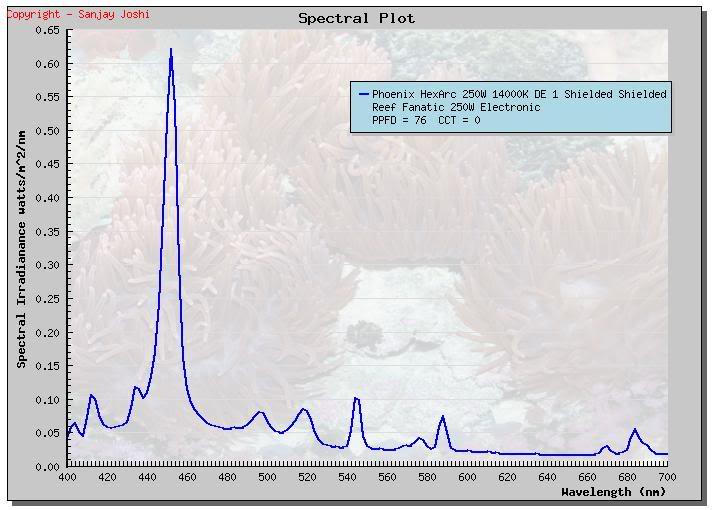
Funny THE most important range for corals..
We have to just agree to disagree here. It's actually digressing in an undercurrent
I'm sorry unless I was referring to a card game you know xxx trumps yyyy. Never play certain card games?Idk why you didn’t agree to disagree earlier. You keep going on about “blue light”. We all know blue light is bad for the eyes and I have never argued that but you keep going.
I told you I chose otherwise because flashing and blue is 2x bad but you come back with the same irrelevant points and deflections.
Btw.. I’m sure the conversation started digressing with a political undercurrent when you randomly brought up “Trumps” flashing blue leds. TDS on blast.












