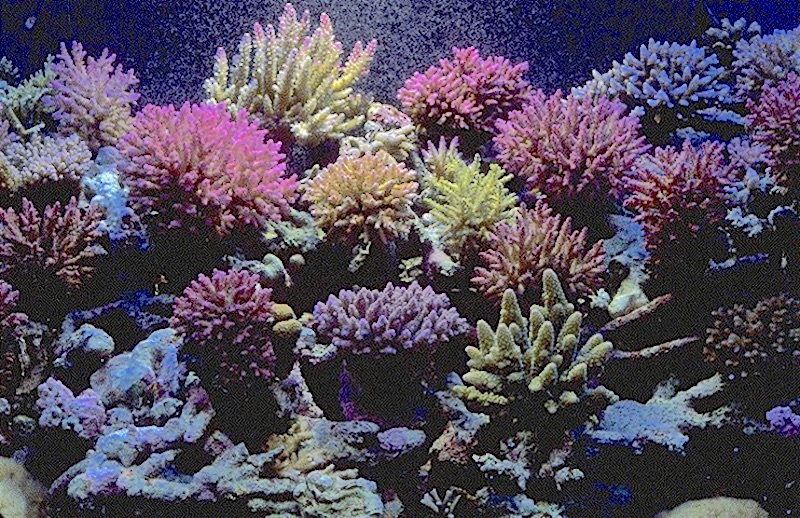
Pretty sure the first HID lamp was a mercury vapor, which reportedly had a blue look to it. I may be mistaken.
Point was any high par light source was the driving source.
If vho's had power densities of say 200w in 24" the likelihood of using any HID source would have diminished if not never had occurred.
Driving force was simply watts sq ft ("PAR"/sq ft if you prefer) so to speak.
1960’s – Largely Incandescent Lighting. Not suitable for reef tanks.
1970’s – Largely Fluorescent Lighting (T12). Often not bright enough for reef tanks.
1980’s – VHO fluorescent and Metal Halide Lighting. Reef tanks start to appear using one or both technologies.
1990’s – Compact Fluorescent Lighting (T8 & T5) Smaller, brighter and more efficient than VHO.
2000’s – High Intensity LED Lighting. Compact, bright, efficient.
Spectrum followed based on light attenuation.
Spectrum was, and is still far from " natural" but it worked. Turned out to be good enough (as to nature and possibly better in some areas but I digress) and due to a sort if natural! rgb effect (green and amber mercury spikes), visually appealing.
Same w t5's after tri- phosphor improvements.
I'd be curious to how well plain mercury lamps worked in growing corals, ugly color and all.
Who knows, may beat other light sources.
See power was not the only factor "looks" mattered.
Between the inauguration last week and Martin Luther King Day, you could not turn on anything without hearing the phrase “Events that shaped history”. That got me to thinking about the events that…
reefbuilders.com
Nothing against mh's . The constant degrading of an evolving (like HID did) and frankly popular for many reasons is err not very helpful to put it nicely.
Accusing brs if being machivellian certainly doesn't look good. Sure there are business decision driven in part by err profit and convenience but also by demand.
Don't like their "politics" on MH's go somewhere else, find other data ect.
I' m sure there were "fun" discussions on vho vs " the sparkly new kid MH's"
Heck even in 2006 there was debate on what actinic does ..
Cultivated Reef
Do actinics provide any value to corals?
By junkitu, September 21, 2006 in Lighting Forum
Natural conditions have caused all corals and invertebrates to adapt to bluer light. Therefore, most lighting systems include bulbs that focus specifically on blue wavelengths. Fluorescent systems, for example, offer blue bulbs called actinic bulbs. While most corals and invertebrates thrive under blue light, most people find blue-lit reef aquariums rather unattractive. This aesthetic dilemma can be solved by combining an actinic light with a white light. Most reef aquariums thrive under a half-and-half blue/white light combination in which the white lights give light in the range of 8000 to 12000 K. This lighting combination gives corals and invertebrates the spectrum necessary for growth, in addition to the spectrum necessary for accurate color rendering within the aquarium.
For all intents and purposes actinic is purely aesthetic. It may provide a slight benefit for coral growth but actinics are mainly there for our viewing pleasure. They make the coral colors pop whereas the whiter/yellow light makes the corals grow.
Posted September 21, 2006
All opinions will be mixed on the subject...Ive seen comparisons in coral health that have showed that they do help but Im not so sure I believe them...
i think its kind of out of the scope of most members of this board. Its a matter how how the chloroplast uses different wavelengths of light to perform photosynthesis. I'd ask a biologist
Posted September 22, 2006
There will be enough of the blue spectrum in your daylight lamps for your corals. so for your purpose, the actinics is purely for aesthetics
Blue actinic lights are targeted for this spectrum so they should help stimulate photosynthesis in zooxantellae. This is not to say that your 10K lights will not have enough of the blue spectrum in them for growth as indicated by Keith Man. I think $aint sums up why we use daylight spectrum lights quite well. His summary alines with what is written in “The Reef Aquarium, Volume 1”.
Fortunately, fluorescence in coral is triggered best by light in the blue/green range, which is why actinic lights cause corals to fluoresce more. The local marine society had a guest speaker this past month who studies this for a living (great work if you can get it - night diving with blue flashlights in the Caribbean ). He was showing off blue led flashlights combined with yellowish glasses that made the coral fluoresce like crazy with night viewing. The yellowish brown glasses filter out the blue light (yellow/brown is also the dominate color of zooxanthellae as well – which is why they absorb blue light so well) from the flashlight allowing you to see the light emitted by the fluorescing corals much better. The results are amazing. See attached pic of a doughnut coral and zoos in my tank using the blue led light and filter. This is one reason that actinic lights cause coral’s color to seem more colorful than straight daylight.
The reason I state that it is mainly for aesthetics is twofold. First, actinics put out a very narrow band of wavelengths that do make corals look better but do not in any way simulate natural sunlight. Since these corals have adapted to use sunlight (in its entire spectrum), shooting a narrow wavelength at them is obviously not going to get them everything they receive in nature; which ultimately is what we are trying to duplicate in our homes.
Second, look at people who use 20K bulbs (very similar to actinics in the amount of blue light they produce). Growth is almost always reported as lacking. If blue light was really what corals were 'fine tuned' to receive for photosynthesis than 20K bulbs should produce massive growth. The idea that corals need mostly blue light is bogus. Are red wavelengths absorbed first as light filters through water? Yes. Does that mean corals are only using blue light since the red light gets filtered out? Obviously not.
The fact of the matter is there are two many unknowns to really answer this question absolutely. But if you look at what is reported around the hobby it becomes fairly obvious that coral growth requires the full spectrum of light (white light) and that people who have the blue actinics/bulbs are using this blue light to enhance the coloration of their livestock not to promote the growth/health of said livestock.
LED's aren't going away, nor VHO, T5's, MH, prob. CMH until profits decrease.
All have proven successful. All will be successful. "Degree of success" is variable.
Think of the literally dozens of MH bulbs and fixtures that have "disappeared" over time.
Same w/ LED.
What kind of lighting do you run on your tank?
I build and design fw lighting. Reef lighting research is a hobby.
Happy?
How many high quality
Leds have you used for over a year?
IF one hasn't done their own independent study on MH vs led under controlled conditions you are basing everything on othr s hearsay..
Well so am I .
No different really.
It's all ones opinion.





 www.thereeftank.com

 reefs.com