Moving Tank....Ideas and suggestions with moving Sand

vasilithegreek

Community Member
View Badges
Joined
Nov 13, 2010
Messages
41
Reaction score
1
Location
chicago
Rating - 0%
0   0   0
Im moving my tank from my old place to my new home. What would you guys recommend I do with the Sand.

Option 1: Move the tank with existing sand in it and keep or
Option 2: Take old sand out and add new sand

Is there any downside in just adding new sand. The benefit of keeping the old sand is still there if I move it around, correct?
I know if I keep the tank steady and I dont stir up to much of the old sand I will go through very minimal spikes.

so any thoughts or experience would be great thanks!

 
40 breeder and the sand is over a year. I started fresh with this tank, and accidentally got the sugar grain size
 
I would like to have a more coarse sand type in there now. Just want to know if Im doing more harm than good if I replace the sand or if it would be best to keep the existing sand and setup the tank that way. The setup up of the tank would be 1hr after taking it down.
 
If you dont like the sand anyway why not just replac it and use a few cups of the old sand to seed the new?
 
If you dont like the sand anyway why not just replac it and use a few cups of the old sand to seed the new?

+1

I moved my tank from one room to another,
used the opertunity to thruoghly rinse and sift the sand I had
had almost no cycle
(but I do have over 100lbs of LR)

I'm about to upgrade from a 75 to a 90,
I'm planning on going with new sand (keeping a couple cups of old sand to seed it)
 
Simply add new sand to your liking. Sand is relatively inexpensive and a great opportunity to start fresh. Keep a couple of pounds of old sand to seed the new sand.

HTH
 
Agree with all above. Moved a 125 with sand and regretted it. Ended up taking old sand out and wish I'd done that in the beginning. Good luck.
 
I decided im going to get new sand, thanks for all the info. I was so indecisive about what to do. If I clean out the old sand really well (after I use it to see the new stuff) I would be able to use it for my fuge, or will it have left over deterius and other bad stuff.
 
Get new and use Seachem Stability I actually switched to a 75 a while back and used new water and new sand with little to no cycle just used the Stability and everything was fine. Just made sure the water was right salinity and temp and threw fish straight from one to the other along with the corals and inverts.
 
I decided im going to get new sand, thanks for all the info. I was so indecisive about what to do. If I clean out the old sand really well (after I use it to see the new stuff) I would be able to use it for my fuge, or will it have left over deterius and other bad stuff.

Should be fine, but if u want something for ur fuge get mineral mud. I got it in mine and its great. Not only will it go anaerobic within a half inch, it will also dissolve and replace some trace elements in ur tank.

Sent from my LG-P999 using Tapatalk
 
Hows the mud work, can i mix it with sand or throw sand on top of it? Its pretty expensive stuff to fill 1/2" in my fuge.
 
Hows the mud work, can i mix it with sand or throw sand on top of it? Its pretty expensive stuff to fill 1/2" in my fuge.

check it out
Miracle Mud® - Marine


Set-Up Instructions
  1. Place the appropriate amount of MIRACLE MUD® into Chamber #2 of the EcoSystem Aquarium® Filter. Level it to create an evenly distributed, 1-inch thick mud bed when packed down (at least 1 to 1.5 inches of dry Miracle Mud), to ensure adequate denitrification takes place.

  2. Place plastic bag or plate on top of the MIRACLE MUD® bed. Slowly pour water on top of the plastic bag or plate, allowing water to overflow onto the mud bed. Do not pour water directly onto the mud bed. This will stir up the mud, causing it to become suspended in the water, making the water cloudy. When this happens, it will take a long time for the suspended mud to settle. Once the desired water level is reached (about 10 to 12 inches of water), remove the plastic bag or plate from the EcoSystem Aquarium® Filter.
  3. Allow the MIRACLE MUD® to settle to the bottom (if you follow the above directions carefully and don't accidentally pour water directly onto the MIRACLE MUD® bed, the water should not be cloudy). Once it has settled, remove any floating particles with a net or paper towel.
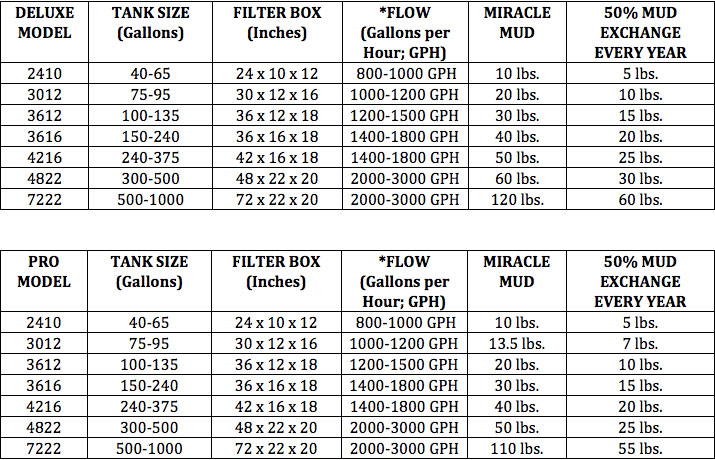
  4. Turn on pump at recommended flow rate – please see table below.


    * The flow rate shown in the table is highly recommended for the EcoSystem filters in order to optimize the efficiency of the EcoSystem Method. However, the current** and/or flow rate within the main display aquarium is totally different/independent of the flow rate that flow through the EcoSystem filters.

    ** The flow rate and/or current within the main display aquarium can be ranging from as little as 10 times and up to 40 times of the aquarium water volume depending on the aquarium inhabitants that you keep. For example, for the sps corals dominated reef aquarium the gentle current / flow rate within the tank must be very high while the soft and lps corals dominated reef aquarium would like low flow rate and gentle current.
  5. Cycle the tank for 6 to 8 weeks. During the second week, add macro-algae (we recommend Chaetomorpha Caulerpa). Tie the macro-algae and/or plant strands to small pieces of live rock or other rock, with fishing line. Scatter the macro-algae/plant "rocks" over the MIRACLE MUD® bed. We recommend that you prepare a minimum of 10 to 20 macro-algae/plant rocks to avoid a macro-algae/plant mass die off.
  6. After the cycling period is ended, fish and corals that have been quarantined may be introduced into the aquarium.

 
Refugium Mineral Mud

The ideal substrate for refugiums, it supplies trace elements, iodine, minerals, and nutrients, helping create a beneficial environment for aquarium food such as copepods, burrowing worms, decapods, and other sump organisms. It can also help boost your refugium's filtration, as it supports many types of nitrifying bacteria. Similar to varied sand in texture, its layers include marine bacteria, organic rich clay, iodine and chelated-element rich substrate, and super-fine aragonite organic acids. 1 gallon

CaribSea Mineral Mud Refugium Substrate 1 Gallon

CaribSea Mineral Mud Refugium Substrate 1 Gallon Information


CS.jpg

CaribSea Mineral Mud : This is a unique blend of sediments that duplicate tropical fringing coastal mangrove environments. Mineral Mud is in a size range compatible with soft, burrowing infaunal, macro animal assemblages. Ideal for mud refugiums, seaglasses, macro-algaes, and mangroves, Mineral Mud provides a variety of trace elements, chelated trace elements, natural bio-availble Iodine plus Calcium, Strontium, Iron, and free Carbon. In addition, Mineral Mud contains live marine bacteria, to complete the tropical ecosystem. 1 Gal.


Specifications

  • 1 galllon


Manufacturer Info

At CaribSea we take aquariums seriously. Since 1972 we have supplied hundreds of public aquariums, zoos, aquaculture facilities, public and private institutions, and hundreds of thousands of dedicated aquarists with the highest quality marine and freshwater products. CaribSea has been in the forefront of the principle that substrates are a piece of equirment, not just a decorative afterthought. Caribsea substrates are as precisely engineered as any piece of advanced equipment used by today`s hobbyists and professionals. CaribSea products are the chemical support, biological filtration, and biodiversity backbone for many of the most spectacular aquatic displays ever created. We are now celebrating our 35th year in the business, and our product line has continued to grow; making CaribSea your aragonite source and so much more.
 
Last edited:
Don't confuse mineral mud work miracle mud tho. Miracle mud costs an arm and a leg plus ur first born. Mineral mud is just as good and like 30 bucks for a gallon.

Sent from my LG-P999 using Tapatalk
 
Marine depot buddy. That's where i got mine, i also have some walt Smith fiji mud too.

Sent from my LG-P999 using Tapatalk
 

IF YOU HAD TO TAKE A REEFING EXAM, WOULD YOU PASS?

  • Yes!

    Votes: 32 45.7%
  • Not yet, but I have one that I want to buy in mind!

    Votes: 9 12.9%
  • No.

    Votes: 26 37.1%
  • Other (please explain).

    Votes: 3 4.3%
Back
Top