Navigation
Install the app
How to install the app on iOS
Follow along with the video below to see how to install our site as a web app on your home screen.
Note: This feature may not be available in some browsers.
More options
You are using an out of date browser. It may not display this or other websites correctly.
You should upgrade or use an alternative browser.
You should upgrade or use an alternative browser.
Need help
- Thread starter jesse88
- Start date
- Tagged users None




DebatableAre they ok in a reef tank?
Pretty standard hitchhiker.I have no clue how they got into my reef tank


vetteguy53081
Well known Member and monster tank lover
View Badges
Partner Member 2024
Excellence Award
Reef Tank 365
RGB
Article Contributor
Tampa Bay Reef Keepers
West Palm Beach Reefer
Hospitality Award
Ocala Reef Club Member
305 Reef Club
Wisco Reefers
Midwest Reefer
Fish Medic
MAC of SW Florida
Rock Pool Reef Keepers
R2R Secret Santa 2023
My Tank Thread
My Aquarium Showcase
Asterina star and not to be trusted. They are known to take down zoa and other soft coral. I caught two that took down and entire colony of bam Bam zoaCan anyone tell me what this is? This was the best pic that I could get.

vetteguy53081
Well known Member and monster tank lover
View Badges
Partner Member 2024
Excellence Award
Reef Tank 365
RGB
Article Contributor
Tampa Bay Reef Keepers
West Palm Beach Reefer
Hospitality Award
Ocala Reef Club Member
305 Reef Club
Wisco Reefers
Midwest Reefer
Fish Medic
MAC of SW Florida
Rock Pool Reef Keepers
R2R Secret Santa 2023
My Tank Thread
My Aquarium Showcase
remove manually by hand or small 2" fish net and discard. If a whole array of them- Consider a harlequin shrimpAny ideas how I could get them out of my tank


They’re small and they reproduce in our tanks by dropping legs that grow into more starfish, so it could’ve come in on almost anything.
I've heard some species eat corals and others don't - I've seen convincing evidence for one species (a very darkly colored one), and one piece of somewhat convincing evidence for one different species, but the vast majority of these guys seem to be at least mostly safe.
With regards to whether or not the average "Asterina" (technically Aquilonastra - Asterina is a separate genus within the Asterinidae family) eat corals, it might be a species specific thing, it might be a you have way too many starfish so they're out of other food options thing, it might be they're eating the slime coat/mucus on the coral rather than the coral itself (see below), or they might just opportunistically eat unhealthy corals. Based on how starfish eat, it seems plausible to me that it may also be coincidental (i.e. the star goes to eat something off the coral and the coral just happens to be one that is able to be negatively effected by the star's everted stomach). Regardless, Zoas are just about the only coral I've heard about regular "Asterina" stars potentially going after with any sort of frequency.
A quote I like to refer to for this:
I've heard some species eat corals and others don't - I've seen convincing evidence for one species (a very darkly colored one), and one piece of somewhat convincing evidence for one different species, but the vast majority of these guys seem to be at least mostly safe.
With regards to whether or not the average "Asterina" (technically Aquilonastra - Asterina is a separate genus within the Asterinidae family) eat corals, it might be a species specific thing, it might be a you have way too many starfish so they're out of other food options thing, it might be they're eating the slime coat/mucus on the coral rather than the coral itself (see below), or they might just opportunistically eat unhealthy corals. Based on how starfish eat, it seems plausible to me that it may also be coincidental (i.e. the star goes to eat something off the coral and the coral just happens to be one that is able to be negatively effected by the star's everted stomach). Regardless, Zoas are just about the only coral I've heard about regular "Asterina" stars potentially going after with any sort of frequency.
A quote I like to refer to for this:
Timfish said:
It's an Aquilonastra spp. starfish and is a great scavenger. I see them with anywhere from 4 to 12 legs. The whole discusion around them seems to me excellent examples of misidentification, mistaken behaviour and assumed causality based just on heresay without looking at the research. Asterina spp starfish are preditary but only reproduce sexually and are shortlived so while it's possible some might get into a tank even if it did happen it's not going to be around long. Aquilonastra are one of the uncommon species that reproduce fissiparous or by splitting so are easy to identify by the different sized legs regrown after splitting. They perform an important function not only feeding off algae films but also feeding off microbial films including those on corals (at least ones that don't sting). FYI the mucus coating on corals ages and corals have to periodicely shed it to renew it and maintian healthy microbial processes (Ref 1, Ref 2). If Aquilonastra are feeding on zoas or softies I'll argue they are either benign or even beneficial as they may be reducing the unhealthy older mucus which can be full of unhealthy microbes which the animal is trying to get rid of and are far more likely to be the actual problem.
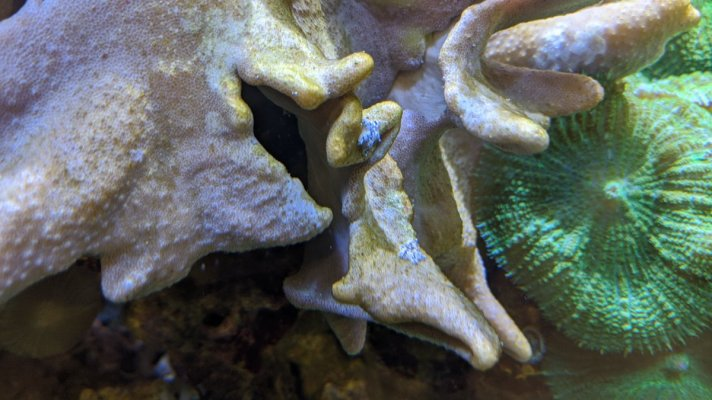
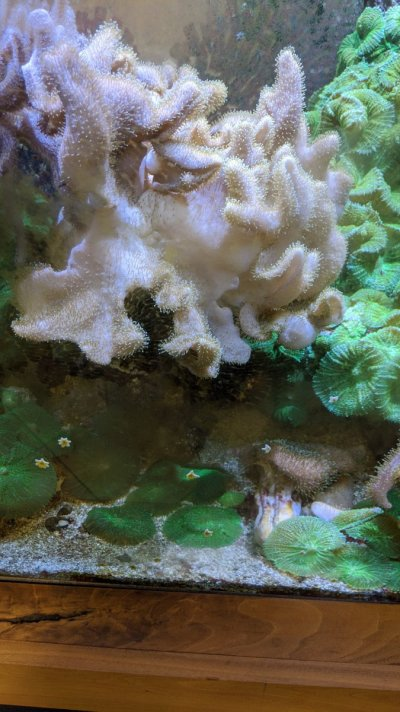
Here's an example, this Toadstool is doing one of it's periodic sheddings. The Aquilonastra have been in this system for years but only climb onto the Toadstool when it's shedding. In the first picture you can see the old mucus film, Aquilonastra starfish and areas they have cleaned off. The second picture shows the Toadstool a week later.


What is that!! A R2R guide to common new tank hitchhikers.
One of the greatest things about starting a reef tank is getting your live rock in and admiring all the diversity within it. The rock comes to life different creatures. This is a guide that I, along with a very well known critter identifier @KJ , have put together for the new reefer on what...
 www.reef2reef.com