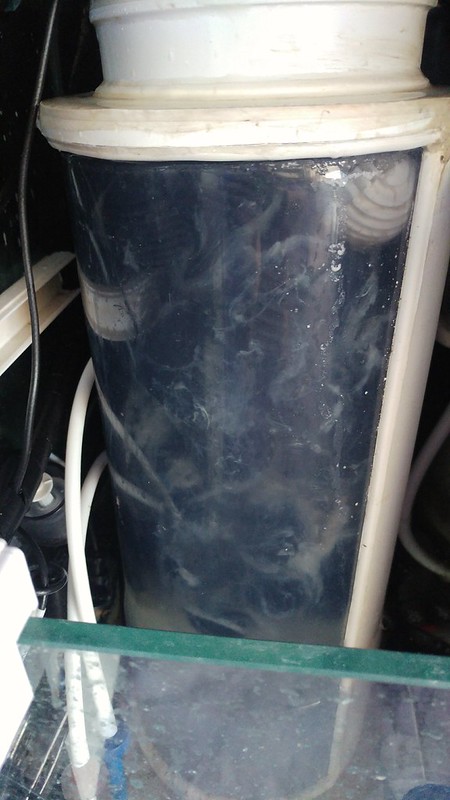
New sulfur denitrator working great!

  • Thread starter Thread starter lawise
  • Start date Start date
  • Tagged users None
@ReeferBud & @una Yes its not needed as long as the effluent is flowing you wont stink the house up. If you turn off the effluent you will stink the house up and have to change out the media. Dont you think if that was needed that Geo's Reef & other manufacturers would have designed their system to have an ORP meter in it like they have a pH probe for the CaRx? If you start smelling H2S your effluent is too slow so all you have to do is increase the effluent.

 
@ReeferBud & @una Yes its not needed as long as the effluent is flowing you wont stink the house up. If you turn off the effluent you will stink the house up and have to change out the media. Dont you think if that was needed that Geo's Reef & other manufacturers would have designed their system to have an ORP meter in it like they have a pH probe for the CaRx? If you start smelling H2S your effluent is too slow so all you have to do is increase the effluent.

The risks of H2S are far higher in a carbon denitrator than a sulfur denitrator (IMO).

I'm not sure there's a process whereby low flow results in the sulfur being converted into hydrogen sulfide, but the reaction of organic matter with sulfate in low O2 seawater by bacteria does result in hydrogen sulfide, and any tank water that gets stagnant has organics and sulfate in it, and can make hydrogen sulfide. A carbon denitrator has extra organic matter added, and hence is functioning at the edge of consuming the nitrate, but not consuming the sulfate.
 
Dont you think if that was needed that Geo's Reef & other manufacturers would have designed their system to have an ORP meter in it like they have a pH probe for the CaRx?

Aquamaxx includes a probe holder precisely for this purpose and there are multiple cases of people monitoring/controlling their sulfur denitrator based on ORP.

Increasing the flow is s simple solution but I travel a lot for work and try to have the tank as automated as possible. In the event the ORP gets out of the operating range, my thought is to prevent the H2S addition to the tank and house by shutting off the flow via a solenoid. This would be a failsafe and would need to then clean/flush the reactor.
 
Aquamaxx includes a probe holder precisely for this purpose and there are multiple cases of people monitoring/controlling their sulfur denitrator based on ORP.

Increasing the flow is s simple solution but I travel a lot for work and try to have the tank as automated as possible. In the event the ORP gets out of the operating range, my thought is to prevent the H2S addition to the tank and house by shutting off the flow via a solenoid. This would be a failsafe and would need to then clean/flush the reactor.

This isn't like a calcium reactor where you need to adjust drip rate and maintain a certain pH via co2 solenoid in order to maintain just right conditions inside the reactor. Once you get the denitrator dialed in, there really isn't anything to it. I really don't think the risk is there for something to go wrong and this piece of equipment hurts your tank. Worst thing that could happen is it clogs and stops flowing in which case your nitrates might rise a little and you will have to flush it out when you get home. If I had an ORP probe on my reactor I don't really know what I'd do with it...
 
There are many threads about dialing in a sulfur denitrator based on ORP. A few examples below:
http://www.reefcentral.com/forums/showthread.php?t=1697043
https://forum.neptunesystems.com/showthread.php?18376-Sulfur-Denitrator-anyway-to-set-a-negative-ORP
https://www.reef2reef.com/threads/sulfur-denitrator-build-thread.275256/

Basically, high ORP means there's too much oxygen in the reactor and it won't result in the anoxic conditions necessary for the bacteria to reduce nitrate effectively. If ORP is too low, then the flow needs to be increased to prevent the formation of H2S. The common target is apparently -170 mv and you can use the ORP probe to determine whether you're in this optimal range. I plan to feed the reactor with a DOS and I can create a low and high flow profile, which can be adjusted based on the ORP reading.

Randy can probably explain the chemistry of how this works and I found an article where it's mentioned:
http://reefkeeping.com/issues/2005-12/rhf/
 
This isn't like a calcium reactor where you need to adjust drip rate and maintain a certain pH via co2 solenoid in order to maintain just right conditions inside the reactor. Once you get the denitrator dialed in, there really isn't anything to it. I really don't think the risk is there for something to go wrong and this piece of equipment hurts your tank. Worst thing that could happen is it clogs and stops flowing in which case your nitrates might rise a little and you will have to flush it out when you get home. If I had an ORP probe on my reactor I don't really know what I'd do with it...

I have a diy carbon one online for not so long & i couldn't disagree more as i try to get some stability ironed out.
I had a tap controlling output...That tap (1/4 jg)partially blocks with mulm - i've now moved the tap over to the delivery side - the mv/orp reading showed this, as the output reduced the mv climbed. I'm not really worried about it not removing no3 but rather bombing my tank from the potentially risky effluent.
I started at 20ml/min output with zero nitrate - i'm now at around 200ml/min flow - the mv/orp reading has been a immense help in seeing what is going on & keeping me alert to any oddness happening.
So far for what i've seen i'd never attempt to run one without it.
Differant views i guess :)
 
There are many threads about dialing in a sulfur denitrator based on ORP. A few examples below:
http://www.reefcentral.com/forums/showthread.php?t=1697043
https://forum.neptunesystems.com/showthread.php?18376-Sulfur-Denitrator-anyway-to-set-a-negative-ORP
https://www.reef2reef.com/threads/sulfur-denitrator-build-thread.275256/

Basically, high ORP means there's too much oxygen in the reactor and it won't result in the anoxic conditions necessary for the bacteria to reduce nitrate effectively. If ORP is too low, then the flow needs to be increased to prevent the formation of H2S. The common target is apparently -170 mv and you can use the ORP probe to determine whether you're in this optimal range. I plan to feed the reactor with a DOS and I can create a low and high flow profile, which can be adjusted based on the ORP reading.

Randy can probably explain the chemistry of how this works and I found an article where it's mentioned:
http://reefkeeping.com/issues/2005-12/rhf/

I understand this is a thing people do... I'm just saying I can't see why it's necessary. I have not found it to be the kind of thing that requires that much effort.
 
I have a diy carbon one online for not so long & i couldn't disagree more as i try to get some stability ironed out.
I had a tap controlling output...That tap (1/4 jg)partially blocks with mulm - i've now moved the tap over to the delivery side - the mv/orp reading showed this, as the output reduced the mv climbed. I'm not really worried about it not removing no3 but rather bombing my tank from the potentially risky effluent.
I started at 20ml/min output with zero nitrate - i'm now at around 200ml/min flow - the mv/orp reading has been a immense help in seeing what is going on & keeping me alert to any oddness happening.
So far for what i've seen i'd never attempt to run one without it.
Differant views i guess :)

I'm not talking about a carbon one, I only have experience with the sulfur type. No idea if ORP control would be more beneficial on a carbon reactor.
 
Beginning to need to look at tuning down my carbon denitrator,
Would anyone know is there a mv level that is best to stay below of so nitrite is least likely to become present?
I have a trickle flow present & have been running a controller that pushes extra water thru the reactor once my mv has been hitting -170, flow is now at 200ml/minute & each time i increase flow it seems a day later the reactor has stepped up its game & then i need to increase flow more else i have trouble getting the reactor to budge below that -170, i 'm not going to be able to keep doing this increase flow strategy as the no3 is getting lower.

SO as i see it my options are
1) Raise the mv level so its not so efficient
2) Its a 15L/4Gal volume reactor with 145 bacto balls & 45 deniballs, the deniballs are a time release carbon source good for 1year so reducing the deniballs/carbon source would also work i guess.

Perhaps i end up doing both but for the mv part anyone have any idea of a good figure to stay below of re the possibilty of nitrite appearing? @Randy Holmes-Farley ?? Any rule of thumb at all?
 
Last edited:
I don't have a rule of thumb, but I wouldn't be concerned about nitrite. It's not toxic. Hydrogen sulfide is the one to worry about.

Hydrogen sulfide can begin to form at 0 mv and lower.

Hydrogen Sulfide and the Reef Aquarium by Randy Holmes-Farley - Reefkeeping.com
http://reefkeeping.com/issues/2005-12/rhf/index.php

Okay thanks Randy - Had no sign of that smell yet,opened it to remove some of the carbon food balls & it was almost like jelly inside there with so much bacteria mulm so also removed a bunch of the other balls as well. Hopefully that will tame it down some.
 
If extra air or bubbles are trapped in the denitrator got this response from aquamaxx.
Bubbles trapped in the denitrator is a natural part of the denitrification process, and can be purged by tilting the reactor and running the effluent fully open. After purging, you can return back to the normal rate.

Thanks,

AquaMaxx Technical Support
 
@lawise
With your sulphur denitrator do you get this kind of bacteria mulm build up or does it stay more down in the sulphur?
Trying to dial in any sort of constant stream with this mulm is kind of becoming mission impossible.
Just wondering if the sulphur option is a bit more "cleaner" so the flow could be dialled in better,I'm finding now i just have to rely on the controller to kick in once i hit a certain mv level but that does'nt give me good flow rate options for getting the tank no3 level stable

36107385643_0811da9c75_c.jpg
 
@lawise
With your sulphur denitrator do you get this kind of bacteria mulm build up or does it stay more down in the sulphur?
Trying to dial in any sort of constant stream with this mulm is kind of becoming mission impossible.
Just wondering if the sulphur option is a bit more "cleaner" so the flow could be dialled in better,I'm finding now i just have to rely on the controller to kick in once i hit a certain mv level but that does'nt give me good flow rate options for getting the tank no3 level stable

36107385643_0811da9c75_c.jpg
With my sulfur denitrator I see no build-up scum of any kind it looks the same as the day I bought it, I don't know if it makes any difference or not but mine was only set up now for about 2 months but is working great. If I see anything unusual in the future I will definitely post.
 
Also sharing my early experience, since this thread has been instrumental I deciding to purchase a sulfur denitrator and learning how to set it up.

I've had it running for a little over a month now. I bought the Aquamaxx Ts-3 and it's on a heavily stocked 450 gal sps reef. The break in period was seamless. To be honest, I never really tested the effluent, I just let it run at the recommended 3 drops/sec.

I tested nitrates on my tank and effluent today and the tank is at 2pmm and the effluent is at 0pmm, so it's definitely working.

I'm very happy with the experience so far. I've run bio-pellets, carbon dosed and done many different things over the years and I have NEVER had nitrate at 2pmm. Always struggled in the 10pmm+ range.

The next step is to do some of the automation and optimization a with the ORP proble and variable flow dosing.

Overall, I don't understand why these denitrators are not more popular (other than set up cost), given how effective it appears to be. I know it's still early and will need to keep an eye on things. I really like the idea of being able to"control" my nitrates by bringing them down and now I can start to investigate how to get them to my desired target of 5pmm.

What do others do? Dose KNO3? Adjust the denitrator somehow? Keep 0ppm nitrate?
 
I am running a carbon induced denitrator for over a year with great success. I can control my no3 level quite easily (keeping no3 between 3ppm to 5ppm). The idea is the same, the only difference is the media being used. This device simplify my filtration system, as you can see in the picture below. It just a small 10gG sump, halfway filled, with my denitrator, air stone, small wavemaker and a return pump in it. My wild SPS dominated tank is doing good with this setup.

I would say either sulfur denitrator or similar concept denitrator like my bacteria nitrate destroyer is good enough as nutrient controller.

Sight_2017_09_10_073658_148.jpg


WP_20170723_19_15_51_Pro - Copy.jpg


WPDrawing2017-23-03_07_23_16.jpg
 
Currently have had the aquamaxx ts-1 running for 6 months, no effect.
 
Currently have had the aquamaxx ts-1 running for 6 months, no effect.

Many questions about this.
What is your drip rate?
Have you tested the effluent coming out of the denitrator?
What is your Nitrate level in your tank?

I have been running mine for 1.5 years and it brought my 72 gal bf from well over 160 down to 10-20 in less time than 6 months, probably about 5. It has gone from my 72 to a 40B rescue tank and now on my 90 and it's keeping my Nitrates in that around 5.
 
2-3 drops per second effluent is 0 nitrate. Tank nitrate 60. It’s a 525 xl, with biopellet reactor, made the ATO a refugium with miracle mud , rowaphos reactor, chemipure on sump. Aquamaxx ts1. Fiji rock, live sand, 3 tangs, 1 foxface, 2 triggers, 1 marine beta, 1 clownfish, 3 chromis, 3 anthias, 2 damsels, CUC, 3 peppermints. LFS said I might be feeding a lot. LRS chunky and reef mix and hikari mysis approx. 1.5 inch each. I also let it sift thru rodi water to remove excess phosphates. Phosphate on tank is 1.1. Zoas and softies has survived. All sps dead. I think I’m getting burned out with this hobby. Bought everything, done everything to get rid of nitrates and phosphates.
 
I use a DIY passive sulfur reactor that was created out of an Aquamaxx media reactor and 25 mm Siporax tubes. I cut strips of needle point plastic and coiled the strip, then pushed it through the Siporax tubes, creating a bundle of tubes stacked in the reactor to the height of the reactor. Each tube is filled with sulfur preens and then capped on the top and bottom with a small square of needle point mesh pushed into the end. The sulfur reactor is plumbed after a reactor filled with empty Siporax tubes, and before a smaller reactor filled with ARM media. I just pump a steady flow of water through it and let the Siporax create the anaerobic conditions needed for the Sulfur bacteria. This reactor along with a tiny amount of All In One pellets keeps my NO3 between 2.5 - 5 ppm.

I did have one incident where the feed pump had slowed down too much and it smelled like a 1000 elephants had farted in my basement. Adjusted the pump and all was fine. The only other thing I have noted is the out of balance alkalinity consumption that Randy mentioned. I have been thinking about discontinuing the sulfur reactor as I dose AF 1,2,3+ components and have to keep disabling the 1st and 3rd component as they rise while my Alk stays steady (when dosed in equal amounts). I guess I could mix my Component 2 (Alk) stronger, or the other 2 weaker.

Just now I had a look at the reactors, and noticed that the ARM media in the 3rd reactor has been dissolved for about 1/2" on the bottom of the reactor. The remaining media is being held by friction above the dissolved portion. The sulfur reactor has huge bacterial sheets covering the outside of the Siporax tubes. I noticed some small amount of bacteria a couple of weeks ago, but I have been on vacation for the last 10 days and the tank sitter was probably feeding a lot heavier than I do. I will have to keep an eye on it and see if the bacterial films decrease as feeding returns to normal. It would be cool if it auto regulates itself even though it is just a passive flow through design.

Dennis
 
Last edited:

IF YOU HAD TO TAKE A REEFING EXAM, WOULD YOU PASS?

  • Yes!

    Votes: 32 45.7%
  • Not yet, but I have one that I want to buy in mind!

    Votes: 9 12.9%
  • No.

    Votes: 26 37.1%
  • Other (please explain).

    Votes: 3 4.3%

New Posts

Back
Top