Nitrate, phosphate and algae.

Yes. Detritus, poop etc.
I wonder if the algae outbreak would have happened if the same nitrate and phosphate levels were reached with nitrate and phosphate additives.


I find it important as a newbie, to not get false or inaccurate information. Especially, if it contradicts other information.

Fair enough, that is the whole reason for the Reef Chemistry forum. The internet and manufacturer claims are filled with reef chemical falsehoods.

But comparing to freshwater systems is often not useful in many contexts (for example, nitrite is not toxic in a marine system).

Cyanobacteria is the only problem "algae" best we have that consumes organics. Detritus can contribute nitrate and phosphate as it breaks down, but is not typically the main driver of those values, and ordinary green algae does not need any organic matter. However, sand that is filled with organic matter can grow algae on top of it as the N and P released can locally spur growth.

Regardless of the reason, reefers have found through years of trial and error, that lowering nutrients cannot always solve an algae problem before starving corals. Keeping nitrate at about 1-10 ppm and phosphate around 0.03 ppm can slow the growth of many types of algae (but not stop it) and will allow most corals to grow adequately.

But as I said above, a local source of phosphate on rock and sand can still allow algae to thrive even when concentrations in the water column might suggest otherwise.

 
Fair enough, that is the whole reason for the Reef Chemistry forum. The internet and manufacturer claims are filled with reef chemical falsehoods.

But comparing to freshwater systems is often not useful in many contexts (for example, nitrite is not toxic in a marine system).

Cyanobacteria is the only problem "algae" best we have that consumes organics. Detritus can contribute nitrate and phosphate as it breaks down, but is not typically the main driver of those values, and ordinary green algae does not need any organic matter. However, sand that is filled with organic matter can grow algae on top of it as the N and P released can locally spur growth.

Regardless of the reason, reefers have found through years of trial and error, that lowering nutrients cannot always solve an algae problem before starving corals. Keeping nitrate at about 1-10 ppm and phosphate around 0.03 ppm can slow the growth of many types of algae (but not stop it) and will allow most corals to grow adequately.

But as I said above, a local source of phosphate on rock and sand can still allow algae to thrive even when concentrations in the water column might suggest otherwise.
I can only agree.
The main difference I see regarding nutrients (phosphates,nitrates) in reef vs. planted tanks is how we adjust to our desired levels.
Low level nutrients, close to 0 ppm, in reef tanks is adjusted by feeding more and or skim less etc. creating more organic matter to break down.
In planted tanks, feeding more is not recommended. Dosing phosphates is fine.
So we still clean filter, sand, tank etc. to avoid algae and then dose 'heavily' with fertilizers.

The bottom line is, it seems people say "high level phosphates = algae" but it should be "high levels of decaying organic matter=algae". High phosphates are just a by product and not the cause.
 
The bottom line is, it seems people say "high level phosphates = algae" but it should be "high levels of decaying organic matter=algae". High phosphates are just a by product and not the cause.
I do not agree. Phosphate is straight up algae food. More food = more algae.

It's currently a major problem in North America. As lakes gets more and more populated, people do their laundry with detergent containing phosphate, and have their waste leaching in the lake.
Fertilizers used in agriculture also leaches into lakes and rivers.
Then, an algae bloom occurs in the lake, killing everyting and making it pretty much sterile.
I'm from the Quebec province in Canada, and our governement had to take measures to limit phosphate usage in home products and agriculture.

Here is a quote from the EPA : "Phosphorus is usually considered the “limiting nutrient” in aquatic ecosystems, meaning that the available quantity of this nutrient controls the pace at which algae and aquatic plants are produced. "
Source : Indicators: Phosphorus | National Aquatic Resource Surveys | US EPA

The key is having a balance. You need just enough phosphate and nitrates to feed the stuff you want (plants and corals), but not enough excess to feed the stuff you dont want (algae). The enclosed ecosystem can balance itself to a degree, but it will have problems dealing with excess nutrients.
 
I do not agree. Phosphate is straight up algae food. More food = more algae.

It's currently a major problem in North America. As lakes gets more and more populated, people do their laundry with detergent containing phosphate, and have their waste leaching in the lake.
Fertilizers used in agriculture also leaches into lakes and rivers.
Then, an algae bloom occurs in the lake, killing everyting and making it pretty much sterile.
I'm from the Quebec province in Canada, and our governement had to take measures to limit phosphate usage in home products and agriculture.

Here is a quote from the EPA : "Phosphorus is usually considered the “limiting nutrient” in aquatic ecosystems, meaning that the available quantity of this nutrient controls the pace at which algae and aquatic plants are produced. "
Source : Indicators: Phosphorus | National Aquatic Resource Surveys | US EPA

The key is having a balance. You need just enough phosphate and nitrates to feed the stuff you want (plants and corals), but not enough excess to feed the stuff you dont want (algae). The enclosed ecosystem can balance itself to a degree, but it will have problems dealing with excess nutrients.
The lake scenario you are refering to, is what I remember as a kid here (we don't use much of that stuff anymore, because of these effects in rivers and lakes).
However, as already mentioned, in a controlled system like an aquarium, phosphates, nitrates etc. does not cause algae (in planted tanks). Even with quite high phosphates 4-8+ppm, I could introduce various algae types, and not have them thrive and spreading.
 
The bottom line is, it seems people say "high level phosphates = algae" but it should be "high levels of decaying organic matter=algae". High phosphates are just a by product and not the cause.

Both statements are wrong.

Many things are needed for algae growth, and phosphate from any source is one of them.
 
Both statements are wrong.

Many things are needed for algae growth, and phosphate from any source is one of them.
Was exactly the answer I was looking.
Phosphate is a vital component for algae, but not the cause.
I see the logic in limiting such components to where corals thrive.
 
Phosphate is a vital component for algae, but not the cause.
Great way to say it. The cause of algae is algae itself. If no spores are there, then algae doesnt grow. But phosphate is only one ingredient in the algae recipie. :)
 
Many aquatic life forms need phosphates. Algae can be controlled naturally(and slowly). Again just give it a place to grow(not your DT) talk about a natural filter and stable water quality.... Algae blooms are natures way of dealing with a on-slot of pollutants, most of them man made..
 
Yes. Detritus, poop etc.
I wonder if the algae outbreak would have happened if the same nitrate and phosphate levels were reached with nitrate and phosphate additives.


I find it important as a newbie, to not get false or inaccurate information. Especially, if it contradicts other information.

Detritus, poop or additives - all of this ends up as inorganic phosphates which is what the algae consumes. So there will be no difference.

very small amount of phosphates as well as large amount of phosphates can both cause Algae to grow in a reef. There is no misconception here. If your specific question is whether Algae dies if there is too much phosphates - then the answer is no.
 
Detritus, poop or additives - all of this ends up as inorganic phosphates which is what the algae consumes. So there will be no difference.

very small amount of phosphates as well as large amount of phosphates can both cause Algae to grow in a reef. There is no misconception here. If your specific question is whether Algae dies if there is too much phosphates - then the answer is no.
No. My initial question is: Do phosphate cause algae. To rephrase; will higher/elevated phosphate levels increase algae?
I know that in planted tanks, increasing phosphate levels has no impact on algae growth, although too low levels can increase population of specific algae.
IF elevated phosphates do increase algae growth in salt water tanks, then why?
 
No. My initial question is: Do phosphate cause algae. To rephrase; will higher/elevated phosphate levels increase algae?
I know that in planted tanks, increasing phosphate levels has no impact on algae growth, although too low levels can increase population of specific algae.
IF elevated phosphates do increase algae growth in salt water tanks, then why?

for autotrophic growth algae needs Macro as well as Micro elements. Macro elements are C, N, P. So Phosphorus is just one of them. Also many micro elements required are ca, mg, na, k, fe,su, zn, cu, co... and different algae have different uptakes of these nutrients in varying levels.

So if Algal growth is not limited by other elements then high phosphates will contribute to more growth.

Obviously high phosphates will not lead to more algal growth if something else is limiting,
 
for autotrophic growth algae needs Macro as well as Micro elements. Macro elements are C, N, P. So Phosphorus is just one of them. Also many micro elements required are ca, mg, na, k, fe,su, zn, cu, co... and different algae have different uptakes of these nutrients in varying levels.

So if Algal growth is not limited by other elements then high phosphates will contribute to more growth.

Obviously high phosphates will not lead to more algal growth if something else is limiting,
True. However, plants needs the same elements, and in higher concentrations.
High nutrients (macro and micro) promotes plant health and growth, and less algae.
Low nutrients inhibets plant growth, leaf shedding and promotes algae growth.
I'm trying to understand and/or find examples or reasons why this isn't so in salt water tanks.

I can understand, that it will be hard to find anyone that would like to dose high level phosphates in their tank, and increasing nutrients, if needed, is easily done by feeding more and or skim less.
 
True. However, plants needs the same elements, and in higher concentrations.
High nutrients (macro and micro) promotes plant health and growth, and less algae.
Low nutrients inhibets plant growth, leaf shedding and promotes algae growth.
I'm trying to understand and/or find examples or reasons why this isn't so in salt water tanks.

I can understand, that it will be hard to find anyone that would like to dose high level phosphates in their tank, and increasing nutrients, if needed, is easily done by feeding more and or skim less.
That is because instead of plants we have corals ( animals) in the reef.

Plants require the same nutrients in similiar proportions as the algae, so when you promote the growth of one, you inihibhit the other.
Coral nutrient needs are completely different proportions when compared to plants.
 
True. However, plants needs the same elements, and in higher concentrations.
High nutrients (macro and micro) promotes plant health and growth, and less algae.
Low nutrients inhibets plant growth, leaf shedding and promotes algae growth.
I'm trying to understand and/or find examples or reasons why this isn't so in salt water tanks.

I can understand, that it will be hard to find anyone that would like to dose high level phosphates in their tank, and increasing nutrients, if needed, is easily done by feeding more and or skim less.

I'm still not sure what you are asking. Low nutrients certainly does inhibit algae growth. It is just not always completely effective at preventing algae in reef tanks without hurting corals. Since you do not have corals to worry about in fresh water, there does not seem to be a conundrum.

Sources of N and P are often limiting to all of the photosynthetic organisms in seawater. The paper below measured whether N or P availability is limiting macroalgae in the ocean near Hawaii.


Many "macro" elements are already high in seawater. Higher than typical freshwater. Potassium at 400 ppm, for example.

There are very few actual "plants" that are used in reef aquaria. Not sure if that is relevant to your concern, but seagrass and mangroves are the only ones I can think of. Macroalgae are not actually plants.
 
That is because instead of plants we have corals ( animals) in the reef.

Plants require the same nutrients in similiar proportions as the algae, so when you promote the growth of one, you inihibhit the other.
Coral nutrient needs are completely different proportions when compared to plants.
Sure. Corals have other demands which is our concern. But you can take corals and plants out of the equation it makes more sense.

I'm still not sure what you are asking. Low nutrients certainly does inhibit algae growth. It is just not always completely effective at preventing algae in reef tanks without hurting corals. Since you do not have corals to worry about in fresh water, there does not seem to be a conundrum.

The differences in salt water and fresh water, corals and plants are huge, so I'm not debating if 0.05 or 5.00 ppm phosphates matters.
I could setup a scenario, and perhaps a future setup to 'test' what I'm looking for.

3 identical tanks (salinity, kh, ca, temp. light etc).

First tank you add fish food, dead shrimp etc.
Daily tests of nitrate, phosphates.

Second tank. Dose phosphates and nitrates daily to match ppm of first tank.

Third tank. Dose to twice ppm nitrates and phosphates of first tank.

If above was done in a planted tanks, I would be 99% sure that first tank would grown far more algae than the other two, even though phosphates and nitrates are same or higher concentration.
Would same scenario be likely in a saltwater tank?
 
Sure. Corals have other demands which is our concern. But you can take corals and plants out of the equation it makes more sense.


The differences in salt water and fresh water, corals and plants are huge, so I'm not debating if 0.05 or 5.00 ppm phosphates matters.
I could setup a scenario, and perhaps a future setup to 'test' what I'm looking for.

3 identical tanks (salinity, kh, ca, temp. light etc).

First tank you add fish food, dead shrimp etc.
Daily tests of nitrate, phosphates.

Second tank. Dose phosphates and nitrates daily to match ppm of first tank.

Third tank. Dose to twice ppm nitrates and phosphates of first tank.

If above was done in a planted tanks, I would be 99% sure that first tank would grown far more algae than the other two, even though phosphates and nitrates are same or higher concentration.
Would same scenario be likely in a saltwater tank?

You cannot compare tank 1 and tank 2. Dead shrimp will decay into not only nitrogen and phosphate. It will also contain other trace elements as well. Tank 2 does not contain these traces because you are only adding nitrates and phosphates,
I think we are repeating the same thing again now.
 
If above was done in a planted tanks, I would be 99% sure that first tank would grown far more algae than the other two, even though phosphates and nitrates are same or higher concentration.
Would same scenario be likely in a saltwater tank?

Well, no, that would not happen long term in seawater either since the needed trace elements will run out. In reef tanks those come from feeding, dosing, and water changes. The shrimp is not needed, but those trace elements are. Before some limiting trace element run out (such as iron, which already limits phytoplankton in parts of the ocean), algae will run amok, yes.

Unlike freshwater, CO2 is usually not a limiting factor, since there is a huge amount of bicarbonate around and many marine organisms get CO2 from that.
 
You cannot compare tank 1 and tank 2. Dead shrimp will decay into not only nitrogen and phosphate. It will also contain other trace elements as well. Tank 2 does not contain these traces because you are only adding nitrates and phosphates,
I think we are repeating the same thing again now.
Well, we could dose trace elements aswell.
But your answer is valid, and is exactly what I try to understand / figure out;
Decaing food contains a lot of things and can / will cause algae. Pure phosphate?

From another thread I was just reading about zoas:
Another trick is to feed them the liquid from thawed food, but that is risking getting a phosphate buildup and algae
See how phosphates are being directly linked to algae? I agree that adding this frozen food liquid, could cause algae growth, but is it because of the phosphates or the mix of all the other elements that is also generated?
 
See how phosphates are being directly linked to algae? I agree that adding this frozen food liquid, could cause algae growth, but is it because of the phosphates or the mix of all the other elements that is also generated?

Don't believe everything you read. People misunderstand that and a lot of things. Again, that's why the chemistry forum exists.

That said, adding pure phosphate can spur algae, including in the ocean in scientific studies (like the one I posted). Since everything else is also in place in many reef tanks (and needs to be for coral growth), elevating phosphate may remove that as a limitation, and algae can be spurred to grow.

But a tank with 1 ppm phosphate vs the much less than 0.02 ppm in the ocean and many reef tanks does not necessarily have algae because something else is limiting it. This is very well understand by people who understand these things.

Check this article:


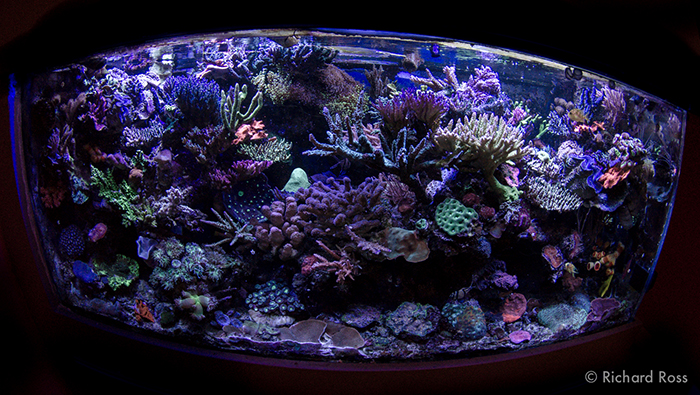
Rich’s 150 gallon display, on a 300 gallon system, is running a phosphate level of 1.24 ppm, a level at 24.8 times higher than the often recommended .05 ppm. Photo by Richard Ross.

1610637263491.png
 

IF YOU HAD TO TAKE A REEFING EXAM, WOULD YOU PASS?

  • Yes!

    Votes: 32 45.7%
  • Not yet, but I have one that I want to buy in mind!

    Votes: 9 12.9%
  • No.

    Votes: 26 37.1%
  • Other (please explain).

    Votes: 3 4.3%
Back
Top