In the last two decades, genetic and genomic studies have revealed the astonishing diversity and ubiquity of microorganisms. Emergence and expansion of the h...

www.frontiersin.org
How is Homeostasis Maintained between Corals and their Microbial Symbionts?
The coral holobiont, from pre-larval to adult stages, is a complex system of diverse organisms that coexist and interact. This complex system is capable of fixing nutrients and building biomass and carbonate structures in nutrient poor waters. When one or more components of the holobiont fail to function as required for system stability, bleaching (
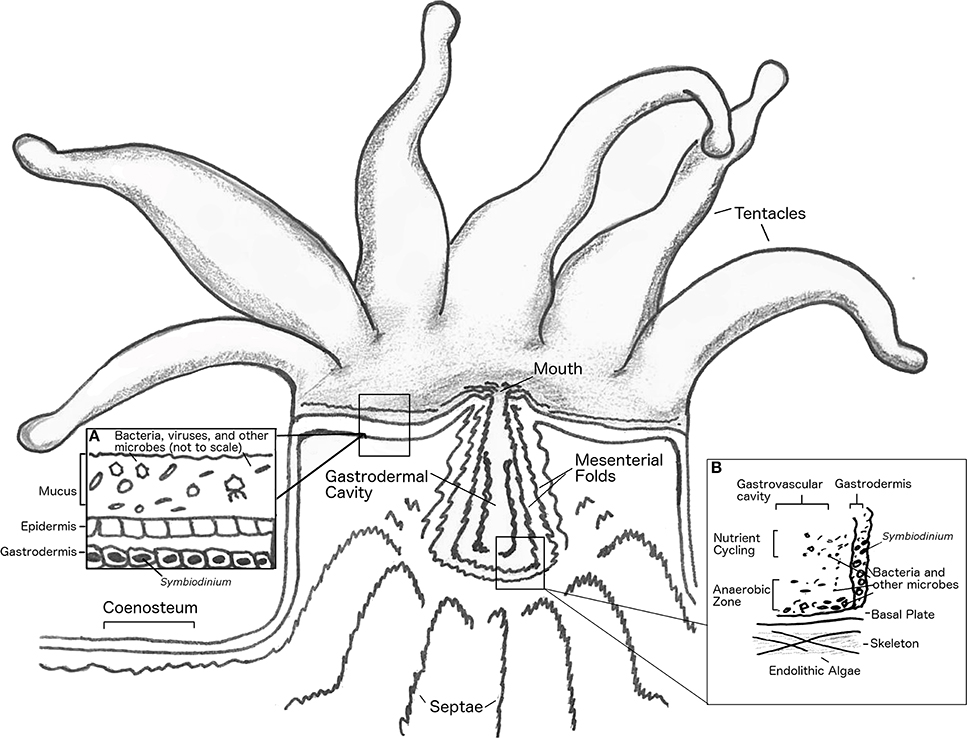
Symbiodinium loss) and/or tissue-death may result and lead to progressive death of the entire coral colony. The control and regulation of activities in the holobiont to maintain emergent function is termed homeostasis. In the coral holobiont, like any other animal holobiont, stressors that threaten homeostasis may be biological, chemical, or physical, and an initial stressor may lead to cascading interactions that trigger additional responses. To assess how homeostasis is maintained among components of the coral holobiont this section will focus on how physical and chemical gradients shape the microbiota in different habitats within the coral animal, and consider how perturbation of these gradients influence holobiont function. In particular, we will examine the following habitats: (1) the coral mucus and epidermal surface, (2) intracellular and interstitial spaces, (3) the gastrovascular cavity, and (4) the skeleton (Figure
2).
FIGURE 2
 Figure 2. Anatomy of coral polyp
. Basal body wall not shown. Inset
(A), shows close up of mucus layer, epidermis and upper gastrodermis. Inset
(B), shows close up of coral gastrovascular cavity.
Coral Mucus and Epidermal Surface
The tissue of the coral organism contains numerous secretory cells that are responsible for production of a continuous mucus layer that is typically a few hundred micrometers thick (
Brown and Bythell, 2005;
Jatkar et al., 2010;
Garren and Azam, 2012). The formation and roles of coral mucus have been reviewed in detail (
Brown and Bythell, 2005). Coral mucus serves multiple functions to maintain holobiont homeostasis that may vary in relative importance depending on the coral species. As a permeable barrier between the coral tissue and seawater that can be periodically shed by a mechanism functionally analogous to mucus clearing in other metazoans, the mucus layer is the first line of defense against biofouling, pathogen invasion, and shading by sedimentation (
Brown and Bythell, 2005). In addition, the mucus layer may serve as a trap for nutrient-bearing particles (including bacteria) that are periodically ingested by the coral as a mode of suspension feeding (
Coles and Strathman, 1973;
Muscatine, 1973). Mucus layers are enriched in photosynthate and coral waste products and thus represent a resource-rich habitat that is readily colonized by marine bacteria (
Brown and Bythell, 2005). Mucus layers accumulate dense assemblages of bacteria that share similarity with the bacterial composition of seawater (
Bourne and Munn, 2005;
Lema et al., 2012) and are also structured by interaction with members of the coral holobiont through both top-down process (i.e., removal/selection) (
Ritchie, 2006;
Franzenburg et al., 2013) and bottom-up processes (i.e., resource availability) (
Nakajima et al., 2009) as discussed further in Section How can Ecological Approaches Deepen our Understanding of the Multiple Levels of Coral–Microbial Interactions? Coral mucus layers are complex habitats, defined by chemical, physical and biological gradients (
Brown and Bythell, 2005), thus it is not surprising that spatial heterogeneity of mucus-associated bacterial community composition in adult corals can be observed over the scale of a single coral colony (
Daniels et al., 2011). Indeed, over a diurnal cycle the mucus of some corals may cycle from being fully-oxygenated due to the photosynthetic metabolism of
Symbiodinium to anaerobic at night when respiration rates exceed oxygenesis—this may be enhanced by physical compartmentalization of mucus-bearing structures on the coral colony (
Carlton and Richardson, 1995;
Kuhl et al., 1995;
Brown and Bythell, 2005).
Although the mucus layer is densely colonized by microorganisms, microscopic examination of the coral epidermis beneath the mucus layer reveals a nearly sterile environment (
Johnston and Rohwer, 2007). Surface coral cilia have been implicated in deterring the attachment of fouling organisms by generating surface currents on the order of 2 mm per second (
Johnston and Rohwer, 2007;
Garren et al., 2014). Although coral mucus and ciliary currents are physical deterrents to colonization of coral surfaces, it has been recently demonstrated that the coral pathogen
V. coralliilyticus breaches this barrier through rapid bursts of chemotaxis (i.e., directional swimming relative to a gradient) and chemokinesis (i.e., acceleration in response to a chemical concentration) guided by gradients of infochemicals such as DMSP that are produced by the holobiont and may increase during periods of temperature stress (
Garren et al., 2014). Exposure to
V. coralliilyticus leads to rapid death of coral tissue (
Ben-Haim et al., 2003a;
Santos et al., 2011). Thus, the dynamic coral mucus layer is a critical, and traversable, barrier that is essential to maintaining a healthy balance of surface-colonizing microorganisms.