Oceamo ICP?

Spare time

10K Club member
View Badges
Joined
Apr 12, 2019
Messages
13,208
Reaction score
10,672
Location
Here
Rating - 0%
0   0   0
I’ve not seen any independent accuracy analysis of the results, but I do have confidence based on many posts here that Oceamo knows what it is doing more so than some other icp companies, and I’d be inclined to give them a try.
 
I’ve not seen any independent accuracy analysis of the results, but I do have confidence based on many posts here that Oceamo knows what it is doing more so than some other icp companies, and I’d be inclined to give them a try.

I'm curious what leads you to post this. Anything you can share?
 
Hey @Randy Holmes-Farley

I was curious what your opinions are in regards to oceamo icp test (that is, if you have an opinion). I am debating between this is fauna marin. The Fauna Marin is only 20 bucks which is nice but the oceamo sounds like it may be a bit more transparent than most icp companies for reef tanks based on this https://www.reef2reef.com/threads/i...seawater-certified-reference-material.891657/

The ICP test is basically a flawed test because of the way the sample is handled. in addition, ICP-OES and ICP-MS both use “ICP” to generate something to analyze and ICP has difficulties with saltwater analysis. The best you can hope for is a good approximation of what is in your water.

If this sounds whacky, remember that no vendor has a warranty for precision or accuracy for their results. It is pretty much who do you trust. I bring all this up just to illustrate that there is no good answer to your question.

Also, keep in mind that with the advent of ICP tests, reef keeping hasn’t all of a sudden gotten easier or better. There are examples where someone has found high levels of a trace element that caused or could have caused a problem and this seems to justify spending money on ICP test for some folks. You might save your money and skip ICP testing unless you have a very specific reason for the test results. Just getting a check up is not a good reason. Obtaining data to trend, maybe, possibly, could be useful.
 
The ICP test is basically a flawed test because of the way the sample is handled. in addition, ICP-OES and ICP-MS both use “ICP” to generate something to analyze and ICP has difficulties with saltwater analysis. The best you can hope for is a good approximation of what is in your water.

If this sounds whacky, remember that no vendor has a warranty for precision or accuracy for their results. It is pretty much who do you trust. I bring all this up just to illustrate that there is no good answer to your question.

Also, keep in mind that with the advent of ICP tests, reef keeping hasn’t all of a sudden gotten easier or better. There are examples where someone has found high levels of a trace element that caused or could have caused a problem and this seems to justify spending money on ICP test for some folks. You might save your money and skip ICP testing unless you have a very specific reason for the test results. Just getting a check up is not a good reason. Obtaining data to trend, maybe, possibly, could be useful.

Boy - you sure do know how to open a can of worms :D Well said and I tend to agree.

All teasing aside. It is why I always recommend people read Rich's article from 2015 (I think it was).
 
Dan_P, i am very sorry, but i have to strongly disagree.

With proper sample introduction ICP can handle high TDS (total dissolved solids) very well. ICP-OES is known for very high TDS tolerance. - In ICP-MS it is more "tricky", but can be done.

The quality of results is not primarily dependent on the machine, but its the operation procedured, the sampling protocol, the sample handling, the calibration, the knowledge of the involved processes, their risks and limitations. So basically on a) the operator, b) the laboratory surrounding and c) the machine and its limits.

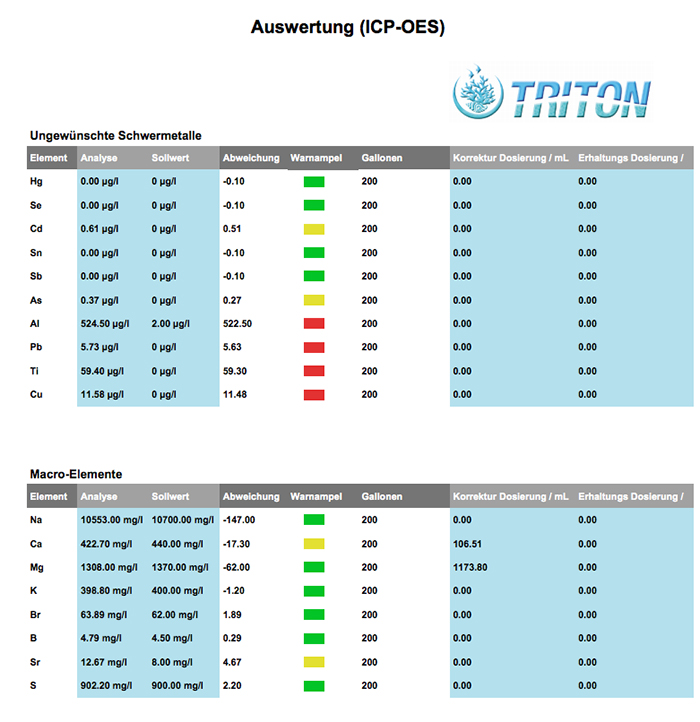
We have demonstrated here that we can quantify correctly even in the (very) low level concentration range:


The more we move up the concentration range it gets "easier" to quantify, since there is much more signal present.

But a misconception that i often encounter is that ICP-measurements are "absolutely correct", thus showing an exact and true number. I think the fact that some companies report 3 or more digits after the decimal point contribute to this misconception. Every measurement has an error range, laboratory ICP measurements included.

All the best,
Christoph
 
I took biotechnology class at a trade school for a cpl months and I wouldn't trust anyone to test my fish tank water other than me.
Yes I've compared results and had other people test salinity and alkalinity just to see if I'm getting a correct result but I wouldn't trust an actual company or pay someone sorry.
My opinion..
D
 
Boy - you sure do know how to open a can of worms :D Well said and I tend to agree.

All teasing aside. It is why I always recommend people read Rich's article from 2015 (I think it was).
Here it is

 
I took biotechnology class at a trade school for a cpl months and I wouldn't trust anyone to test my fish tank water other than me.
Yes I've compared results and had other people test salinity and alkalinity just to see if I'm getting a correct result but I wouldn't trust an actual company or pay someone sorry.
My opinion..
D

Lol

Pretty cynical view on commercial analytical chemistry.
 
Here it is


Yeah - it is a great read. The questions after are also worth the time.

Also I was listening to a few videos as I was cleaning the house this weekend. I forget who as I didn't catch it but I think they said reef-labs(?) and their icp test reporting total water volume...
 
I’ve not seen any independent accuracy analysis of the results, but I do have confidence based on many posts here that Oceamo knows what it is doing more so than some other icp companies, and I’d be inclined to give them a try.

I second that. I’ve seen a lot of OCEAMO analysis and if it weren’t for the cost (MS)
I’d get them over any other ICP out there. For now I stick with ATI and most of the time they are pretty consistent, but there are some elements that come back in error, but I think that can happen with any of these ICP’s. The key is if you get a really crazy number don’t act on it. Call and have them retest or wait until the next analysis. If it’s something very critical, cross-check it.
 
Last edited:

IF YOU HAD TO TAKE A REEFING EXAM, WOULD YOU PASS?

  • Yes!

    Votes: 32 45.7%
  • Not yet, but I have one that I want to buy in mind!

    Votes: 9 12.9%
  • No.

    Votes: 26 37.1%
  • Other (please explain).

    Votes: 3 4.3%

New Posts

Back
Top