

Navigation
Install the app
How to install the app on iOS
Follow along with the video below to see how to install our site as a web app on your home screen.
Note: This feature may not be available in some browsers.
More options
You are using an out of date browser. It may not display this or other websites correctly.
You should upgrade or use an alternative browser.
You should upgrade or use an alternative browser.
par meter
- Thread starter reefwreck
- Start date
- Tagged users None




- Joined
- Sep 18, 2017
- Messages
- 5,970
- Reaction score
- 3,673
SQ-520 or Seneye are prob. your best 2 choices.
SQ is 2x the price of the Seneye and is a "one trick" pony..
Most comparisons show the 2 are quite similar but the Sq is still more of a "respected" device..
Both would require, for the most part, a Windows laptop..
The technical difference is the SQ is cosine corrected, meaning it correctly samples more incident light.
The Seneye is "directional" and will not "see" some side incident lighting though in most cases this appears to be a small error.
Does make it more sensitive to placement (parallel to the light source) so is a wee bit harder to "aim" and get an accurate reading.
Oh and the seneye really ha no commercial "stick" one can buy.
SQ is 2x the price of the Seneye and is a "one trick" pony..
Most comparisons show the 2 are quite similar but the Sq is still more of a "respected" device..
Both would require, for the most part, a Windows laptop..
The technical difference is the SQ is cosine corrected, meaning it correctly samples more incident light.
The Seneye is "directional" and will not "see" some side incident lighting though in most cases this appears to be a small error.
Does make it more sensitive to placement (parallel to the light source) so is a wee bit harder to "aim" and get an accurate reading.
Oh and the seneye really ha no commercial "stick" one can buy.


I get by just fine with the USB biotek 300 series sensor https://premiumaquatics.com/products/biotek-marine-btm3000-par-sensor-15-usb-cable.html
I know the 500 series is better accuracy but cmon... We just need to get in the ballpark.
I know the 500 series is better accuracy but cmon... We just need to get in the ballpark.



IMO, the Apogee is far easier to use and more accurate/consistent if you are going to be doing any precision stuff. It is more money, though.
I ended up with Apogee 510.
Whatever you get, pay attention to the spectrum that it reads as well as any correction factor that might need to be applied to the readings.
I ended up with Apogee 510.
Whatever you get, pay attention to the spectrum that it reads as well as any correction factor that might need to be applied to the readings.


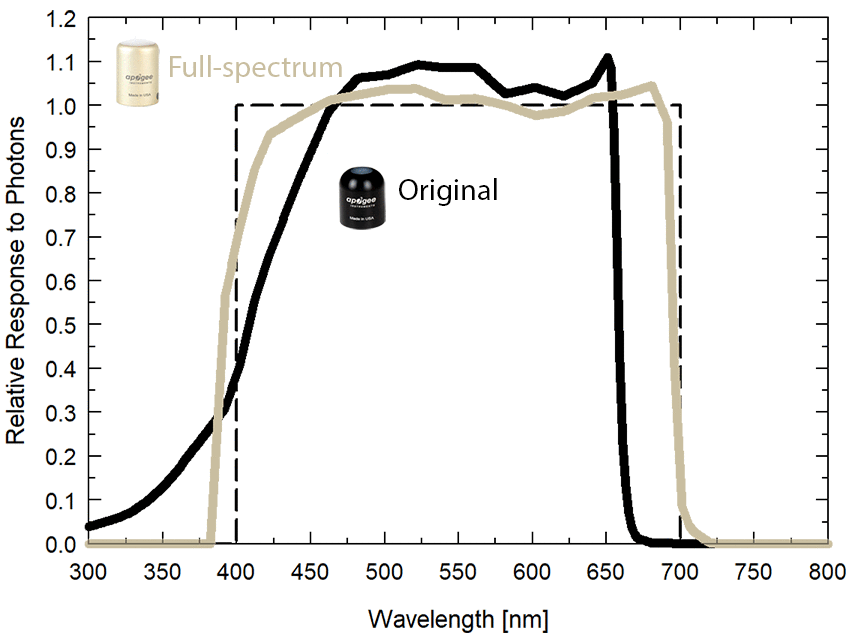
210 is a fine meter, but it needs a 1.32 correct factor applied to all of it's readings. It also does a lesser job of capturing blue below 440nm and red above 650nm, both of which are important - the sensor is less "full spectrum," but even the 510/520 sensor is not truly "full spectrum." You can overcome all of this just as long as you know that not only will it read less, it also might need fudged-up a bit to accommodate what the more inclusive sensor in the 510 and 520 can read.
For example, 400 on a Apogee 510 might only read 280 on an Apogee 210. This is fine if you apply the 1.32 to get up to 370 with the 210 and then raise it a bit more for the lack of spectrum grab.
You also need to factor in the light source. Most LED will only emit light in the visible spectrum and a better PAR meter can capture all of it. T5, PC and MH will all have spectrum below and above what the sensor can read, and sometimes this can be significant. An identical 350 PAR number from a Radion, for example, will not be as much light as from an ATI - the ATI will have more below and above what the sensor can read... and lots, but not all, corals can get significant use from 350 to 850nm. You kinda have to guess what the difference is, but probably around 15-20% for MH and mayde 10-15% for T5s and PCs - this is just me supposing since I have never seen any numbers mentioned.
Any of these can work if you know what you are doing... but people throw PAR around as some sort of an absolute when you really need to know which meter and sensor was used.
For example, 400 on a Apogee 510 might only read 280 on an Apogee 210. This is fine if you apply the 1.32 to get up to 370 with the 210 and then raise it a bit more for the lack of spectrum grab.
You also need to factor in the light source. Most LED will only emit light in the visible spectrum and a better PAR meter can capture all of it. T5, PC and MH will all have spectrum below and above what the sensor can read, and sometimes this can be significant. An identical 350 PAR number from a Radion, for example, will not be as much light as from an ATI - the ATI will have more below and above what the sensor can read... and lots, but not all, corals can get significant use from 350 to 850nm. You kinda have to guess what the difference is, but probably around 15-20% for MH and mayde 10-15% for T5s and PCs - this is just me supposing since I have never seen any numbers mentioned.
Any of these can work if you know what you are doing... but people throw PAR around as some sort of an absolute when you really need to know which meter and sensor was used.


The Apogee 510 is a stand-alone unit. You do not need a PC at all.

- Joined
- Sep 18, 2017
- Messages
- 5,970
- Reaction score
- 3,673
Apogee Connect
software has long allowed users of Apogee’s smart USB sensors to take spot measurements, perform datalogging, take accurate underwater PAR measurements, and save data files to their Mac or PC
SQ-520.
As stated above "MQ" has it's own hand held unit..
suppose it's like "meter quantum" and "sensor quantum".. or some such nonsense..

Got our own page.. Never saw that before.
https://www.apogeeinstruments.com/aquarium-par-meters/

- Joined
- Jul 31, 2017
- Messages
- 178
- Reaction score
- 160
I purchased a mq-510 apogee meter and I am very glad I did as I had no idea what intensity to put for my ap700s. I’m used to mh or t5 bulbs and it’s more set and forget and you know generally what par you will get. Great idea to get a meter for LED measurement.



- Joined
- Feb 15, 2018
- Messages
- 504
- Reaction score
- 248
I'm considering the SQ-520. Is the MQ-510 worth having the built in screen?
I'm going to buy the sq520 also. Easy to hook up to a laptop
I'm considering the SQ-520. Is the MQ-510 worth having the built in screen?
I have a $3400 MacBook pro. If I can keep it nowhere near my tanks and water, that is OK with me.


- Joined
- Sep 18, 2017
- Messages
- 5,970
- Reaction score
- 3,673
I have a $3400 MacBook pro. If I can keep it nowhere near my tanks and water, that is OK with me.
Then you certainly can afford a cheap win10 handheld unit..
https://www.ebay.com/p/NuVision-Solo-10-Draw-10-1-32GB-Wi-Fi-Tablet-Pink/2158810735?thm=1000&chn=ps
I use one of these for my Seneye...
Hint though.. find an older version w/ 2 USB ports..
If I remember correctly it will gather data just using a 5V phone charger.. Then dump it to your tablet..
Yep.. remembered correctly..
Internal Data Storage
The sensor has internal data storage capability with the ability to hold up to 10,000 measurements. This allows the sensor to collect data while connected to most stand-alone 5 V DC power supply such as a USB wall adapter.
As an eBay Associate we earn from qualifying purchases.

210 is a fine meter, but it needs a 1.32 correct factor applied to all of it's readings.
Where did you get the 1.32 correction factor from? I have a Biotek3000 USB PAR meter (same as the Apogee 210) and I am trying to figure out the best correction factor to use for my LED lights. Thanks!












