Playing with different di resins

  • Thread starter Thread starter mfinn
  • Start date Start date
  • Tagged users None
Outstanding thread and very interesting as well mfinn.

Thanks for starting it.
 
Omg ya, my di resins are lasting at least 3 times as long before being needed to be changed out. So I’m running the 3 stage, if you look at the picture I posted of my setup they were changed about six months ago and they are not even close to being up. I’m making about 100 gallons+ a week. I use to have to change out my original setup at least every 2 months.

 
Omg ya, my di resins are lasting at least 3 times as long before being needed to be changed out. So I’m running the 3 stage, if you look at the picture I posted of my setup they were changed about six months ago and they are not even close to being up. I’m making about 100 gallons+ a week. I use to have to change out my original setup at least every 2 months.
Do you have a tds meter after each of the different resins?
 
I have a handheld tds meter I pulled the line off between cation and anion, then again after the mixed bed. I have to still hook up my in line meters for after cation and after mixed bed lol. Final product water comes out zero tds (test that 2x a weeks with the handheld) I also send my water to triton for icp testing bimonthly and all is stil good!
 
After talking with Tyler at BRS this morning, he said that the rise in tds after the anion didn't seem right.
So he suggested I try switching the tds meter probes around and see what happens.
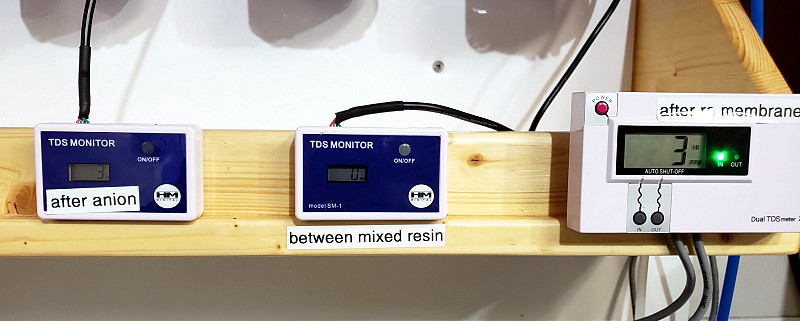
This is the results. So I'm thinking that a 1 or 2 point error in the meters is possible. ( common?)

 
Now that’s interesting lol. Was told that the tds increase was just because of the charge (giving a false spike in tds) my thoughts were as long as its back at zero after mixed bed then all is well. The 1-2 tds doesn’t worry me now if it was spiking to like 5-10+ id definitely look into it more.
 
Now that’s interesting lol. Was told that the tds increase was just because of the charge (giving a false spike in tds) my thoughts were as long as its back at zero after mixed bed then all is well. The 1-2 tds doesn’t worry me now if it was spiking to like 5-10+ id definitely look into it more.

He also said the only increase after the anion would be ph not tds.
 
TDS isn't a measure of purity exactly. It reading the conductivity of the water as a measure of the ions that are present. Carbon dioxide is usually weakly ionized and not detected easily by conductivity meters. However, after running through the anion bed it's being swapped out for ions that are more easily detected by the TDS meter.
 
I have high Co2 in my water (from a well). It comes out of the RO with only 2 TDS, but I was burning through a mixed bed DI cartridge every ~70 gallons.

Since the mixed bed cartridges have both anion/cation in them, they're really only half filled with the resin you want.

So, I now have an Anion cartridge, followed by two Mixed bed resin beds. I've increased the life of the 1st cartridge to about 3X. This saves me a lot money and the trouble of always replacing cartridges.

BTW, I went through this myself regarding TDS readings after the single bed cartridges. Don't worry about reading coming out of these. They will likely not be zero due to changes in the water chemistry and what ion is being substituted. Only measure after a mixed bed cartridge.
 
After talking with Tyler at BRS this morning, he said that the rise in tds after the anion didn't seem right.
So he suggested I try switching the tds meter probes around and see what happens.
This is the results. So I'm thinking that a 1 or 2 point error in the meters is possible. ( common?)



doesn’t surprise me. these meters are consumer grade and although they can be calibrated, it’s a pain. the only thing i trust my inlines for is calculating my rejection rate. for everything else i use a high quality handheld.
 
This has @Ryanbrs written all over it. One thing he mentions in the DI Resin video is that the resins do need to be configured in the cation>anion>mixed configuration. As it pertains to CO2, Ryan mentions how the separated resins can be a much better solution versus running them mixed, specifically from a cost savings standpoint since you aren't needlessly throwing away unused cation resin (saving cost in the long run).

I'm sure he'll have a much better and more thorough explanation to add here. :)
 
Alright, I got to post the results so far with this little test.
At first I thought this was a failure just from the numbers on the tds meters ( How many times have I advised friends or others to stop chasing numbers).

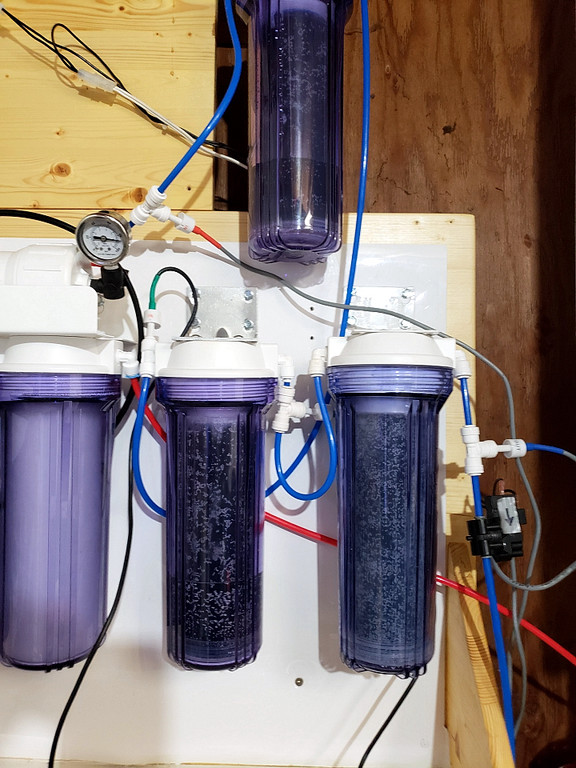
I've made 155 gallons of water so far and this is a picture of my mixed bed di resin.
There is no visible color change in the resin. Also you can see there is no color change in the upper canister which is the anion di resin.
Before adding the anion canister the first mixed bed canister on the left would have been nearly depleted.
So maybe this is going to pay off big after all.


Alright, I got to post the results so far with this little test.
At first I thought this was a failure just from the numbers on the tds meters ( How many times have I advised friends or others to stop chasing numbers).

I've made 155 gallons of water so far and this is a picture of my mixed bed di resin.
There is no visible color change in the resin. Also you can see there is no color change in the upper canister which is the anion di resin.
Before adding the anion canister the first mixed bed canister on the left would have been nearly depleted.
So maybe this is going to pay off big after all.


So the third canister, the mixed bed, has no color change yet. What about the other two? Can you grab TDS readings after the Cation and after the Anion?

 
So the third canister, the mixed bed, has no color change yet. What about the other two? Can you grab TDS readings after the Cation and after the Anion?

The picture in my last post shows no color change in any of the canisters.
The top canister is anion resin, and the other 2 are mixed bed resin.
After running probably and collecting 70+ gallons, this picture shows what the tds meters were picking up.


IF YOU HAD TO TAKE A REEFING EXAM, WOULD YOU PASS?

  • Yes!

    Votes: 32 45.7%
  • Not yet, but I have one that I want to buy in mind!

    Votes: 9 12.9%
  • No.

    Votes: 26 37.1%
  • Other (please explain).

    Votes: 3 4.3%

New Posts

Back
Top