

Please add your best woodworking tips here!

  • Thread starter Thread starter glb
  • Start date Start date
  • Tagged users None
I too want to put in a plug for the pocket hole jig as well......Kreg being the number one brand.

Back in the day (I'm an old fart), the way we joined boards together or built face frames was by using a doweling jig. I didn't want to pull mine out (for one, I don't know where it is) and take a picture, so I searched the internet for a picture and found my actual jig....in an antique tool site.
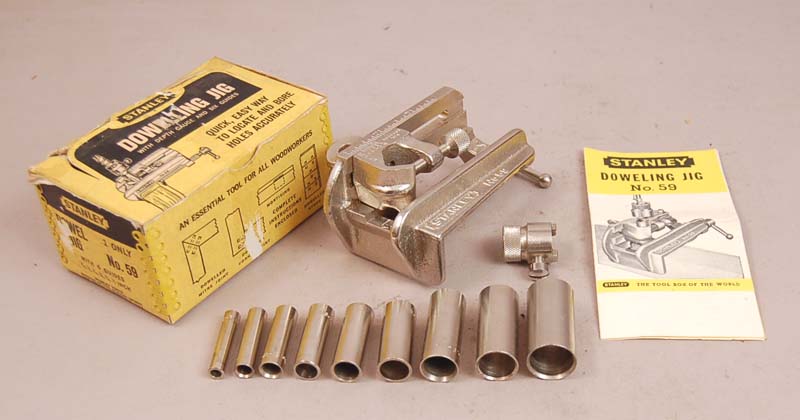
dowel_jig_b.jpg


Then at some point plate cutters (biscuit cutters), came out and we all went out and purchased these. Great for gluing up multiple boards and making sure they were aligned, and with large face frames, they could be used as well. But for the thin face frames and small paneled doors, we were still stuck with the doweling jig. And we still had to glue and clamp them up and let them dry over night.

And then, along came Kreg....and the pocket hole jig. What a great invention! And the reason I'm mentioning this now is that I just used mine again to make four doors for a new stand from my JBJ28. Here's the back side showing the pockets.


What's great is that a little glue, a screw, and I could immediately take it over to the router table and finish the round over and dado for the door. No waiting overnight....and a super tight fit as well.

Even if you get the single hole small Kreg, it's money well spent. And to save money, you can get the locking pliers at Harbor Freight HERE.

The pocket hole jig is a great tool you'd want to include in your toolbox.

 
I would say don't go cheap on a table saw, it is in my opinion the most important tool in my wood shop, it needs to be stable accurate and have a real good blade.
 
Thanks to all for the suggestions and yes you all have the point to not go cheap. That's why i decided to ask.

I will check the recommendations and evaluate...

Thanks... Appreciated...
 
I'm no master craftsmen but, I try an play one on TV...

...after years with a brand that I'm too embarrassed to mention, I'm biting the bullet and going with a DELTA 13-Amp 10-in table saw, the saw has attached wheels so you can say it's "portable" but, that's not what I want it. I also will only ever run diablo saw blades in any of my saws; 15yrs working on odds and ends in woodworking and they're the best I have used.

Excellent choice Alex. I purchased a Delta 36-725 (I think that’s the model) about a year ago after going through a couple of table top versions. I was going to recommend it to @wcharon but I got the impression he was looking for a little more portability. Yes the Delta is on wheels, but it does have a semi-large footprint. Don’t hesitate on the Delta. Yes there may be “better” and more expensive options, but I’m a hobbyist, I'm not making a living at this.

As to blades, I too use nothing but Freud/Diablo. I would agree with @pilot108 above...A good table saw, with a good fence and a good blade, is probably the most important tool in a wood shop. But somehow, that still doesn't keep me from wanting a jointer!!!
 
Thanks Buddy... Checking and will go to Home Depot to see them in person but yes portability should be a most.
 
But somehow, that still doesn't keep me from wanting a jointer!!!

I love my P-C 10-Amp Bench Jointer, it a must have for both wood and cell-cast work, and would recommend it to any!
 
I would say too that if your new to wood working and don't have a lot of space you can make a lot of projects with just a good sliding miter saw and a circular saw. Also is attached a pic of one of my latest wood working projects I made.
20151013_161553.jpg
 
I would say too that if your new to wood working and don't have a lot of space you can make a lot of projects with just a good sliding miter saw and a circular saw. Also is attached a pic of one of my latest wood working projects I made.
20151013_161553.jpg
Very nice!
 
Make sure the floor where you build this stand is level, other wise the tank water will Not be level either.

I don't think that is fully accurate. It shouldn't matter as long as all the boards are flush with one another while building. As long as your final stand matches the floors level that its being built on you shouldn't have any issues.
 
I don't think that is fully accurate. It shouldn't matter as long as all the boards are flush with one another while building. As long as your final stand matches the floors level that its being built on you shouldn't have any issues.
As long as your final stand matches the floors level that its being built on you shouldn't have any issues. At the end this is what counts.
 
I hope my question doesn't get his great and informative thread out of topic.

Can you recommend me a good portable bench saw for a newbie??? It needs to be portable as i don't have much space for storage and leaving it permanent.

Thanks in advance...

If you don't have space for a table saw, I would look into a track saw.
Festool makes a great one:
http://www.festoolproducts.com/Fest...P0M1nzyo_rYkHptXodTsbSvDyX-K_WlcVYaAlSd8P8HAQ

Here is the dewalt version:
http://www.cpooutlets.com/on/demand...K6lQvIrSaG6vlD8kx-dbbyYVMN8Ch7930saAqQV8P8HAQ
 
Some aquarium specific suggestions:

1) Be careful of very large dead-loads
A 100G tank can be upwards of 1,000 pounds.
And it is constant load, for years.
Wood supports, especially 2x4s, are cheap. Up-size!

2) Use a pretty thick finish
You WILL spill salt water all over your cabinet.
A few extra layers of verathane (or paint) would be a good plan
Plus, there can be a lot of humidity. Protect against it.

3) Use stainless #10 screws
With the moisture and salt creep, steel screws can rust easily.
Nothing worse than red stain coming up through a nice paint job or finish.
But remember that stainless is soft and loads are large, hence the #10 suggestion.

4) Use glue to attach finish work to frame
Yes, you need big screws for the inner structure.
But visible heads/holes are a real pain, especially if it is stained not painted.
A good quality waterproof glue will last forever, and can hold plenty of weight.
So for all the external pieces, clamp + glue.

This is my stand I built.

stand_5.jpg
 
As long as your final stand matches the floors level that its being built on you shouldn't have any issues. At the end this is what counts.
My understanding is that the tank needs to be level, or else it is vulnerable to failure. I'm lucky that my floor is level and the tank is level, but I think if it's not you need to level the stand to make sure the tank is level. Some people use shims. If the water tilts even a little it can put too much pressure on one part of the tank.
 
Some aquarium specific suggestions:

1) Be careful of very large dead-loads
A 100G tank can be upwards of 1,000 pounds.
And it is constant load, for years.
Wood supports, especially 2x4s, are cheap. Up-size!

2) Use a pretty thick finish
You WILL spill salt water all over your cabinet.
A few extra layers of verathane (or paint) would be a good plan
Plus, there can be a lot of humidity. Protect against it.

3) Use stainless #10 screws
With the moisture and salt creep, steel screws can rust easily.
Nothing worse than red stain coming up through a nice paint job or finish.
But remember that stainless is soft and loads are large, hence the #10 suggestion.

4) Use glue to attach finish work to frame
Yes, you need big screws for the inner structure.
But visible heads/holes are a real pain, especially if it is stained not painted.
A good quality waterproof glue will last forever, and can hold plenty of weight.
So for all the external pieces, clamp + glue.

This is my stand I built.

stand_5.jpg
That's a sweet stand!
 

IF YOU HAD TO TAKE A REEFING EXAM, WOULD YOU PASS?

  • Yes!

    Votes: 32 45.7%
  • Not yet, but I have one that I want to buy in mind!

    Votes: 9 12.9%
  • No.

    Votes: 26 37.1%
  • Other (please explain).

    Votes: 3 4.3%

New Posts

Back
Top














