PO4 results Triton vs Hanna

rynosreef

Active Member
View Badges
Joined
Nov 26, 2011
Messages
140
Reaction score
136
Location
Burbank, CA
What state or country do you live in
California
Rating - 0%
0   0   0
Hi all,

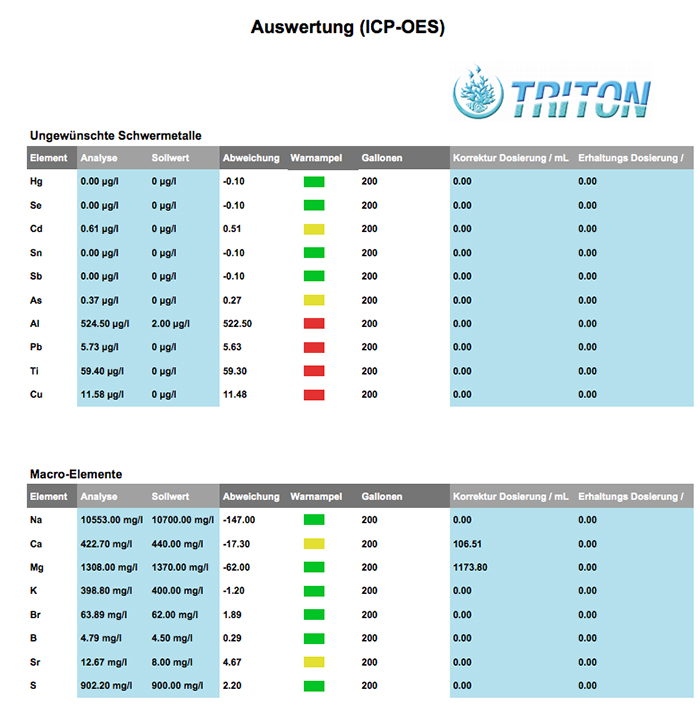
So I'm a bit unsure of my PO4 levels. According to Triton ICP my PO4 is high. But according to 2 Hanna Checkers (both the ULR and the regular one) I'm sitting at around 0.05ppm. I've even used the Hanna PO4 standard solution to make sure they weren't way off and both were within the margin of error.

Any experience on which to trust more than the other? The tank generally looks okay. There's some patches of bubble algae here and there, but acros are colorful and growing (although it could always be faster). My tank uptakes about 1.5 to 2 dKH of alk per day with approximately 40 acros and a derasa clam. I would just like to get some feedback before I up my nutrient export game. If it really is 0.05ppm, I could bottom out if I add GFO or the like which I'd like to avoid. Currently I just run a skimmer and do weekly water changes.

po4 1.jpg

po4 2.jpg


These two Triton results are about 4 months apart, with the upper being the most recent.

 
Hi all,

So I'm a bit unsure of my PO4 levels. According to Triton ICP my PO4 is high. But according to 2 Hanna Checkers (both the ULR and the regular one) I'm sitting at around 0.05ppm. I've even used the Hanna PO4 standard solution to make sure they weren't way off and both were within the margin of error.

Any experience on which to trust more than the other? The tank generally looks okay. There's some patches of bubble algae here and there, but acros are colorful and growing (although it could always be faster). My tank uptakes about 1.5 to 2 dKH of alk per day with approximately 40 acros and a derasa clam. I would just like to get some feedback before I up my nutrient export game. If it really is 0.05ppm, I could bottom out if I add GFO or the like which I'd like to avoid. Currently I just run a skimmer and do weekly water changes.

po4 1.jpg

po4 2.jpg


These two Triton results are about 4 months apart, with the upper being the most recent.

If you know this, then you are going to think this is a dumb post, but when using your Hanna, are you then doing the additional computations? Here is the Hanna chart from phosphorus to phosphate:
 
Do not assume that phosphate hasn't changed between collection and ICP testing.

FWIW, the Hanna standard isn't really any confirmation of proper function, except to know the electronics is working. The reagents or test methodology may still be off.
 
Last edited:
It's unusual for the error to be in that direction: ICP repeatably higher than locally measured PO4. Usually if they deviate it's reversed.
If I'm guessing which is more likely correct, I think I'd lean toward the higher of the two measures - in this case ICP, just because I think it's easier to mistakenly under-measure PO4 that's really in the water than to mistakenly over-measure and come up with high PO4 when it isn't actually there.
To try to debug it, these would be my next steps:
Watch a video of the hanna test being executed - just to make sure of method (I know - sounds dumb, but written instructions don't always come across the same as seeing it done )
Check the lot number on the reagent packets, and redo test on tank water with packets from different lot number.
Then spike the tank water with additions of 0.05ppm and 0.10ppm PO4 (seachem flourish phosphorus or similar), and check the meter/chemistry performance.
Next Triton test, filter the tank water in case there's particulates getting vaporized by ICP and pushing the measurement higher than the water.


If I really wanted to know, those would be the things I'd look at.
 
Hi all,

So I'm a bit unsure of my PO4 levels. According to Triton ICP my PO4 is high. But according to 2 Hanna Checkers (both the ULR and the regular one) I'm sitting at around 0.05ppm. I've even used the Hanna PO4 standard solution to make sure they weren't way off and both were within the margin of error.

Any experience on which to trust more than the other? The tank generally looks okay. There's some patches of bubble algae here and there, but acros are colorful and growing (although it could always be faster). My tank uptakes about 1.5 to 2 dKH of alk per day with approximately 40 acros and a derasa clam. I would just like to get some feedback before I up my nutrient export game. If it really is 0.05ppm, I could bottom out if I add GFO or the like which I'd like to avoid. Currently I just run a skimmer and do weekly water changes.

po4 1.jpg

po4 2.jpg


These two Triton results are about 4 months apart, with the upper being the most recent.

ICP measures all forms of phosphorous, not just phosphate. The Hanna Checker only measures PO4-P.

If I was in doubt about PO4 measurements with the Hanna Checker, I would buy a standard solution of PO4. Look at Grainger for phosphate standards.

@taricha suggestion to filter a sample going to Triton is a neat experiment. I would use a 0.22 to 0.45 micron syringe filter.
 
It's unusual for the error to be in that direction: ICP repeatably higher than locally measured PO4. Usually if they deviate it's reversed.
If I'm guessing which is more likely correct, I think I'd lean toward the higher of the two measures - in this case ICP, just because I think it's easier to mistakenly under-measure PO4 that's really in the water than to mistakenly over-measure and come up with high PO4 when it isn't actually there.
To try to debug it, these would be my next steps:
Watch a video of the hanna test being executed - just to make sure of method (I know - sounds dumb, but written instructions don't always come across the same as seeing it done )
Check the lot number on the reagent packets, and redo test on tank water with packets from different lot number.
Then spike the tank water with additions of 0.05ppm and 0.10ppm PO4 (seachem flourish phosphorus or similar), and check the meter/chemistry performance.
Next Triton test, filter the tank water in case there's particulates getting vaporized by ICP and pushing the measurement higher than the water.


If I really wanted to know, those would be the things I'd look at.

Great advice here.

I have 2 Hanna phosphate checkers. One that tests in PPB and the other in PPM. One is the ULR the other is the standard one. Each has there own reagents so fortunately I can somewhat double check them against each other. And yep, I've watched videos etc on the procedure and have my own little system to do the tests consistently without it turning off on me haha.

Here's what I did with the advice so far: I used Brightwell NeoPhos in a gallon of RODI water to make a standard solution with 0.05ppm PO4 based off Brightwells dosing instructions. The ULR checker read it as 7ppb or 0.021ppm. I tested the same standard with the regular Hanna PO4 checker and it also came out to 0.02ppm. Both are within the margin of error for a Hanna checker so I was pretty happy with the consistency of the results at least. Besides who's to say Brightwell's dosing instructions are all that accurate or I had exactly 1 gallon anyway.

But it appears that the Hanna checkers are correct thus far albeit maybe a little low by 0.03ppm, again assuming Brightwell's dosing instructions are accurate to begin with. Perhaps the samples sent to Triton should have been filtered or they were somehow just inaccurate.

ICP measures all forms of phosphorous, not just phosphate. The Hanna Checker only measures PO4-P.

If I was in doubt about PO4 measurements with the Hanna Checker, I would buy a standard solution of PO4. Look at Grainger for phosphate standards.

@taricha suggestion to filter a sample going to Triton is a neat experiment. I would use a 0.22 to 0.45 micron syringe filter.

Yep, the ICP report I posted above shows both the Phosphorous and the PO4 values I believe. And yep, both Hanna checkers were tested against Hanna's standard PO4 solution and were within the margin of error. I think perhaps the sample sent to Triton had something in it or somehow it was just inaccurate.
 
Do not assume that phosphate hasn't changed between collection and ICP testing.

FWIW, the Hanna standard isn't really any confirmation of proper function, except to know the electronics is working. The reagents or test methodology may still be off.
Okay good to know. I received the Triton ICP results 4 days after I took the sample. It's nice living close by to their California location.

What sort of things effect the PO4 results between sample collection and testing? Do you think ICP phosphate results are typically useful or does that variability make them less meaningful?

Thanks!
 
I believe ICP tests for PO4 are not that reliable, don't they essentially guess the amount of PO4 based on phosphorus? Which isn't going to give a reliable result?

I would tend to trust the Hanna in this case, maybe buy a cheap Salifert PO4 test kit to check your Hanna result, the salifert is not great at reading under .1 so if the ICP test is correct the salifert test will show a clear blue colour, if your Hanna is closer, the sample will be near enough unchanged in colour.
 
Okay good to know. I received the Triton ICP results 4 days after I took the sample. It's nice living close by to their California location.

What sort of things effect the PO4 results between sample collection and testing? Do you think ICP phosphate results are typically useful or does that variability make them less meaningful?

Thanks!

Organism growth and consumption of phosphate is a potential concern after the samples are collected. IMO, that can impact more than phosphate.

ICP can certainly be "useful" but one should not assume it is a perfect.
 
I believe ICP tests for PO4 are not that reliable, don't they essentially guess the amount of PO4 based on phosphorus? Which isn't going to give a reliable result?

I would tend to trust the Hanna in this case, maybe buy a cheap Salifert PO4 test kit to check your Hanna result, the salifert is not great at reading under .1 so if the ICP test is correct the salifert test will show a clear blue colour, if your Hanna is closer, the sample will be near enough unchanged in colour.

All of the phosphorus in reef tank water will be some form of phosphate. That can include organic forms and inorganic forms, but whether organic forms are a significant fraction of the total (possibly making the assumption that it is all inorganic phosphate not correct) isn't clear.
 
I have 2 Hanna phosphate checkers. One that tests in PPB and the other in PPM. One is the ULR the other is the standard one. Each has there own reagents so fortunately I can somewhat double check them against each other. And yep, I've watched videos etc on the procedure and have my own little system to do the tests consistently without it turning off on me haha.
Good job. This settles the possibility of it being a bad checker, and probably weighs against the likelihood of it being a bad reagent batch.

Here's what I did with the advice so far: I used Brightwell NeoPhos in a gallon of RODI water to make a standard solution with 0.05ppm PO4 based off Brightwells dosing instructions. The ULR checker read it as 7ppb or 0.021ppm. I tested the same standard with the regular Hanna PO4 checker and it also came out to 0.02ppm. Both are within the margin of error for a Hanna checker so I was pretty happy with the consistency of the results at least.
I will say that using a chemistry kit meant for saltwater and applying it in distilled water will lead to unpredictable results. I think you may(?) be able to get away with it for the Hanna po4 test, but I'm not sure.
I know you can dilute samples that are out of range high to 50/50 with di water, re-run the test, and the checker still gives expected results, but I've never seen anyone do a calibration curve with the PO4 checkers in distilled water. @Rick Mathew, ever tested these in DI water?

Most of the time using chemistry kits designed for salt water in distilled water changes things in unpredictable ways. Also remember the values you are trying to distinguish, from ICP results and the checker results are actually pretty close together.
I'd do this:
test aquarium water, aquarium water +.05ppm PO4, and aquarium water +0.10ppm PO4.

See if your results are in the ballpark of: X, X+.05, and X+0.10
This is called "standard additions" and it's a great way to check performance without needing a complete "zero" baseline.

If the checkers and kits pass that - then I'd trust them and think about why ICP is reading high.
 
Just remembered this article and the testing of Triton’s ICP accuracy. In the table below taken from the article, the results were higher than the certified sample sent to Triton for testing. So, maybe your results aren’t so strange after all.

DEC5847F-EA82-4AE1-872D-F487E081428A.jpeg


One comment I'd make not necessarily related to the Hanna results vs. ICP: If the ICP results are correct, that's still no cause for concern, especially since you noted that the tank is doing well. There have been a lot more folks that have really trashed their tank trying to "correct" phosphate concentrations with interventions when the tank was doing well than folks that made an improvement to their tank by interventions.

One other aspect of this to consider is that the typical recommendation for an SPS tank is in the 50 -100 ppb range for phosphate, with higher numbers preferred if the alkalinity is kept on the high side. Keep in mind that this accumulated wisdom would almost entirely be based on Hanna checker results, as the judge-color-by-eye assays are too inaccurate to base such a recommendation on, and at least in general, ICP results would be too infrequent.

Bottom line - I highly suggest that you not use GFO or lanthanum chloride dosing to remove phosphate unless you have a specific problem you're trying to address, such as out of control algal growth.
 
Good job. This settles the possibility of it being a bad checker, and probably weighs against the likelihood of it being a bad reagent batch.


I will say that using a chemistry kit meant for saltwater and applying it in distilled water will lead to unpredictable results. I think you may(?) be able to get away with it for the Hanna po4 test, but I'm not sure.
I know you can dilute samples that are out of range high to 50/50 with di water, re-run the test, and the checker still gives expected results, but I've never seen anyone do a calibration curve with the PO4 checkers in distilled water. @Rick Mathew, ever tested these in DI water?

Most of the time using chemistry kits designed for salt water in distilled water changes things in unpredictable ways. Also remember the values you are trying to distinguish, from ICP results and the checker results are actually pretty close together.
I'd do this:
test aquarium water, aquarium water +.05ppm PO4, and aquarium water +0.10ppm PO4.

See if your results are in the ballpark of: X, X+.05, and X+0.10
This is called "standard additions" and it's a great way to check performance without needing a complete "zero" baseline.

If the checkers and kits pass that - then I'd trust them and think about why ICP is reading high.
I have never tested these these in DI water....
 

IF YOU HAD TO TAKE A REEFING EXAM, WOULD YOU PASS?

  • Yes!

    Votes: 30 44.8%
  • Not yet, but I have one that I want to buy in mind!

    Votes: 9 13.4%
  • No.

    Votes: 25 37.3%
  • Other (please explain).

    Votes: 3 4.5%
Back
Top